7 Powerful Vishwakarma Mantras with Meanings
1. Mool Mantra (the basic invocation):
ॐ विश्वकर्मणे नमः
Transliteration: Om Vishwakarmaye Namah.
Meaning: Salutations to Vishwakarma.
When to chant: Daily, at the start of any work involving tools, machines, computers, vehicles. Especially before beginning a new project or repair. Chant 108 times for full power; minimum 11 times for daily routine.
2. Beej Mantra (seed mantra for invoking creative energy):
ॐ ऐं ह्रीं श्रीं विश्वकर्मणे नमः
Transliteration: Om Aim Hreem Shreem Vishwakarmaye Namah.
Meaning: Om - the cosmic sound. Aim - seed of Saraswati (knowledge). Hreem - seed of Lakshmi (prosperity). Shreem - seed of Lakshmi's grace. Vishwakarmaye - to Vishwakarma. Namah - I bow.
When to chant: When starting a new creative project (writing, design, coding, art, engineering). For artists, IT professionals, architects, designers. Chant 108 times in morning. Particularly effective for solving complex technical problems.
3. Vishwakarma Gayatri Mantra:
ॐ विश्वकर्मणे विद्महे विश्वशिल्पाय धीमहि तन्नो विश्वकर्मा प्रचोदयात्
Transliteration: Om Vishwakarmaye Vidmahe, Vishwa-shilpaya Dhimahi, Tan-no Vishwakarma Prachodayat.
Meaning: I know Vishwakarma. I meditate on the divine cosmic artisan. May Vishwakarma inspire and direct my mind.
When to chant: Daily after morning prayers. The Gayatri form is universally powerful - it carries blessings of intelligence, skill, and divine guidance. Architects, engineers, software developers find this particularly potent.
4. Vastu Shanti Mantra (for property and home):
ॐ श्री विश्वकर्मणे शिल्प गुरवे नमः
Transliteration: Om Shri Vishwakarmaye Shilpa Gurave Namah.
Meaning: Salutations to Sri Vishwakarma, the guru of all artisans and architects.
When to chant: When buying/selling property, building a new house, renovating, or moving to a new location. Helps neutralize any Vastu doshas. Chant during griha pravesh (housewarming) ceremony.
5. Daridrya Nashan Mantra (for removing poverty):
ॐ विश्वकर्मणे शुभं फलं देहि देहि स्वाहा
Transliteration: Om Vishwakarmaye Shubham Phalam Dehi Dehi Swaha.
Meaning: Om Vishwakarma, please grant auspicious fruit (success, prosperity). Swaha.
When to chant: For business growth, debt clearance, financial improvement. Especially powerful for small business owners and traders. Chant 1008 times (10 mala) over 21 days for major impact.
6. Yantra Mantra (for protection of machinery):
ॐ ह्रीं विश्वकर्मणे यंत्र रक्षायै नमः
Transliteration: Om Hreem Vishwakarmaye Yantra Rakshayai Namah.
Meaning: Om, Vishwakarma, please protect my machines/tools.
When to chant: When you have valuable machinery, vehicles, computers, factory equipment. Recite during Vishwakarma Puja while applying tilak on each machine. Chant 11 times before starting heavy equipment for the day.
7. Karma Phala Mantra (for righteous fruits of work):
ॐ विश्वकर्मणे कर्म फलम् देहि देहि नमः
Transliteration: Om Vishwakarmaye Karma Phalam Dehi Dehi Namah.
Meaning: Om Vishwakarma, grant me the rightful fruits of my work.
When to chant: When you've worked hard but recognition/reward seems delayed. For salary increase, promotion, project approval, business deal completion. Particularly effective on Tuesdays and during Kanya Sankranti.
Best chanting practices:
- Time: Brahma Muhurta (4-5:30 AM) or sunrise.
- Direction: Face east or north-east.
- Mala: Tulsi mala or rudraksha mala (108 beads).
- Posture: Sukhasana or Vajrasana, spine straight.
- Visualization: Picture Vishwakarma as a golden figure with 4 arms holding tools - hammer, scale, plumb-line, book of knowledge.
- Pranayama: 5 deep breaths before starting. Maintain breath-mantra sync.
- Conclusion: End with 3 audible 'Om Shanti Shanti Shanti'.
Vishwakarma Aarti - Complete Lyrics in Hindi & English
Vishwakarma Aarti (Full Lyrics):
Hindi:
जय श्री विश्वकर्मा प्रभु, जय श्री विश्वकर्मा। सकल सृष्टि के कर्ता, रक्षक स्तुति धर्मा॥
जय श्री विश्वकर्मा प्रभु, जय श्री विश्वकर्मा।
आदि सृष्टि में विधि को, श्रुत उपदेश दिया। जीव मात्र का जग में, ज्ञान विकास किया॥
जय श्री विश्वकर्मा प्रभु, जय श्री विश्वकर्मा।
ऋषि अंगिरा तप द्वारा, शास्त्र जो जान लियो। योग बल से तुम सब, ब्रह्म ज्ञान दीयो॥
जय श्री विश्वकर्मा प्रभु, जय श्री विश्वकर्मा।
शिल्प शास्त्र निर्मित कर, अर्थ धर्म दीया। धन्य धन्य विश्वकर्मा, जग रचना कीया॥
जय श्री विश्वकर्मा प्रभु, जय श्री विश्वकर्मा।
एक बार पुष्पक यान, खोल बनाया था। इन्द्र राज की लंका, वीर बनाया था॥
जय श्री विश्वकर्मा प्रभु, जय श्री विश्वकर्मा।
वसुदेव श्री कृष्ण के, शुभ अवतार लिया। द्वारिका भवन निर्माण, का काम किया॥
जय श्री विश्वकर्मा प्रभु, जय श्री विश्वकर्मा।
इन्द्र भोग के लिए, सब इंद्रासन रचा। यक्ष राज कुबेर के, भण्डार सब सजा॥
जय श्री विश्वकर्मा प्रभु, जय श्री विश्वकर्मा।
English Transliteration:
Jai Shri Vishwakarma Prabhu, Jai Shri Vishwakarma. Sakal srishti ke karta, rakshak stuti dharma.
Aadi srishti mein vidhi ko, shrut updesh diya. Jeev maatra ka jag mein, gyan vikas kiya.
Rishi Angira tap dwara, shastra jo jaan liyo. Yog bal se tum sab, brahma gyan diyo.
Shilp shastra nirmit kar, arth dharma diya. Dhanya dhanya Vishwakarma, jag rachna kiya.
Ek baar pushpak yaan, khol banaya tha. Indra raj ki Lanka, veer banaya tha.
Vasudev Shri Krishna ke, shubh avatar liya. Dwarika bhavan nirman, ka kaam kiya.
Indra bhog ke liye, sab Indrasan rachaa. Yaksh raj Kuber ke, bhandar sab sajaa.
English Meaning:
Victory to Sri Vishwakarma, the Lord, victory to Sri Vishwakarma. Creator of all creation, protector and praise-worthy upholder of dharma.
In the beginning of creation, you imparted the science to the creator (Brahma). You gave knowledge and development to all life in the world.
Through Sage Angira's penance, the scriptures were known. Through your yogic power, you gave all the wisdom of Brahman.
You created the shilp shastra (architecture science) and bestowed wealth and dharma. Blessed Vishwakarma, you created the world.
You created the celestial Pushpak Vimaan (flying chariot). You built the great city of Lanka for King Indra (later Ravana).
You took shubh avatar (auspicious form) for Lord Krishna. You did the work of building Dwarika Bhavan (Lord Krishna's city).
For Indra's pleasure, you created all the throne of Indrasan. You decorated all the treasury of Yaksha king Kubera.
How to perform aarti:
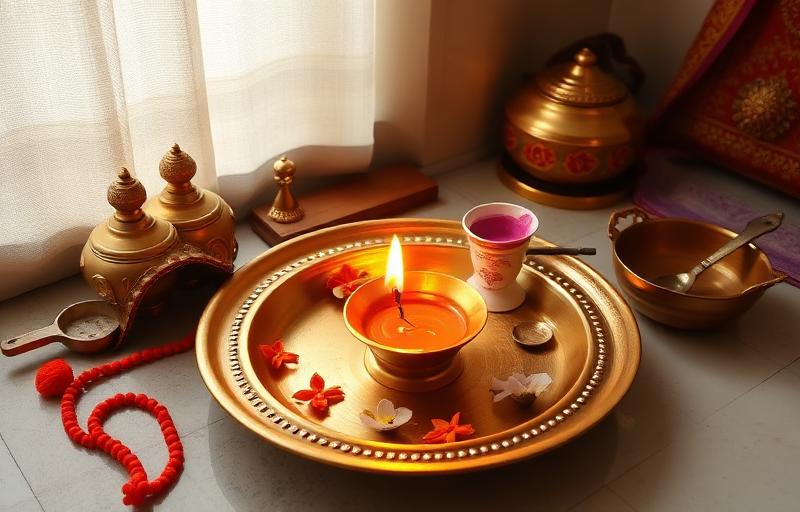
1. Stand or sit facing the Vishwakarma idol/picture. 2. Light the aarti diya - 5 wicks in pure ghee or oil. 3. Hold the aarti plate in right hand. 4. Move the plate clockwise in front of the idol - small circular motions. 5. Start at the deity's feet level, slowly raise to forehead level, complete circular motion. 6. Sing the aarti verses continuously while moving the plate. 7. After the song, ring the bell with left hand while continuing to circle. 8. Take the aarti flame near your eyes (touch the warm air, not the flame). 9. Place the aarti plate respectfully. 10. Distribute aarti among all family members.
Vishwakarma Katha - The Divine Architect's Story
Vishwakarma's Origin:
Vishwakarma is one of the most ancient deities in Hinduism, mentioned in the Rigveda itself. He is described as the 'all-doer' (vishvakarman = visva + karman = world + maker), the divine craftsman who created all the cosmos.
There are several origin stories:
Story 1 - The Cosmic Architect:
In the beginning, before any form existed, only the Adi Purusha (cosmic being) was. From this being, Vishwakarma manifested as the creative principle - the one who 'gives form'. Without Vishwakarma, the formless would remain formless; with him, divine ideas become material realities.
Vishwakarma then created:
- The planets and stars - their precise orbits and luminosity.
- The mountains - Himalayas, Meru (cosmic mountain).
- The oceans and rivers - with their tides and currents.
- All living forms - from gods to humans to animals to plants.
- The divine cities - Indra's Amravati, Yama's Yamapuri, etc.
For this work, Brahma the Creator considered Vishwakarma his right hand. Without Vishwakarma's skill, Brahma's ideas would remain just ideas.
Story 2 - Vishwakarma and the City of Lanka:
The most famous Vishwakarma story involves the city of Lanka.
Lord Shiva and Parvati were getting married. Brahma performed the wedding ceremony. As wedding gift, Brahma asked Vishwakarma to build a magnificent city for Shiva and Parvati to live in. Vishwakarma built the city on a beautiful island, decorated with gold, jewels, and divine craftsmanship - calling it 'Lanka' (the golden city).
When Shiva saw it, he thought it was too lavish for an ascetic like himself. He gave it as a dakshina (gift) to the priest who performed the ceremony - which was Sage Vishwashravan. Vishwashravan's son was Ravana - so the city passed to Ravana.
Thus Vishwakarma's masterpiece - the golden city of Lanka - became Ravana's kingdom. Centuries later, Ravana would kidnap Sita, and Hanuman would burn Lanka (the irony - Hanuman burnt what Vishwakarma built). After the war, Ram returned the kingdom to Vibhishana (Ravana's righteous brother).
Story 3 - Krishna's Dwarka:
When Lord Krishna established the Yadava kingdom on the western coast, he commissioned Vishwakarma to build a magnificent city. Vishwakarma built Dwarka in just one night - a city of gold, jewels, and divine architecture. Dwarka stood for thousands of years before sinking into the sea (current archaeological excavations have found ruins off Gujarat coast that may be ancient Dwarka).
Story 4 - The Weapons of the Gods:
Vishwakarma is also the celestial weapon-maker. He forged:
- Vishnu's Sudarshan Chakra (discus).
- Shiva's Trishul (trident).
- Indra's Vajra (thunderbolt) - made from sage Dadhichi's bones.
- Yama's Danda (staff of death).
- Kartikeya's spear.
- The arrows of various gods.
- The bow of Rama (Pinaka).
When evil times come and gods need to fight, they all turn to Vishwakarma for weapons. He is the eternal celestial blacksmith.
Story 5 - Krishna's chariot and the cosmic wheel:
The famous Sudarshan Chakra of Lord Vishnu/Krishna was forged by Vishwakarma. It was made by him in a special celestial smithy, balanced perfectly on a divine spindle, blessed with infinite spinning power. The chakra returns to the wielder's hand after being thrown, ensuring it never fails its target.
The Spiritual Lesson:
All these stories convey one truth: without skilled work and material craft, even gods' powers cannot manifest in the world. Vishwakarma represents the principle that 'devotion without skill is incomplete, skill without devotion is hollow.'
Every artisan, craftsperson, engineer, builder, programmer, designer, and worker is participating in Vishwakarma's eternal work. Their daily craft - however humble - is sacred work. This is why even small workshops, individual artisans, taxi drivers, and IT freelancers do Vishwakarma Puja - they recognize they are continuing what the divine architect started.
Quick Answers
Can I do daily Vishwakarma puja or is it only for Kanya Sankranti?+
Daily worship is welcome and traditional. Many artisans, engineers, and IT workers do quick daily Vishwakarma puja - 5-10 minutes. Daily routine: morning, light a diya near your work setup, chant 'Om Vishwakarmaye Namah' 11 times, offer a flower or rice grain, touch your tools/laptop reverently, ask for blessings on the day's work. The annual Kanya Sankranti Vishwakarma Puja is the GRAND celebration - factories close, families gather, full samagri used. Both are valid: daily for personal practice, annual for community celebration. Daily devotion builds long-term grace; annual celebration renews the connection publicly.
What's the difference between Vishwakarma and Vishwakarma Jayanti?+
Vishwakarma is the deity (the divine architect). 'Vishwakarma Jayanti' is one specific festival celebrating his birth/manifestation - typically on Kanya Sankranti (Sept 17). There's also 'Vishwakarma Puja' which can mean: (a) any worship of Vishwakarma at any time, or (b) the annual September celebration (which is also called Vishwakarma Jayanti). In common usage, these terms overlap. Functionally: 'Vishwakarma Jayanti' is the formal name, 'Vishwakarma Puja' is the action of worshipping, and 'Vishwakarma' is the deity himself. All refer to honoring the same divine architect.
Do I need to do all 7 mantras or can I choose just one?+
Choose just one based on your need. The mool mantra (Om Vishwakarmaye Namah) is sufficient for all general purposes - 108 times daily delivers comprehensive blessings. The specialized mantras are for specific situations: Daridrya Nashan for financial issues, Vastu mantra for property concerns, Yantra mantra for equipment protection. If you want maximum impact: chant mool mantra daily + 1 specialized mantra based on current life challenge. Don't overload - 1 mantra chanted with devotion is more powerful than 7 chanted mechanically. Quality over quantity always wins in mantra practice.
Can I worship Vishwakarma at my office workspace - is it appropriate?+
Absolutely yes - in fact, workplace Vishwakarma puja is the most appropriate setting. Setup: keep a small photo or icon of Vishwakarma in a drawer or on your desk (small, professional). On Tuesdays or your chosen day, take 5 minutes: bring out the photo, place at desk corner, light a diya (battery-operated if office prohibits open flame), chant Vishwakarma mantra 11 times silently, touch your laptop/equipment with intention. Many Indian IT/manufacturing companies have a dedicated puja corner in their office for daily prayer. This is increasingly accepted in modern workplaces. The deity blesses your work; the workplace is the natural domain of Vishwakarma worship.
About the author
Acharya Vinaya Kapoor · M.A. Sanskrit, Mantra & Stotra Studies
Acharya Vinaya holds an M.A. in Sanskrit from Banaras Hindu University and writes the mantra and stotra commentary on Vandnaa. Her focus is on accurate pronunciation, traditional context, and helping modern readers connect with classical texts.
Meet the Vandnaa editorial team →