Saraswati - The Goddess of Knowledge and Arts
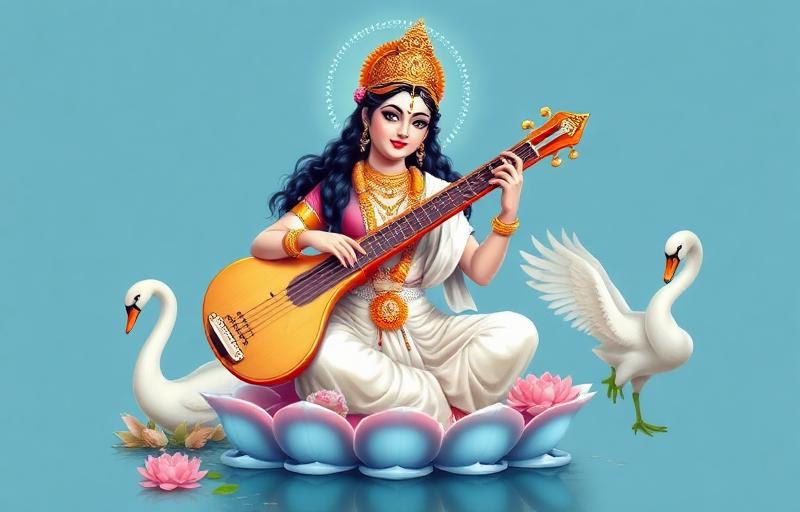
Goddess Saraswati is the deity of knowledge, learning, speech, music and the arts. She is shown dressed in white, seated on a white lotus, holding a veena in two hands, a book and a mala in the others, with a graceful swan (hansa) beside her and sometimes a peacock nearby.
Every element of this serene image is a symbol. Two of the most meaningful are the veena she plays and the swan she rides. Together they reveal what true knowledge is and how the wise mind works.
Why the Veena - The Music of Knowledge
The veena in Saraswati's hands represents the arts, music and the harmony of all knowledge. Several beautiful meanings flow from it:
- Knowledge must be harmonious: A veena makes sweet music only when its strings are tuned in balance. So too, true learning is not dry facts but wisdom brought into harmony - mind, heart and conduct in tune.
- The union of arts and wisdom: By holding the veena, Saraswati shows that fine arts and music are not separate from knowledge; they are part of a complete, cultured life.
- The cosmos as music: Indian tradition often sees creation itself as vibration and sound (nada). The veena's music symbolises the deep, ordered rhythm underlying the universe.
That she plays while seated calmly teaches that knowledge should be expressed gently and sweetly, spreading harmony rather than noise.
Why the Swan - The Power of Discernment
Saraswati's vahana is the hansa (swan), and it carries one of the most cherished teachings in Sanatana Dharma - the idea of neer-ksheer viveka.
It is said that the divine swan has the unique ability to separate milk from water (neer-ksheer) - drinking only the milk and leaving the water behind. This is a perfect symbol of viveka, the power of discernment: the wise mind can sift the essence (truth, the good) from the mixture of life and take only what is pure and worthy.
The swan also symbolises:
- Purity: Its spotless white colour reflects the pure, sattvic nature of true knowledge.
- Grace and serenity: Gliding calmly on water, the swan represents a mind at peace, moving smoothly through life.
By choosing the swan as her mount, Saraswati teaches that knowledge without discernment is incomplete. The seeker must learn to choose the lasting over the fleeting, the true over the false.
The Complete Picture and Its Teaching
Put together, Saraswati's image is a complete map of the life of the mind:
- The white sari and white lotus stand for purity and truth - knowledge untainted by desire.
- The book in one hand is the eternal Vedas and all learning.
- The mala shows that knowledge must be joined to devotion and meditation, not just intellect.
- The veena brings harmony, art and the sweetness of expression.
- The swan brings discernment - the wisdom to choose the essence and leave the rest.
The deeper teaching is that real knowledge is not just information stored in the head. It is harmonious (the veena), pure (the white and the lotus), devoted (the mala) and discerning (the swan). To worship Saraswati is to pray for this whole, balanced wisdom - and to cultivate the swan-like ability to seek out and hold only what is true.
Frequently Asked Questions
Why does Saraswati hold a veena?+
The veena represents the arts, music and the harmony of all knowledge. Just as a veena sounds sweet only when its strings are balanced, true learning is wisdom brought into harmony - mind, heart and conduct in tune. It also shows that arts and music are part of complete knowledge.
What does Saraswati's swan symbolise?+
The swan (hansa) symbolises viveka, the power of discernment. By tradition the divine swan can separate milk from water (neer-ksheer), taking only the milk. This shows the wise mind sifting truth and the good from the mixture of life. The swan also stands for purity, grace and a serene mind.
What is neer-ksheer viveka?+
Neer-ksheer viveka is the swan's legendary ability to separate milk (ksheer) from water (neer) and drink only the milk. It is a symbol of discernment - the wisdom to separate truth from falsehood, the essential from the worthless, and accept only what is pure and good.
Why is Saraswati dressed in white?+
White symbolises purity, truth and the sattvic nature of knowledge - learning untainted by desire or ego. Seated on a white lotus in white attire, Saraswati shows that true wisdom is clean, serene and free from worldly impurity.
About the author
Anjali Mehta · Editor, M.A. Religious Studies
Anjali is the managing editor for Vandnaa and oversees the festival and vrat coverage. She holds an M.A. in Religious Studies and reviews every published article for accuracy, accessibility, and tradition-fidelity.
Meet the Vandnaa editorial team →