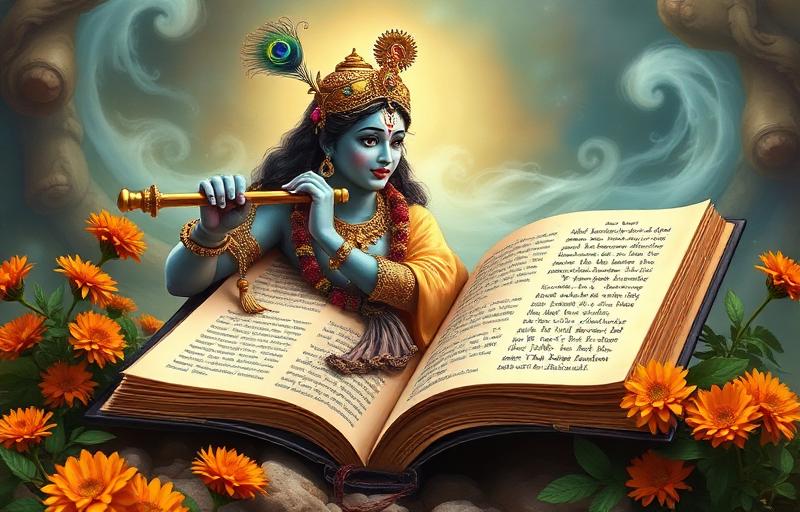
The Complaint About Mud
The setup for this episode is deliberately domestic and small. Krishna's playmates, the other cowherd children, run to Yashoda with the ordinary complaint children make about each other - that Krishna had been eating dirt. Not a demon, not a miracle in progress, just a toddler with mud on his face and a mother's mildly exasperated response to a familiar kind of tattling.
Yashoda caught hold of him, scolded him lightly, and told him to open his mouth so she could check whether he had actually swallowed clay. Krishna, the Bhagavata Purana says, opened his mouth without protest, as any scolded child might, expecting to be checked and released.
What Yashoda saw inside was not a mouth. She saw the whole of space - the sky, the directions, the sun and moon and stars, the oceans, the continents, mountains, forests, all living beings, and, the text specifies with a detail that seems to be there precisely to disorient the reader as much as it disoriented her, her own village of Gokul and her own house, with herself standing in it, looking in.
The vision did not last. Yashoda's mind, the Bhagavata says, was immediately clouded by Krishna's own yogamaya, the power that keeps his divine nature veiled from those around him for their own sake, and within moments she forgot what she had seen and returned to ordinary motherly concern - relief that there was no mud, a hug, business as usual.
A Vision Given Twice, to Different People
Readers who know the Bhagavad Gita will recognise the shape of this scene, because it happens again, in a much more famous form, on the battlefield of Kurukshetra decades later, when Krishna shows Arjuna his Vishwarupa, his universal form, at Arjuna's own request before the war begins.
The two visions are structurally similar - both show the totality of creation contained in or emanating from Krishna - but the circumstances could not be more different, and the tradition treats that difference as the actual point. Arjuna asks for the vision, is prepared for it as much as anyone can be, and still finds it terrifying enough to beg Krishna to return to his gentle, human form. Yashoda never asks for anything; she is a mother checking a toddler's mouth for mud, and the vision arrives entirely unbidden, in the middle of an utterly unremarkable domestic moment.
Commentators in the Vaishnava tradition, including Jiva Goswami, read this contrast as central to why the Vraja episodes of Krishna's childhood are held in such special devotional regard, sometimes above even the Gita's teachings, within certain strands of bhakti. The Gita's revelation is majestic and requires the right conditions, the right request, the right spiritual readiness. Yashoda's requires nothing - no worthiness test, no preparation, not even belief. She gets the same totality shown to a warrior on the eve of the greatest war in the epic, simply because she is a mother doing an ordinary mother's task, and the tradition takes that as proof that maternal love (vatsalya bhava) can access something that even disciplined spiritual effort has to work harder for.
Why She Forgets
The detail that Yashoda forgets the vision almost immediately is not an oversight in the storytelling - it's arguably the most theologically loaded part of the whole episode. Yogamaya, in the Bhagavata's framing, is not deception in any deceitful sense; it is the mechanism that allows an ordinary human relationship - a mother raising a child, feeding him, scolding him, worrying about mud on his face - to continue functioning at all, despite the fact that the child in question periodically reveals himself to contain everything that exists.
Without that veiling, the text implies, the relationship itself would become impossible. A mother who held the memory of having seen the entire universe inside her son's mouth every single day could not go on treating him as a son to be fed, scolded and worried over - she would treat him as an object of awe, at a distance, and the entire point of Krishna's Vraja childhood, in the theology built around it, is that awe is not the highest form of relationship available to a devotee. Intimacy is. Yashoda gets to keep the intimacy specifically because the awe doesn't stick.
This episode is frequently painted and sculpted across temples in Braj and beyond, usually showing Yashoda peering into the child's open mouth with tiny worlds visible within, and remains one of the most commonly referenced Krishna-childhood scenes in devotional poetry, cited as often for its tenderness as for its cosmology.
Frequently Asked Questions
Why did Yashoda ask Krishna to open his mouth?+
The other cowherd children complained that Krishna had been eating dirt, so Yashoda wanted to check his mouth for mud - a completely ordinary parental check that turned into a cosmic vision.
Is this the same as Krishna's Vishwarupa in the Bhagavad Gita?+
It's a structurally similar vision of the universe contained in Krishna, but a separate episode, from decades earlier in his life, given to his mother rather than to Arjuna, and given without her asking for it.
Why does Yashoda forget what she saw?+
The Bhagavata attributes this to Krishna's yogamaya, the power that veils his divine nature from those close to him so that ordinary, intimate relationships like a mother raising a son can continue undisturbed by constant awe.
About the author
Anjali Mehta · Editor, M.A. Religious Studies
Anjali is the managing editor for Vandnaa and oversees the festival and vrat coverage. She holds an M.A. in Religious Studies and reviews every published article for accuracy, accessibility, and tradition-fidelity.
Meet the Vandnaa editorial team →