भक्तिविहीन अनुष्ठानों का एक वन
Daruka forest, also called the Pine Forest in various tellings across the Shiva Purana, Kurma Purana and Padma Purana, was home to a large community of sages who had, over generations of settled practice, come to treat ritual performance itself as sufficient for liberation, believing that correctly executed karma-kanda, ritual action, guaranteed spiritual merit regardless of the inner devotion or understanding behind it.
This position, called Mimamsa in its philosophical form, is a genuine and respected school within Hindu thought, but the Daruka sages' particular version of it, in this story's telling, had hardened into a kind of complacent self-sufficiency: confident that their mastery of ritual technique alone made them beyond need of grace, beyond need of a personal deity's own intervention.
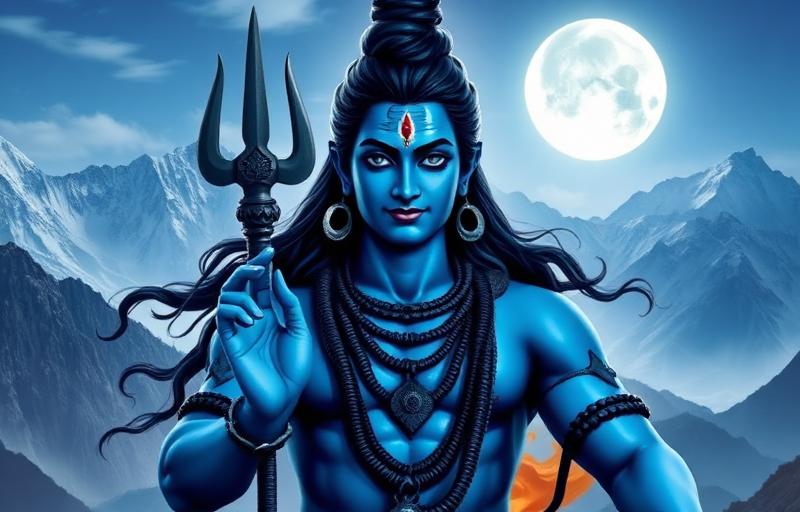
Shiva, seeing this settled certainty, resolved to disturb it directly rather than through any philosophical argument the sages could simply out-debate, and took the form of Bhikshatana: a wandering mendicant of extraordinary, unsettling beauty, entirely naked, adorned only with ash and a garland, accompanied in some tellings by Vishnu disguised as Mohini walking alongside him, and by Vishnu's own bull-form or a ghostly attendant depending on the version.
पत्नियों ने वह देखा जो पतियों ने देखने से मना किया
Bhikshatana walked through the forest begging alms in this radiant, unclothed form, and the effect on the sages' wives was immediate and total: they abandoned their household duties, their composure, and by several tellings their own modesty, drawn toward him with an intensity none of their husbands' careful ritual discipline had ever produced in them.
The sages, returning to find their wives in this state and their own domestic order thrown into chaos by a single wandering beggar, reacted with fury rather than reflection, and, wielding the very ritual power they had spent their lives perfecting, attempted to destroy Bhikshatana directly: conjuring a fierce tiger through their sacrificial fire and sending it at him, which he calmly killed and wore its skin; sending a venomous serpent, which he wore as an ornament instead; and finally, in the story's best known escalation, sending Apasmara, a dwarf demon of ignorance and forgetting, whom Shiva simply crushed underfoot and danced upon, this becoming the origin, in several tellings, of Nataraja's own iconic dancing form with the dwarf beneath his foot.
Every weapon the sages' ritual mastery produced, Bhikshatana absorbed and turned into an ornament or a foundation for his own dance, demonstrating with each escalation that their command of ritual power, however real, was answerable to a force their doctrine had no category for.
पहचान में समाप्त होता अपमान
Overwhelmed and finally recognising that the naked beggar before them was Shiva himself rather than any ordinary mendicant, the sages abandoned their attacks and fell at his feet, and the encounter closes, in most tellings, with their humility restored: their ritual power was never in question, but its emptiness without genuine devotion had been made undeniable to them in a way no argument could have achieved.
In one further escalation found in some versions, one sage, still resistant, tears off his own linga in fury and hurls it at Bhikshatana, at which point it transforms into a massive pillar of fire whose ends neither the sage nor anyone else can find - connecting this story directly to the Lingodbhava episode told elsewhere in this series, some traditions treating the two as continuous parts of the same larger narrative rather than separate events.
Bhikshatana's iconography, distinct and recognisable across South Indian bronze sculpture in particular, remains one of the tradition's most direct visual statements about the limits of ritual without devotion: a god choosing to appear not in overwhelming majesty but in the single form - naked, wandering, beautiful, beyond category - that a community certain of its own mastery had least prepared itself to encounter.
पाठकों के प्रश्न
दारुक वन के ऋषि कौन थे, और शिव क्या परख रहे थे?+
एक ऋषि समुदाय जो मानता था कि सही ढंग से किया गया अनुष्ठान अकेले मुक्ति की गारंटी देता है, आंतरिक भक्ति की परवाह किए बिना। शिव ने इसी आत्मसंतुष्ट निश्चितता को भंग करने भिखारी भिक्षाटन का रूप धारा।
What weapons did the sages send against Bhikshatana?+
A tiger conjured through their sacrificial fire, which he killed and wore as a skin; a venomous serpent, which he wore as an ornament; and the dwarf demon Apasmara, whom he crushed underfoot, an act connected to Nataraja's dancing iconography.
यह कथा शिव के लिंगोद्भव रूप से कैसे जुड़ी है?+
कुछ कथाओं में, एक अड़ियल ऋषि अपना लिंग तोड़कर भिक्षाटन पर फेंकता है, और वह लिंगोद्भव कथा में वर्णित अनंत अग्नि स्तंभ में बदल जाता है - कुछ परंपराएं इन दोनों प्रसंगों को एक ही निरंतर कथा मानती हैं।
About the author
Anjali Mehta · Editor, M.A. Religious Studies
Anjali is the managing editor for Vandnaa and oversees the festival and vrat coverage. She holds an M.A. in Religious Studies and reviews every published article for accuracy, accessibility, and tradition-fidelity.
Meet the Vandnaa editorial team →