A Temple Conceived and Built in the 21st Century
Unlike nearly every other major Hindu temple in India, which trace their origins back centuries or millennia, Swaminarayan Akshardham in New Delhi is a distinctly modern creation, opened to the public in 2005. Built by the BAPS Swaminarayan Sanstha under the spiritual guidance and inspiration of Pramukh Swami Maharaj, the temple was conceived as a comprehensive expression of Hindu spirituality, culture and values, designed to serve both as an active place of worship and as an accessible introduction to Hindu philosophy for visitors of every background.
Situated on the eastern bank of the Yamuna river, the temple complex occupies a substantial campus that extends well beyond the central monument itself, incorporating landscaped gardens, exhibition halls, a large stepped water tank and various visitor facilities, making Akshardham less a single shrine and more an integrated cultural and spiritual campus built entirely within the span of a few years rather than accumulated gradually across centuries as most historic temples were.
The decision to build such a monument in the twenty-first century, using techniques and materials deliberately rooted in ancient Indian temple-building tradition rather than modern construction methods, reflects a specific philosophy behind the project, the conviction that traditional shilpa shastra architectural principles remain entirely capable of producing monuments of genuine grandeur even in the present era, without requiring compromise toward more contemporary construction shortcuts.
For visitors accustomed to associating major Hindu temples exclusively with ancient history, Akshardham offers a notable contrast, a monument whose foundations were laid within living memory, built by architects, artisans and volunteers whose work can be documented, photographed and, in many cases, personally recounted by those still alive who took part in its construction.
Built Without Structural Steel, Using Ancient Techniques
Perhaps the most striking architectural fact about Akshardham's central monument is what it deliberately avoids, structural steel. In keeping with the building traditions followed at India's ancient stone temples, the monument was constructed using an interlocking stone technique, where individually carved blocks of pink sandstone and white Italian Carrara marble are fitted together with mathematical precision, relying on their sheer weight, shape and careful joinery to hold the structure stable rather than modern reinforced construction methods involving steel framing.
This approach required an enormous mobilization of traditional craftsmanship, with thousands of stone carvers and artisans, many trained in traditional sculptural techniques passed down through generations, working alongside architects and volunteers over an extended construction period to hand-carve the monument's walls, pillars, domes and ceilings. Every surface of the central structure carries some form of detailed relief work, floral patterns, depictions of deities, saints, dancers and mythological scenes, executed with the same painstaking attention to detail found at India's great historic stone temples.
The logistics of this undertaking were substantial, involving the quarrying, transport and precise carving of an enormous volume of stone, coordinated across a large workforce and supplemented significantly by volunteer labor contributed by devotees who took part in various stages of the temple's construction as an act of personal devotion, a detail often highlighted in accounts of the temple's building process.
This commitment to traditional technique, deliberately avoiding structural steel that could have simplified and accelerated the build, was a considered choice rather than a limitation, intended to demonstrate that the architectural wisdom of ancient Indian temple builders remains not just historically admirable but practically achievable at a monumental scale even in the present day.
A Monument of Record-Breaking Scale
The scale of Akshardham's central monument earned it formal recognition in the Guinness World Records in 2007 as the world's largest comprehensive Hindu temple, a distinction based on assessment of the complex's overall scale, area and architectural completeness rather than height alone. The main structure features 234 intricately carved pillars, nine ornate domes, and reportedly around 20,000 individual carved figures of deities, devotees, musicians, dancers and animals distributed across its surfaces, an almost overwhelming density of sculptural detail that rewards slow, repeated viewing rather than a single quick visit.
At the heart of the monument stands a large central murti of Bhagwan Swaminarayan, the founding figure of the Swaminarayan tradition, surrounded by murtis representing other significant gurus within the lineage, arranged within an inner sanctum whose scale and ornamentation match the grandeur of the surrounding structure.
Beyond the main monument, the wider Akshardham complex includes several other record-scale features, most notably the Yagnapurush Kund, a vast stepped water tank considered among the largest of its kind anywhere in the world, built in the traditional stepwell style found historically across Gujarat and Rajasthan, repurposed here to also host an evening water and light show for visitors.
This emphasis on scale is not simply about spectacle for its own sake, within the philosophy behind the temple's construction, the sheer size and comprehensiveness of the monument is understood as a way of expressing the totality and richness of Hindu spiritual and cultural tradition in a single, unified space, offering visitors an experience that aims to be comprehensive rather than narrowly focused on one deity or one architectural period.
Beyond the Monument: Exhibitions and the Water Show
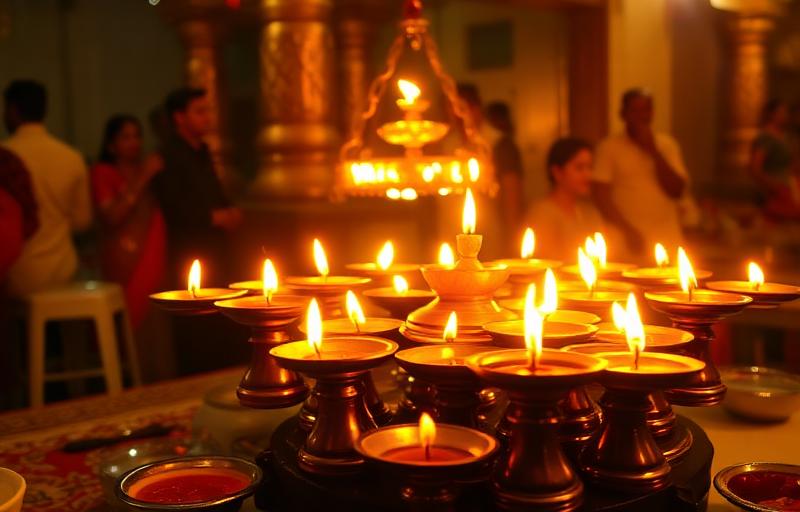
Akshardham distinguishes itself from most traditional temples in the sheer range of visitor experiences built into its campus, designed explicitly to educate as well as facilitate worship, particularly for visitors, including many young people and those unfamiliar with Hindu philosophy, encountering these concepts for the first time in an accessible, structured format.
The complex includes several dedicated exhibition halls exploring themes connected to Hindu values, history and the life of Bhagwan Swaminarayan, presented through a combination of dioramas, audio-visual presentations and an immersive boat ride exhibit that takes visitors through scenes depicting ancient Indian achievements in science, mathematics and culture. A large-format film, often referred to by visitors as the Neelkanth Yatra film, dramatizes the extensive travels undertaken by Swaminarayan across India as a young ascetic, projected across an exceptionally large screen format that has become one of the complex's most popular single attractions.
In the evenings, the Yagnapurush Kund hosts the Sahaj Anand Water Show, a choreographed presentation combining water, light, fire and music to narrate a story drawn from Hindu philosophical themes, drawing large crowds who gather around the stepped tank as darkness falls over the complex, extending a visit well into the evening hours for those staying through the presentation. Many families structure their day around this sequence deliberately, beginning with quiet darshan in the cooler morning hours and closing out the visit with the exhibitions and the illuminated evening water show.
🪔 Vandnaa's temple guides help you plan a full day like this one, balancing quiet darshan with enriching cultural exhibits, so nothing about your visit feels rushed.
Same Devotional Purpose, a Different Era
For all its modern origins and record-setting scale, Akshardham's underlying purpose remains continuous with the oldest traditions of Hindu temple building, a dedicated space where devotees come to seek darshan, offer worship and deepen their connection to the divine. The daily ritual schedule within the sanctum, including scheduled aartis and the reverent presentation of the central murtis, follows conventions recognizable to devotees familiar with temple worship anywhere in India, even as the surrounding architecture and visitor experience reflect thoroughly contemporary design and construction choices.
What Akshardham represents, in this sense, is not a departure from temple tradition but a demonstration of its continued vitality, proof that the impulse to build grand, devotionally serious monuments to the divine has not diminished in the modern era, even as the tools, materials logistics and audience for such a project have changed considerably since India's ancient and medieval temple-building periods. Where historic temples like Konark or Somnath tell stories of endurance across centuries of change, Akshardham tells a complementary story, that the same devotional ambition remains alive and capable of producing monuments of comparable scale and seriousness even today.
This makes Akshardham a particularly interesting stop for visitors interested in Hindu temple architecture more broadly, offering a instructive contrast when considered alongside ancient sites, the same underlying architectural grammar, stone carving, pillared halls, towering forms, ornate surfaces, deployed using contemporary project management, engineering assessment and construction planning suited to the twenty-first century.
For many devotees, particularly those based in or visiting Delhi without easy access to India's more geographically distant ancient temples, Akshardham has also become a significant and accessible site of regular worship in its own right, not merely a tourist curiosity but a living, actively used temple with its own devoted regular congregation.
Visitor Guide: Timings, Access and What to Know Before You Go
Akshardham's location within Delhi and its position on the metro network make it one of the more straightforward major temples to visit for both residents and travelers passing through the capital.
- How to reach: The temple is directly served by Akshardham metro station on the Delhi Metro's Blue Line, making it easily accessible without needing a car; it is also well connected by road for those driving or taking a taxi
- Entry to the monument: Entry to the main temple monument for darshan is free of charge, while the exhibition halls, boat ride and water show typically require separate paid tickets
- Security: Given its scale and visitor volume, security protocols are strict; mobile phones, cameras, bags and most personal electronic items are not permitted inside and must be deposited at cloak rooms near the entrance before proceeding
- Timings: The complex is generally closed on Mondays, with the monument and exhibitions open through the rest of the week; the evening water show has its own specific showtimes worth checking in advance
- Best time to visit: Weekday visits, especially mornings, tend to be considerably less crowded than weekends and holidays; the water show is understandably most popular after sunset
Given the combination of darshan, exhibitions and the evening show, many first-time visitors find that a proper Akshardham visit comfortably fills the better part of a day, and arriving with this expectation, rather than treating it as a brief stop, allows for a considerably more complete and unhurried experience of the complex.
Reader Questions Answered
When was Akshardham Temple Delhi built and by whom?+
Akshardham opened in 2005, built by the BAPS Swaminarayan Sanstha under the inspiration of Pramukh Swami Maharaj, using traditional stone-carving techniques rather than modern steel-based construction.
Why was Akshardham built without structural steel?+
The monument follows ancient Indian temple-building tradition, using interlocking carved stone blocks of sandstone and marble to hold the structure stable, demonstrating that traditional shilpa shastra techniques remain viable at monumental scale today.
Is Akshardham Temple in the Guinness World Records?+
Yes, it was recognized in 2007 as the world's largest comprehensive Hindu temple, based on the overall scale, area and architectural completeness of the complex.
What can visitors see at Akshardham besides the main temple?+
The complex includes exhibition halls, an immersive boat ride, a large-format film on Swaminarayan's travels, and the Yagnapurush Kund stepped water tank, which hosts an evening water, light and music show.
Is entry to Akshardham Temple free?+
Entry to the main temple monument for darshan is free of charge, while the exhibitions, boat ride and water show typically require separate paid tickets.
How do I reach Akshardham Temple by metro?+
Akshardham metro station on the Delhi Metro's Blue Line connects directly to the temple, making it one of the most straightforward major temples to reach without a car.
About the author
Pandit Ravindra Sharma · Vedic Rituals & Bhakti, 22+ years
Pandit Ravindra is the Vandnaa editorial team's resident specialist on aarti, chalisa, and daily devotion. He has performed home and temple pujas across Varanasi and Delhi for over two decades and contributes the bhakti-focused articles on this site.
Meet the Vandnaa editorial team →