Who Is Ayyanar
Ayyanar is among the most widely worshipped guardian deities of rural Tamil Nadu, stationed traditionally at the boundary of a village rather than at its centre. Devotees regard him as the chief of the kaval deivams, the guardian deities entrusted with keeping a settlement safe, and his shrines are found in villages across the state, each one considered a living outpost of his protection.
Tradition holds Ayyanar to be the son of Shiva and Mohini, the enchanting form Vishnu assumed during the churning of the ocean. Because of this union of Hari and Hara, devotees know him as Hariharaputra, a name that ties him firmly into the wider Hindu pantheon rather than treating him as a deity apart from it.
The Legend of His Birth
The katha behind Ayyanar's birth is set during the great churning of the ocean, when Vishnu took the radiant form of Mohini to safely distribute the amrita among the devas. Shiva, drawn to that divine beauty, is said to have united with Mohini, and from that union Ayyanar was born, carrying within him the grace of Vishnu and the power of Shiva together.
Devotees see real meaning in this dual parentage. It is not treated as an incidental detail but as the very reason he is trusted with guarding sacred village space, a figure who inherits both the preserving compassion of Hari and the protective strength of Hara, and stands ready to use both on behalf of his devotees.
His Form and His Shrine
Ayyanar shrines are easily recognised by the towering terracotta horses and elephants that stand guard outside them, some rising many feet into the air. Devotees regard these as his vahanas, kept saddled and ready so that he may ride out with his retinue each night to patrol the fields and homes under his care. The shrine itself is often a simple, open platform beneath an old tree at the edge of a settlement, rather than an enclosed temple.
He is usually depicted with a commanding, moustached figure, holding weapons and seated or standing in a posture of readiness, worshipped alongside his consorts Poorna and Pushkala. Crafting new terracotta horses for him remains a living folk art, made by hand and offered with devotion each festival season.
Worship and Offerings

Devotees approach Ayyanar with simple offerings of flowers, fruit, camphor and cooked rice, invoking his protection before starting a journey, sowing a field, or laying the foundation of a new home. In many villages, his worship has been entrusted for generations to a particular local family or community, whose members serve as his priests and caretakers.
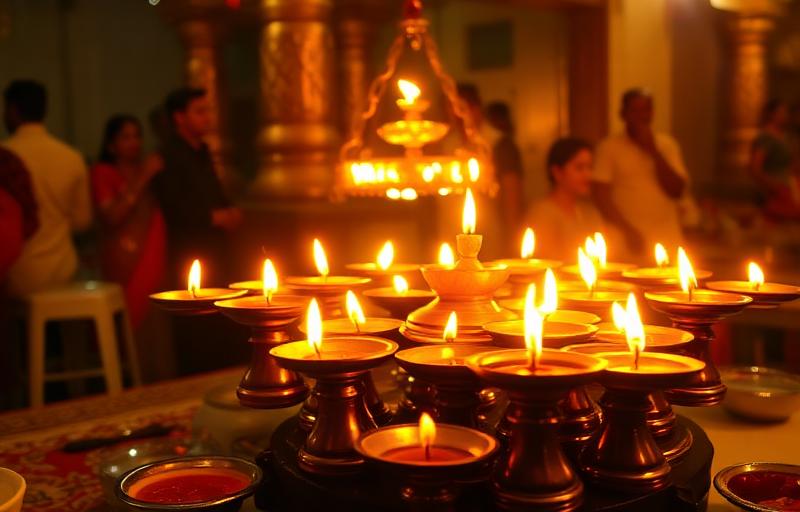
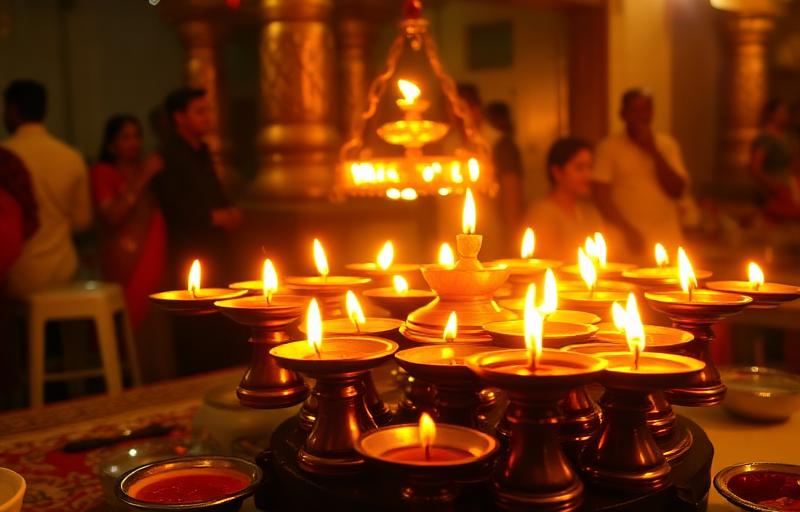
Because he is believed to patrol only after dark with his soldiers, his shrines are often quiet through the day and come alive during evening rituals and the annual festival, when lamps are lit and offerings are made in gratitude for the safety of the past year.
Festival and Regional Presence
Ayyanar's annual festival draws the whole village together, with the installation of new terracotta horses, processions, drumming and communal feasting marking the occasion. In many places he is worshipped alongside the village Amman temple at the centre of the settlement, together forming a complete system of protection, the Goddess presiding at the heart of the village and Ayyanar keeping watch at its edge.
His worship has also travelled with Tamil communities beyond Tamil Nadu, remaining part of devotional life among Tamil families in Sri Lanka and elsewhere, a sign of how deeply this guardianship is woven into Tamil Hindu identity wherever it settles.
The Takeaway
Ayyanar's worship teaches that protection in Hindu tradition operates at every level, from the great gods enshrined in the temple sanctum to the watchful guardian stationed at the village's edge. Turning to him before a journey or a new beginning is an act of trust in that unbroken chain of divine care, an offering of faith rather than mere custom.
Common Questions From Devotees
Who is Ayyanar in Hindu tradition?+
Ayyanar is a guardian deity of Tamil Nadu, believed by tradition to be born of Shiva and Mohini, and worshipped as Hariharaputra, the chief protector stationed at village boundaries.
Why are huge horse and elephant statues placed at Ayyanar shrines?+
These terracotta statues are regarded as his vahanas, kept ready so devotees believe he can ride out with his retinue each night to patrol and protect the village.
Is Ayyanar connected to Ayyappa?+
Both share a tradition of divine parentage from Shiva and Mohini, though they are worshipped as regionally distinct forms, Ayyanar mainly across Tamil Nadu and Ayyappa mainly in Kerala.
About the author
Pandit Ravindra Sharma · Vedic Rituals & Bhakti, 22+ years
Pandit Ravindra is the Vandnaa editorial team's resident specialist on aarti, chalisa, and daily devotion. He has performed home and temple pujas across Varanasi and Delhi for over two decades and contributes the bhakti-focused articles on this site.
Meet the Vandnaa editorial team →