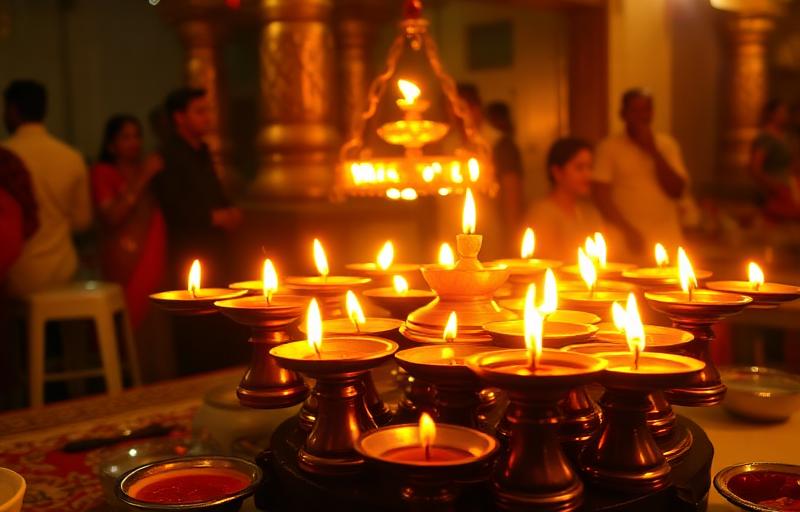
The Temple on the Hill
Azhagar Kovil, also written Alagar Koyil, stands about twenty one kilometres northeast of Madurai in Tamil Nadu, at the foot of the Alagar hills, also called Solaimalai.
What is there:
- A temple with a walled complex, gopurams and corridors, in wooded hill country
- The deity Kallazhagar, also called Sundararaja Perumal and simply Azhagar, meaning the beautiful one
- A shrine of Karuppanaswamy, the guardian deity, near the entrance
- The Noopura Ganga, a spring higher on the hill
- The Pazhamudircholai Murugan shrine further up, one of the six principal Murugan shrines of Tamil Nadu
Where it sits in the tradition. Azhagar Kovil is one of the 108 Divya Desams, celebrated by the Alvars, and it is one of the major Vishnu temples of the Madurai region.
What makes it unusual. Most temples are known for what happens inside them. This one is known for what happens when the deity leaves.
Once a year Kallazhagar travels from this hill to Madurai for his sister's wedding, arrives after it has finished, refuses to enter the city, and comes back. That journey, and the crowd that turns out for it, is one of the largest festivals in south India.
The Wedding and the Late Brother
The story requires knowing what happens at Madurai, and the two halves only make sense together.
At Madurai:
- Meenakshi, the goddess of Madurai, is a princess born to the Pandya king, in the tradition with three breasts, the third of which vanished when she met the one she was to marry
- She conquered the directions, and at Kailasa she met Shiva and the third breast disappeared
- She returned to Madurai and married him there, and he took the form Sundareswarar
- The wedding is re enacted annually in the Chithirai festival, in the Tamil month from mid April, at the Meenakshi temple, and it is one of the great occasions of the Tamil year
At Azhagar Kovil:
- Kallazhagar, Vishnu, is understood as Meenakshi's brother
- He sets out from his hill to give his sister away, as a brother should
- He is delayed on the road
- By the time he reaches the Vaigai, the river at Madurai, the wedding has already taken place
- He is displeased. He does not enter the city
- He enters the Vaigai instead, and this is the moment the crowds come for, and then turns back toward his hill
What is being staged. This is not a small ritual detail. Several lakh people gather on and around the Vaigai riverbed to watch a deity arrive too late and go home offended.
Why that would be worth watching. Because everyone present has a brother, or is one, and knows exactly what it looks like when someone misses the wedding and will not say it is fine.
The festival takes the largest possible theological material, the marriage of Shiva and the goddess, and stages it as a family occasion with a family grievance attached. That is why it works.
How Two Festivals Became One
The Chithirai festival's structure has a documented history, and it is one of the more interesting pieces of religious administration in India.
What the position was:
- Madurai had a Shaiva festival, the wedding of Meenakshi and Sundareswarar at the Meenakshi temple
- Azhagar Kovil had a Vaishnava festival, Kallazhagar's journey to the Vaigai
- They were separate occasions, held at different times, drawing different crowds
What changed:
- Tirumalai Nayak, the seventeenth century ruler of Madurai, is credited with combining them
- The two festivals were brought into the same month, so that Kallazhagar's journey coincides with the wedding
- The narrative connection, that Kallazhagar is coming for his sister's wedding and arrives late, gave the merger its logic
Why a ruler would do this. The reasons offered are practical and political, and they are not cynical.
- A single large festival concentrates pilgrims, trade and revenue in one period
- It binds two sectarian communities into one civic occasion, which a ruler governing both has an obvious interest in
- It creates a shared calendar for the city, which is what a capital needs
What it reveals about Indian religion. This is the useful part.
- The relationship between Shaiva and Vaishnava traditions is usually described through their doctrinal disputes, which were real and sometimes bitter
- At the level of a city's actual practice, they were routinely integrated, and rulers integrated them deliberately
- The device used here is kinship. Vishnu is not a rival deity in this arrangement. He is the bride's brother, which places him inside the family and removes the competition entirely
A festival in which the two great traditions of south India are related by marriage, and one of them is sulking about the seating arrangements, is a more accurate picture of how they actually coexisted than any polemical text.
The Descent into the Vaigai

The moment the whole festival builds to is worth describing, because it is one of the great sights of the Tamil year.
What happens:
- Kallazhagar travels from Azhagar Kovil to Madurai over several days, in procession, stopping at points along the route
- He is mounted on a golden horse for part of it, and the horse vahana is a defining image of the festival
- Enormous crowds accompany and receive him at each stage
- At Madurai he comes to the Vaigai, and enters the riverbed
- Several lakh people are present on and around the river
- He does not enter the city. He turns back
The communities involved:
- The Kallar community, particularly the Piramalai Kallars, has a strong hereditary association with Kallazhagar and with the festival, and carries the deity
- Villages along the route have their own specified roles, and the procession is a set of obligations distributed across a region rather than a single temple's event
Why the river matters. The Vaigai at Madurai is usually dry or nearly so for much of the year, and the riverbed is open ground.
That has a practical consequence. The festival's climax happens in a space large enough to hold the crowd, which is not true of a temple. A city's population and everyone who has come in from the districts can physically be present, which is why the numbers are what they are.
Safety, which matters here. Several lakh people in a riverbed in April in Madurai is a serious proposition.
- Temperatures are very high. Heat exhaustion and heatstroke are the real risk. Carry water, cover your head, and get out of the sun periodically
- Do not go into the densest part of the crowd near the deity. You will see more from the edges and be safer
- Keep children held, and agree a meeting point, since phone networks will be congested
- If the river has water in it, do not enter it in a crowd
- Follow police and organiser instructions
The Hill and What Else Is On It
The Alagar hills hold more than the main temple, and the arrangement of shrines up the slope is worth understanding.
Karuppanaswamy:
- A guardian deity with a shrine near the entrance to the complex
- Guardian deities are a major feature of Tamil religion, standing at the boundary of a settlement or a shrine and controlling access
- Karuppasamy in his various forms is among the most widely worshipped of them across Tamil Nadu
- Devotees typically acknowledge the guardian before proceeding
The Noopura Ganga:
- A spring higher on the hill, reached by a climb
- The katha holds that when Vamana grew to measure the worlds, the water that washed his raised foot became this stream, and nupura means anklet
- The water is taken by devotees and is used in the temple
Pazhamudircholai:
- Further up the hill, the shrine of Murugan, and one of the Arupadai Veedu, the six principal Murugan shrines of Tamil Nadu
- The six are Palani, Swamimalai, Thiruchendur, Thiruparankundram, Thiruthani and Pazhamudircholai
- This one is the shrine in the forest, and the name means the grove of ripe fruit
- It is associated with the poet Avvaiyar and a well known episode in which Murugan, appearing as a boy in a tree, asks her whether she wants roasted or unroasted fruit, and she cannot answer the riddle
What the hill is, taken together. A guardian at the gate, Vishnu in the main temple, a sacred spring on the slope and Murugan in the forest above.
That is a complete religious landscape stacked vertically on one hillside, and walking up it takes you through a set of relationships that a single temple could not show you.
Visiting Azhagar Kovil
Getting there
- Azhagar Kovil, about 21 km northeast of Madurai, Tamil Nadu
- Madurai has an airport and a major railway junction and is very well connected
- Buses and taxis run from Madurai and the trip is short
- The temple is at the foot of the hill. Pazhamudircholai is further up and needs transport or a climb
Timings
- Open in morning and evening sessions with a midday closure, as is standard. Check locally
When to go
- November to February for the most comfortable weather
- Chithirai, the Tamil month from mid April, for the festival, accepting extreme heat and extreme crowds
- Ordinary days for a quiet visit, which is a completely different experience and worth having
- Early morning for the hill and the spring
If you go for Chithirai
- It is a very large festival in a very hot month. Plan around heat as much as around crowds
- Book accommodation in Madurai months in advance
- Carry water, cover your head, and take breaks out of the sun
- Watch from the edges of the crowd rather than the middle
- Keep children held and agree a meeting point
- Follow police and organiser instructions
Dress and conduct
- As at Tamil Vaishnava temples, men may be expected to remove upper garments in the sanctum area. Check at the entrance
- Women should dress conservatively
- Photography inside is restricted
Combining the visit
- The Meenakshi temple at Madurai, which is the other half of the story and one of the great temples of India
- Thiruparankundram, another of the six Murugan shrines, on the other side of Madurai
- Pazhamudircholai, up the hill from Azhagar Kovil
- The Gandhi Memorial Museum and Thirumalai Nayak Mahal in Madurai
A closing thought. Every family has the relative who turns up after the ceremony, will not be placated, and leaves early. Madurai has built one of the largest festivals in India around exactly that, cast Vishnu in the role, and been running it for four hundred years.
Common Questions From Devotees
Who is Kallazhagar?+
The deity of Azhagar Kovil, about 21 km northeast of Madurai, a form of Vishnu also called Sundararaja Perumal and simply Azhagar, meaning the beautiful one. The temple is one of the 108 Divya Desams, and in the Madurai tradition he is understood as Meenakshi's brother.
What happens at the Chithirai festival?+
The wedding of Meenakshi and Sundareswarar is re enacted at the Meenakshi temple in Madurai, while Kallazhagar sets out from Azhagar Kovil to give his sister away. He is delayed, arrives at the Vaigai after the wedding is over, refuses to enter the city, enters the riverbed instead before several lakh people, and turns back.
Why were the two festivals combined?+
Tirumalai Nayak, the seventeenth century ruler of Madurai, is credited with bringing the Shaiva wedding festival and the Vaishnava journey into the same month. A single large festival concentrates pilgrims, trade and revenue, and binds two sectarian communities into one civic occasion, which a ruler governing both had an obvious interest in.
What is the significance of Kallazhagar being Meenakshi's brother?+
The device is kinship. Vishnu is not a rival deity in this arrangement but the bride's brother, which places him inside the family and removes the sectarian competition entirely. It is a more accurate picture of how Shaiva and Vaishnava traditions actually coexisted in a city than any polemical text.
What else is on the Alagar hill?+
A shrine of Karuppanaswamy, the guardian deity, near the entrance; the Noopura Ganga spring higher up, said to be the water that washed Vamana's raised foot; and Pazhamudircholai further up, one of the six principal Murugan shrines of Tamil Nadu, associated with the poet Avvaiyar and the riddle about roasted fruit.
What should I be careful about at the festival?+
Several lakh people in a riverbed in April in Madurai means heat is the real risk. Carry water, cover your head and take breaks out of the sun. Watch from the edges rather than the densest part of the crowd, keep children held, agree a meeting point since phone networks will be congested, and follow police instructions.
About the author
Pandit Mahesh Trivedi · Festival Traditions & Panchang
Pandit Mahesh leads the festival-date and Panchang content on Vandnaa. He cross-references multiple regional panchangs (Drik, Vaishnava, Bengali, Marathi) for every festival date published on the site.
Meet the Vandnaa editorial team →