The Elder Brother as Presiding Deity
The Baladevjew temple at Kendrapara in Odisha is unusual in the Jagannath tradition, and the reason is simple.
At Puri, and at the great majority of Jagannath temples, Jagannath is the presiding deity, with Balabhadra and Subhadra beside him. That is the standard arrangement, and it is what devotees expect.
At Kendrapara, Baladevjew, Balabhadra, is the presiding deity, and Jagannath and Subhadra are worshipped alongside him.
Who Balabhadra is:
- The elder brother of Krishna, called Balarama, Baladeva, Sankarshana and Halayudha
- Regarded in tradition as an incarnation of Ananta or Shesha, the serpent on whom Vishnu rests
- Associated with the plough, which is why he is Halayudha, the one whose weapon is the plough, and the deity of agriculture and strength
- Worshipped by both Vaishnavas and Shaivas, since his Sankarshana and serpent associations connect him in more than one direction
Kendrapara is called Tulasi Kshetra, and the town's identity is tied to the temple in the way Puri's is to Jagannath, on a smaller scale.
For devotees in coastal Odisha, this is a major shrine, and the Ratha Jatra here is one of the largest in the state outside Puri.
Why Balabhadra Matters in Odisha
Balabhadra's position in Odisha is stronger than in most of India, and it follows from the Jagannath tradition itself.
At Puri, the three deities on the ratna simhasana are Jagannath, Balabhadra and Subhadra, with the Sudarshana. This is not a case of a main deity with attendants. All three are worshipped as deities in their own right, they have their own chariots, their own colours and their own rituals.
- Balabhadra's chariot at Puri is the Taladhwaja, which leads the procession, going ahead of Jagannath's Nandighosha
- His colour and his flag are distinct
- His identity as Sankarshana places him within the Vaishnava vyuha doctrine, where he is one of the four emanations
- His association with Shesha and the serpent gives him a further set of connections
That established position is what makes a temple like Kendrapara's possible. In a tradition where Balabhadra already leads the procession and has his own worship, a temple where he presides is a variation rather than a departure.
What it produces at Kendrapara is a shrine where the elder brother, usually seen alongside, is the deity people come for, and where his chariot is the principal one.
The Ratha Jatra at Kendrapara
Kendrapara's Ratha Jatra is the temple's great festival, held on the same Ashadha days as Puri's, and it is among the largest in Odisha after Puri itself.
What happens:
- The deities come out of the temple in the pahandi procession, the distinctive swaying movement in which the murtis are carried
- They are placed on the chariots, with Baladevjew's chariot, the Brahma Taladhwaja, as the principal one
- Devotees pull the chariots through the town to the destination temple
- The deities remain there for the prescribed days
- The Bahuda Jatra, the return, brings them back
The Brahma Taladhwaja is a very large chariot, and its construction each year follows the same prescribed process that governs chariot building in the Jagannath tradition, with designated carpenter families, specified timber and a fixed schedule beginning on Akshaya Tritiya.
What is worth understanding about Ratha Jatra generally, and it applies at Kendrapara as much as at Puri:
- The deity leaves the temple and comes into the street
- Anyone can see, and anyone can pull the chariot
- The rope is open to all, and pulling it is the principal act of devotion of the day
That is the theology of the festival, stated as an event rather than as a doctrine. A temple has thresholds and rules. A chariot on a road does not.
Tulasi Kshetra and the Temple's Origins
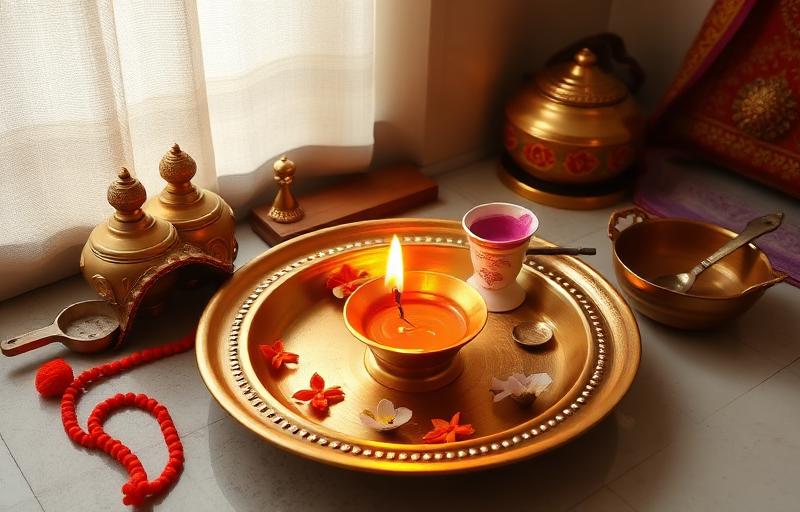
Kendrapara is known as Tulasi Kshetra, and the name is tied to the temple's origin tradition.
Local accounts describe the deity being discovered or manifesting at the site, with the tulsi grove giving the place its name, and worship beginning from that. As with most temple origin traditions, the details vary between tellings and the tradition is held as tradition rather than as history.
The present temple is generally dated to the eighteenth century, with the structure built and expanded under the patronage of the period, and the site's worship understood to be older than the standing building.
What the complex holds:
- The main shrine, with Baladevjew as the presiding deity, alongside Jagannath and Subhadra
- Subsidiary shrines within the enclosure
- The temple compound, which is substantial, in the middle of Kendrapara town
- Facilities that have grown to handle the Ratha Jatra crowds
Daily worship follows the Jagannath tradition's pattern of niti, the prescribed sequence of daily rituals, adapted to this temple's scale, and offerings of bhog are made and distributed as at other temples of this tradition.
Odisha has a considerable number of Jagannath temples, in almost every town, each with its own Ratha Jatra. Kendrapara stands out among them because of what it does with the deities, giving the elder brother the centre.
What Devotees Ask Balabhadra For
Balabhadra's character in tradition shapes what devotees bring to him.
- Strength, since he is the deity of physical power in the Krishna narrative, and wrestlers and akharas across India have long kept him as their deity
- Agriculture, from his identity as Halayudha, the plough wielder, which makes him the deity of the farming season in a state where agriculture is the base of the economy
- Protection of the family, particularly in the elder brother role, which devotees invoke directly
- Serpent related concerns, from his Ananta and Shesha associations
- Justice and firmness, since his character in the Mahabharata and the Puranas is that of someone who is direct and does not dissemble
The elder brother role is the one devotees at Kendrapara emphasise most. In the Krishna narrative Balabhadra is the one who is always there, who is not the centre of attention, and who steps in when something has to be handled.
Devotees describe the relationship in exactly those terms. Krishna is loved. Balabhadra is relied on.
For a temple where the elder brother is the presiding deity, that is the appropriate character, and it is why families in coastal Odisha come to Kendrapara with the practical matters of their households.
Visiting Kendrapara
Kendrapara is an easy addition to a coastal Odisha trip and is very different during Ratha Jatra from the rest of the year.
- Location - Kendrapara town, Kendrapara district, coastal Odisha
- Access - by road from Cuttack and Bhubaneswar, both within a couple of hours, with Cuttack the nearest major rail head
- Best time - October to March for weather. Ratha Jatra in Ashadha for the festival, when the town fills completely.
- Time needed - an hour or two outside the festival
- Etiquette - as at Jagannath tradition temples, follow the temple's rules on entry, dress modestly, remove footwear and do not photograph inside
- Nearby - Bhitarkanika, the mangrove national park, is in this district, and Cuttack and Bhubaneswar are close
What to combine in Odisha:
- Puri, for the Jagannath temple and the great Ratha Jatra
- Bhubaneswar, with Lingaraj and the old temple cluster
- Konark, for the Sun temple
- Jajpur, for Biraja, the state's Shakti Peetha
- Kakatpur, for Maa Mangala, and Ghatgaon further north for Maa Tarini
One closing thought for devotees who know Puri well. Standing at Kendrapara before the chariots on Ratha Jatra day, with Baladevjew's Brahma Taladhwaja at the front and Jagannath behind, is a genuinely different experience of a tradition you already know, and it takes only the willingness to travel two hours from Bhubaneswar to have it.
What People Ask Most
Who is Baladevjew of Kendrapara?+
Baladevjew is Balabhadra, the elder brother of Krishna, worshipped as the presiding deity of the temple at Kendrapara in Odisha, with Jagannath and Subhadra alongside him. This reverses the usual arrangement of the Jagannath tradition.
Why is Kendrapara called Tulasi Kshetra?+
The name is tied to the temple's origin tradition, in which the deity is described as being discovered or manifesting at the site with the tulsi grove giving the place its name. As with most origin traditions, details vary between tellings.
What is the Brahma Taladhwaja?+
It is Baladevjew's chariot at Kendrapara, the principal chariot of the town's Ratha Jatra. Its construction each year follows the prescribed process of the Jagannath tradition, with designated carpenter families and a schedule beginning on Akshaya Tritiya.
Who is Balabhadra in tradition?+
The elder brother of Krishna, called Balarama, Baladeva, Sankarshana and Halayudha. He is regarded as an incarnation of Ananta or Shesha, is associated with the plough and therefore with agriculture and strength, and is worshipped by both Vaishnavas and Shaivas.
When is the Kendrapara Ratha Jatra held?+
On the same Ashadha days as Puri's, with the deities taken out in the pahandi procession, placed on the chariots and pulled through the town, and the Bahuda Jatra bringing them back. It is among the largest Ratha Jatras in Odisha after Puri.
How do you reach Kendrapara?+
By road from Cuttack or Bhubaneswar, both within a couple of hours, with Cuttack the nearest major rail head. Bhitarkanika national park is in the same district, and Puri, Konark and Jajpur are within reach on a wider trip.
About the author
Pandit Ravindra Sharma · Vedic Rituals & Bhakti, 22+ years
Pandit Ravindra is the Vandnaa editorial team's resident specialist on aarti, chalisa, and daily devotion. He has performed home and temple pujas across Varanasi and Delhi for over two decades and contributes the bhakti-focused articles on this site.
Meet the Vandnaa editorial team →Explore on Vandnaa
Related Articles
Jagannath Temple Puri: Complete Darshan Guide and Traditions
7 min read
Jagannath Rath Yatra 2026: Date, History, Three Chariots & How to Watch It from Home
12 min read
Maa Tarini of Ghatgaon: The Goddess Whose Name Is Painted on Odisha's Trucks
8 min read
Biraja Devi Temple, Jajpur: Odisha's Nabhi Gaya Shakti Shrine
7 min read