A Saraswati Temple, Which Is Rare
Basara is a town in Nirmal district, Telangana, on the bank of the Godavari, near the Maharashtra border. Its Gnana Saraswati temple is one of the very few temples in India where Saraswati is the principal deity.
How rare that is. Saraswati is universally known, universally invoked and almost never given a temple of her own.
- Every student in the country knows her name
- Vasant Panchami is observed nationwide in her honour
- Musicians, writers and scholars keep her image
- She appears in nearly every temple as a subsidiary figure
- And there are perhaps a handful of major temples where she is the principal deity
The main ones:
- Basara, in Telangana, the busiest
- Sringeri, in Karnataka, where Sharadamba is the presiding deity of the Shankaracharya matha
- Koothanur, in Tamil Nadu
- Wargal, also in Telangana
- Sharada Peeth in Kashmir, one of the most important shrines in the history of Indian learning, now a ruin in territory that Indian pilgrims cannot reach
- A number of smaller shrines and modern foundations
Why so few. The reason is worth thinking about, because it is not that Saraswati is unimportant.
- Saraswati is asked for learning, and learning is sought over years, not at a single visit
- She is not generally petitioned for the things that fill temples: health, marriage, children, money, relief from affliction
- Her worship is domestic and institutional rather than pilgrimage based. It happens at desks, in schools, at the start of a term, on Vasant Panchami, and at the beginning of any performance
- A deity worshipped daily at home and annually at school does not generate the flow of vows and fulfilments that builds a large temple economy
So Basara is unusual not because Saraswati is neglected but because the way she is worshipped does not usually require travelling anywhere.
Why people do travel to Basara. For one specific thing, which is the subject of the next section.
Akshara Abhyasam
Akshara Abhyasam, also called Vidyarambham or Aksharabhyasa, is the ceremony at which a child is formally started on learning to read and write, and Basara is the best known place in the Telugu country to perform it.
What happens:
- The child, generally between two and five years old, is brought to the temple
- A plate of rice, or sometimes sand, is placed before the deity
- The parent or an elder holds the child's index finger
- Together they trace a letter or a mantra in the rice
- Commonly Om, or the first letter of the alphabet, or Om Namah Shivaya or the Saraswati mantra
- The child may then trace it again on a slate or on the tongue with honey or turmeric
- Priests perform the accompanying puja and the child is blessed
When it is done:
- Vasant Panchami, in Magha, January or February, which is Saraswati's day and the single busiest date at Basara
- Vijayadashami, at the end of Navratri, which is the other classical date for beginning learning
- Mula Nakshatra and other auspicious days
- At Basara, on any day, and families come throughout the year
What the ritual is doing. It is worth taking seriously rather than treating as a photograph opportunity.
- Literacy is being treated as sacred rather than as a utility
- The first letter is written in the presence of the deity, not at a desk
- The adult's hand guides the child's, which states plainly that learning is handed down rather than acquired alone
- The child is too young to remember it, which means the ceremony is at least partly for the family, who are undertaking something on the child's behalf
The equivalents elsewhere:
- Vidyarambham in Kerala, performed at Vijayadashami in enormous numbers, most famously at Thunchan Parambu and at Panachikkadu
- Hathe khori in Bengal, on Saraswati Puja
- Vidyarambha across Maharashtra and Karnataka
- The upanayana at a later age, which is a different and more restricted rite
A note on who this is for. Akshara Abhyasam is performed across communities and is not restricted in the way some other samskaras historically were. Any family may bring a child to Basara and have it done.
That matters. A ceremony that marks the beginning of literacy, in a country with the literacy history India has, is not a small thing to have kept open.
Practical guidance for families:
- Book the seva through the temple, in advance where possible
- Bring the child fed, rested and not at the end of a long journey. A tired two year old will not cooperate and the day will be miserable
- The temple provides most materials but check what to bring
- Vasant Panchami is extremely crowded. If the date does not matter to you, come on an ordinary day and the experience will be far better
The Katha of Vyasa
The temple's origin story explains its name and its three shrines.
As it is told:
- After the Mahabharata war, Vyasa was unsettled by what he had witnessed and composed
- He travelled seeking a place of peace and came to the forest on the Godavari at this spot
- He settled here and undertook penance
- Each day he carried three handfuls of sand from the river
- From them he formed three images: Saraswati, Lakshmi and Kali
- The place took his name, Vyasara, which became Basara
The three goddesses. The temple accordingly holds Saraswati as the principal deity, with Lakshmi and Kali present, and the arrangement is a compact statement of a standard idea.
- Saraswati for knowledge
- Lakshmi for prosperity
- Kali or Mahakali for power and protection
- Together they are the Tridevi, and a life is understood to need all three
The teaching implied is that knowledge alone is insufficient, and so is wealth, and so is strength. The three are named separately so that a devotee is reminded to ask for all of them.
Vyasa after the war. The frame of the story is worth pausing on, because it is unusually humane.
Vyasa is not simply the author of the Mahabharata in the tradition. He is inside it.
- He is the grandfather of both the Pandavas and the Kauravas by the tradition's account
- He appears in the narrative repeatedly, advising, warning and being ignored
- He watched the war and its aftermath
- The Stri Parva, the book of the women, in which the mothers and wives walk the battlefield afterwards, is among the bleakest things in world literature
A story in which the author of that walks away afterwards, goes into a forest, and starts making images of the goddess out of river sand with his hands is a story about somebody trying to recover from what he has written.
Whether or not it is historical, it is a good story, and it tells you what the tradition thought the Mahabharata cost the person who told it.
The turmeric. A practice specific to Basara is that the image of Saraswati is covered with turmeric paste, and devotees receive a small quantity as prasadam.
It is taken as conferring intelligence and clarity, and children are given it particularly. The paste is renewed continuously, so the image carries a thick coating.
Valmiki. A second tradition connects the site to Valmiki, and a Valmiki shrine and samadhi are shown nearby, which is one of several places in India making that claim.
Who Saraswati Is
Saraswati is one of the oldest continuously worshipped deities in the Indian tradition, and her history is unusually well documented.
In the Rigveda:
- Saraswati appears first as a river, and a very important one, praised as the best of rivers and the best of mothers
- She is described as mighty, flowing from the mountains to the sea
- She is also associated with speech and inspired utterance from early on
The river. The Rigvedic Saraswati is generally understood to have been a real river that dried up or changed course, and the identification of its bed has been the subject of a very large amount of research and argument.
- The Ghaggar Hakra channel in Haryana, Punjab and Rajasthan is the most commonly proposed identification
- A great many Harappan sites lie along it, which is why the question matters archaeologically
- The dating, the volume of flow and the relationship to the Vedic descriptions are all contested
- What is not contested is that a major river system in that region did dry up
The transition to a goddess of learning. Over time Saraswati's river identity receded and her association with speech, sound and knowledge became primary.
- She is identified with Vac, speech, the deity of the word
- She becomes the deity of Vidya, learning, and of the arts
- By the Puranic period she is the consort of Brahma, the creator, which places knowledge alongside creation
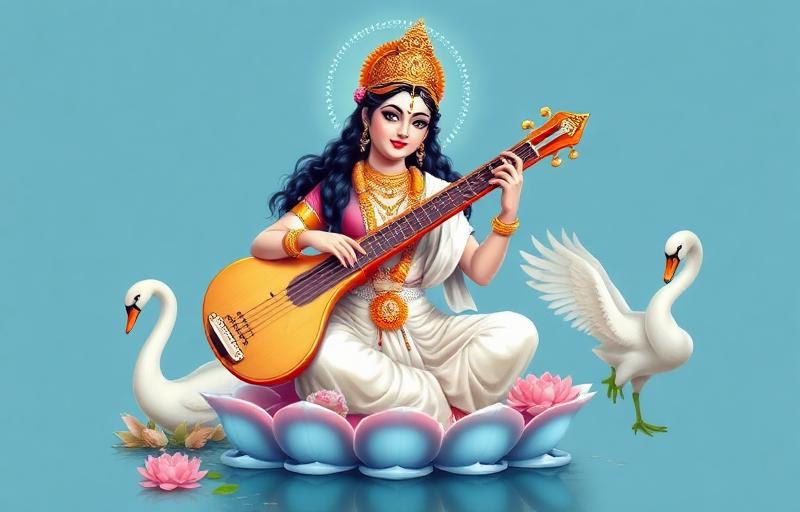
- She holds the veena, the book and the mala, and rides or is accompanied by a swan or a peacock
Reading her image:
- White clothing and white ornament, for purity and for the absence of ostentation
- The veena, for music and for the tuning of the instrument, which is a standard metaphor for the disciplined mind
- The book or palm leaf manuscript, for learning that is recorded rather than merely remembered
- The akshamala, the rosary, for repetition and practice
- The hamsa, the swan or goose, which in the tradition can separate milk from water, and is therefore the emblem of viveka, discrimination between what is true and what is not
- She sits on a white lotus, and is generally not shown with wealth or weapons
What she is asked for. The traditional requests are specific and worth knowing.
- Learning and success in study
- Clarity of speech and expression
- Success in examinations, which is a very large part of her practical worship in modern India
- Skill in music, writing and performance
- Removal of jadya, dullness or mental sluggishness
The Saraswati Vandana. The verse beginning Ya Kundendu Tushara Hara Dhavala is the most widely recited Saraswati prayer in India and is used at the start of school assemblies and performances across the country. Learning it is a reasonable thing to do before visiting Basara.
The Godavari at Basara
The temple stands on the Godavari, and the river is part of what the visit is.
The Godavari:
- India's second longest river, after the Ganga
- Rises at Trimbakeshwar near Nashik in Maharashtra
- Runs east across the Deccan through Maharashtra and Telangana
- Cuts through the Eastern Ghats at Papikondalu
- Forms its delta in coastal Andhra and reaches the Bay of Bengal
- Called the Dakshina Ganga, the Ganga of the south
At Basara, the river runs along the town and devotees bathe before darshan.
Why the Dakshina Ganga. The comparison is not simply flattery, and the parallels are structural.
- Both rise in a sacred hill region and are associated with Shiva at their source, Gangotri and Trimbakeshwar
- Both run through a long inhabited plain and carry the agriculture of a large region
- Both have a twelve year Pushkaram or Kumbh cycle
- Both are lined with tirthas along their whole course
- Both are used for last rites and immersion
Godavari Pushkaram. Once every twelve years, when Jupiter enters Simha, the Godavari Pushkaram is held and very large numbers bathe along the entire length of the river, at Nashik, Nanded, Basara, Dharmapuri, Bhadrachalam and Rajahmundry.
Other Godavari temples in Telangana:
- Dharmapuri, with its Lakshmi Narasimha temple, on the river
- Kaleshwaram, at the confluence with the Pranahita
- Bhadrachalam, the great Rama temple, further downstream
- Nanded, in Maharashtra upstream, with the Sikh Takht Sachkhand Sahib
A note on the river's condition. The Godavari, like most Indian rivers, carries a significant pollution load in stretches, from sewage, industrial discharge and immersion waste, and flow is affected by the large number of dams and barrages along it.
That is worth knowing before bathing, particularly with a small child, which many visitors to Basara have with them. Bathe at the ghats, in shallow water, keep the water out of the mouth and eyes, and do not bathe a very young child in river water at all.
The Basara region. The town is close to the Maharashtra border in a part of Telangana that few visitors see.
- Nirmal, the district town, known for its Nirmal paintings and lacquered wooden toys, a craft tradition with a GI tag
- Basar is also the site of a major state technology university, so the town has a substantial student population, which is a pleasing thing for a Saraswati temple to have grown alongside
- Nizamabad, Adilabad and the Kawal tiger reserve are within reach
- Nanded and the Maharashtra border are close
Visiting Basara
Getting there
- Basara, Nirmal district, Telangana, on the Godavari
- Basar has its own railway station on the Secunderabad to Manmad line
- About 200 km from Hyderabad and roughly 35 km from Nizamabad
- Hyderabad is the nearest major airport
- Buses run from Nizamabad, Nirmal and Hyderabad
Timings
- The temple opens early, before dawn, and runs through the day with a break. Check current timings
Sevas
- Akshara Abhyasam is the principal seva and can be booked
- Other sevas include archana, abhishekam and Saraswati puja
- Book through the official temple system where possible, particularly around Vasant Panchami
- Accommodation is available through the temple and in the town
When to go
- Vasant Panchami, in Magha, January or February, which is the principal festival and extremely crowded
- Vijayadashami, at the end of Navratri
- Maha Shivaratri and the other festivals
- Ordinary weekdays if you are bringing a child for Akshara Abhyasam and want it to be unhurried, which is a serious recommendation
- October to February for weather
Bringing a child
- The ceremony is short but the day is long. Plan for waiting
- Bring food, water, a change of clothes and something to occupy a small child
- Do the ceremony early in the day, before the child is tired
- Do not schedule it at the end of a long drive
- The temple is crowded and loud. A child who is frightened will not settle, so give them time in the compound first
Practicalities
- Traditional dress is expected
- The turmeric prasadam stains clothing. Be aware of it
- Facilities in the town are basic but adequate
Combining the visit
- Nirmal, about 60 km, for the painting and toy craft
- Nizamabad and the Nizamabad fort
- Kawal tiger reserve, in Adilabad district
- Nanded, in Maharashtra, about 130 km, with Takht Sachkhand Sri Hazur Sahib
- Dharmapuri, on the Godavari, with its Narasimha temple
- Hyderabad, at a distance, as the base for the region
A closing thought. Most temples exist because somebody wanted something and got it, and came back to say so.
Basara exists for a different reason. Families come here at the beginning, before the child can read, before anybody knows whether they will do well or badly, before there is anything at all to report.
They hold a small hand, write one letter in a plate of rice, and go home. It is among the most hopeful things done at any Indian temple, and it is done there every day of the year.
What People Ask Most
Where is the Basara Saraswati temple?+
At Basara in Nirmal district, Telangana, on the bank of the Godavari near the Maharashtra border. Basar has its own railway station on the Secunderabad to Manmad line, is about 200 km from Hyderabad and roughly 35 km from Nizamabad, with Hyderabad the nearest major airport.
What is Akshara Abhyasam?+
The ceremony at which a child, generally between two and five, is formally started on reading and writing. A plate of rice is placed before the deity, a parent or elder holds the child's index finger, and together they trace a letter or mantra such as Om. It is performed on Vasant Panchami, Vijayadashami and, at Basara, any day of the year.
Why are Saraswati temples so rare?+
Because her worship is domestic and institutional rather than pilgrimage based. She is asked for learning, which is sought over years rather than at a single visit, and not for the health, marriage, children and relief that fill temples. A deity worshipped daily at home and annually at school does not generate the flow of vows that builds a large temple economy.
What is the katha of Basara?+
After the Mahabharata war, Vyasa was unsettled by what he had witnessed and composed, and came to this spot on the Godavari to undertake penance. Each day he carried three handfuls of sand from the river and from them formed images of Saraswati, Lakshmi and Kali. The place took his name, Vyasara, which became Basara.
What is the turmeric at Basara?+
The image of Saraswati is covered with turmeric paste, renewed continuously so the image carries a thick coating, and devotees receive a small quantity as prasadam. It is taken as conferring intelligence and clarity and is given to children particularly. Note that it stains clothing.
How should I plan an Akshara Abhyasam trip with a small child?+
Book the seva in advance, come on an ordinary weekday rather than Vasant Panchami if the date does not matter to you, and do the ceremony early in the day. Bring food, water, a change of clothes and something to occupy the child. Do not schedule it at the end of a long drive, and give the child time in the compound before the ceremony.
About the author
Pandit Ravindra Sharma · Vedic Rituals & Bhakti, 22+ years
Pandit Ravindra is the Vandnaa editorial team's resident specialist on aarti, chalisa, and daily devotion. He has performed home and temple pujas across Varanasi and Delhi for over two decades and contributes the bhakti-focused articles on this site.
Meet the Vandnaa editorial team →