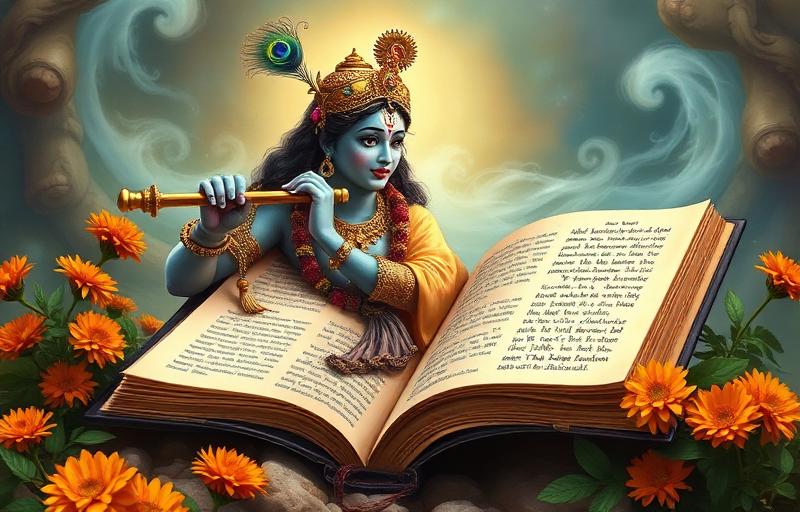
The Setting: Arjuna's Request to See the Divine Form
Moved by Krishna's earlier descriptions of his own glories and all-pervading nature, Arjuna makes a bold request, he wishes to see Krishna's universal, cosmic form (vishwarupa) with his own eyes, not merely hear of it in words.
Krishna grants this wish, but explains that ordinary human eyes cannot perceive this form, so he grants Arjuna divya chakshu, a special divine eye, through which alone such a vision becomes possible. This moment is one of the most dramatic in the entire Gita, a rare and direct divine revelation granted in the middle of an unfinished conversation.
The Core Theme: The Boundless, Awe-Inspiring Divine
Arjuna beholds an overwhelming form, countless mouths, eyes, arms and faces, blazing like a thousand suns, containing within it the entire universe, all gods, all beings, all worlds. He sees warriors from both armies rushing into Krishna's fearsome, flaming mouths, a terrifying vision of time itself devouring all creation.
This vision teaches that beyond Krishna's gentle, personal form as friend and charioteer lies an unimaginable cosmic reality, the source and destroyer of all things. Arjuna is filled with awe and also fear, realizing the sheer scale of the being he has been speaking with so familiarly, and he begs forgiveness for any past casualness in their friendship.
Key Teachings Explained Simply
- Divi surya-sahasrasya bhaved yugapad utthita - if the splendor of a thousand suns were to blaze forth together in the sky, that might resemble the brilliance of this cosmic form, a famous verse conveying the vision's overwhelming radiance.
- Krishna declares Kalo 'smi loka-kshaya-krit pravriddhah, I am time, the great destroyer of the worlds, come to annihilate all beings, revealing his role beyond creation as the force of time itself.
- Arjuna, terrified and awestruck, praises Krishna with trembling hands, asking forgiveness for having treated him casually as a friend, unaware of this true, immense majesty.
- Krishna reassures Arjuna that this cosmic form cannot be seen through ritual, scripture study or austerity alone, only through single-minded devotion (ananya bhakti) can one truly know and enter into him, after which he mercifully returns to his gentle, familiar form to comfort Arjuna.
How This Chapter Answers Arjuna's Dilemma

Arjuna's original grief centered on being the cause of death for people he loved. The vishwarupa reveals a profound truth, these warriors are already destined for death within the vast unfolding of time and cosmic order, whether or not Arjuna acts.
Krishna tells Arjuna directly that he himself has already slain these warriors in a cosmic sense, and Arjuna is merely to be an instrument (nimitta) in that unfolding. This does not remove Arjuna's responsibility, but it reframes his role, easing the unbearable weight of feeling personally, solely responsible for the war's outcome.
Practical Relevance Today
The vishwarupa reminds devotees today of the vastness of the divine beyond any single image or idea they may hold, encouraging humility in approaching faith. It also offers perspective during personal crises, our part in events, however significant it feels, exists within a much larger order.
Krishna's return to his gentle form after the overwhelming vision reassures devotees that the divine, however infinite, remains approachable and personal in daily worship, not distant or only fearsome.
The Takeaway
Vishwarupa Darshan Yoga reveals the staggering, boundless nature of the divine, containing all creation and time itself, while showing that this vastness returns, mercifully, to a familiar and lovable form for the devotee. Beholding the divine in awe and returning to intimate devotion is, tradition holds, an act of faith and love, not a transaction.
What People Ask Most
What is Vishwarupa Darshan Yoga?+
Vishwarupa Darshan Yoga is Chapter 11 of the Bhagavad Gita, describing Arjuna's vision of Krishna's cosmic, universal form, granted through a special divine eye, showing the boundless magnitude of the divine within which all creation exists.
Why did Arjuna need a divine eye to see this form?+
Krishna explains that his universal form cannot be perceived with ordinary human eyes. So he grants Arjuna divya chakshu, a special divine vision, without which the overwhelming vastness of the vishwarupa would remain invisible.
Why did Krishna say 'I am time, the destroyer of worlds'?+
Krishna reveals this to show that beyond his gentle personal form, he is also the cosmic force of time that brings all beings to their eventual end. This helped Arjuna understand that the warriors' fate was already part of a much larger order.
About the author
Anjali Mehta · Editor, M.A. Religious Studies
Anjali is the managing editor for Vandnaa and oversees the festival and vrat coverage. She holds an M.A. in Religious Studies and reviews every published article for accuracy, accessibility, and tradition-fidelity.
Meet the Vandnaa editorial team →