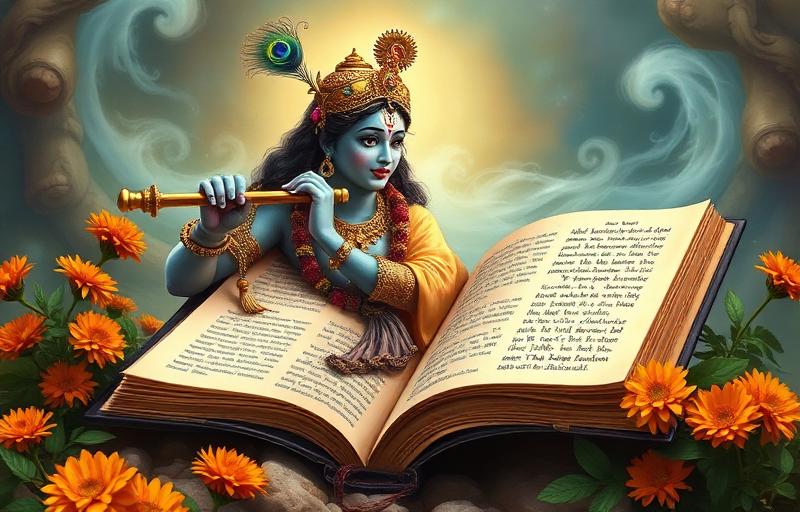
The Setting: Krishna Begins to Reveal Himself
Having taught Arjuna the disciplines of action and meditation, Krishna now begins a new phase, describing his own divine nature directly. He tells Arjuna that among thousands of people, scarcely one strives for perfection, and among those who strive, scarcely one truly comes to know him in essence.
This chapter marks a shift from how to act and meditate, toward who and what the object of true devotion actually is. Krishna promises to explain this knowledge (jnana) together with realized wisdom (vijnana) so completely that nothing more remains to be known.
The Core Theme: The Divine Behind All Creation
Krishna teaches that he is the essence within all things, the taste in water, the light in the sun and moon, the fragrance in earth, and the intelligence in the intelligent. Nothing exists apart from him, though he remains subtler and greater than his own creation.
He also explains maya, his divine, mysterious power that makes it difficult for beings to recognize him behind the play of the material world's three gunas, or qualities. Yet Krishna assures Arjuna that those who surrender to him alone can cross beyond this maya, and he describes four types of virtuous people who turn to him: the distressed, the seeker of knowledge, the seeker of wealth, and the wise, the last being dearest to him for their pure, unwavering devotion.
Key Teachings Explained Simply
- Raso 'ham apsu Kaunteya - I am the taste in water, O Kaunteya, Krishna's poetic way of teaching that the divine pervades ordinary experience, not just grand miracles.
- Krishna describes his lower nature, the material elements of earth, water, fire, air, ether, mind, intellect and ego, and his higher nature, the very life force sustaining the universe.
- Among the four types of devotees, the jnani, the wise one who knows Krishna as the all, is called Krishna's very own self, extremely dear for a devotion free of worldly demand.
- Krishna states plainly that those who worship other lesser deities with faith are, knowingly or not, ultimately reaching toward him, though such worship yields limited, worldly results compared to devotion aimed directly at the Supreme.
How This Chapter Answers Arjuna's Dilemma
Arjuna's crisis was, at its root, a crisis of perspective, seeing the war only through the narrow lens of family loss. By revealing that Krishna pervades all of creation and stands behind every event, this chapter widens Arjuna's vision far beyond the battlefield.
Understanding that even hardship unfolds within the divine's larger presence helps Arjuna trust that his difficult duty is not separate from, but held within, a greater sacred order, easing the sense of being alone in an impossible situation.
Practical Relevance Today
The teaching that the divine can be sensed in ordinary things, taste, light, fragrance, encourages devotees today to find sacredness in daily life rather than only in temples or grand rituals, deepening everyday gratitude.
The four types of devotees also offer a compassionate lens for understanding one's own spiritual journey. Whether someone turns to faith out of distress, curiosity, ambition or wisdom, tradition holds that all sincere approaches are honored, though the path deepens as devotion matures.
The Takeaway
Jnana Vijnana Yoga teaches that the divine pervades every corner of creation, that maya can be crossed through surrender, and that all sincere devotion is valued even as it matures toward pure wisdom. Recognizing the sacred within the ordinary is, tradition holds, an act of faith and love, not a transaction.
What People Ask Most
What is the difference between jnana and vijnana in this chapter?+
Jnana refers to theoretical or scriptural knowledge of the divine, while vijnana refers to realized, experiential wisdom of that same truth. Krishna promises to explain both together so Arjuna's understanding becomes complete.
What is maya according to Krishna in Chapter 7?+
Maya is described as Krishna's divine, mysterious power, made of the three gunas, which makes it difficult for ordinary beings to see the divine reality behind the material world. Krishna says this maya can be crossed through sincere surrender to him.
Who are the four types of devotees mentioned in Chapter 7?+
Krishna names the distressed, the seeker of knowledge, the seeker of wealth, and the wise as four types of virtuous people who turn toward him. He states the wise devotee, who sees him in everything, is especially dear to him.
About the author
Anjali Mehta · Editor, M.A. Religious Studies
Anjali is the managing editor for Vandnaa and oversees the festival and vrat coverage. She holds an M.A. in Religious Studies and reviews every published article for accuracy, accessibility, and tradition-fidelity.
Meet the Vandnaa editorial team →