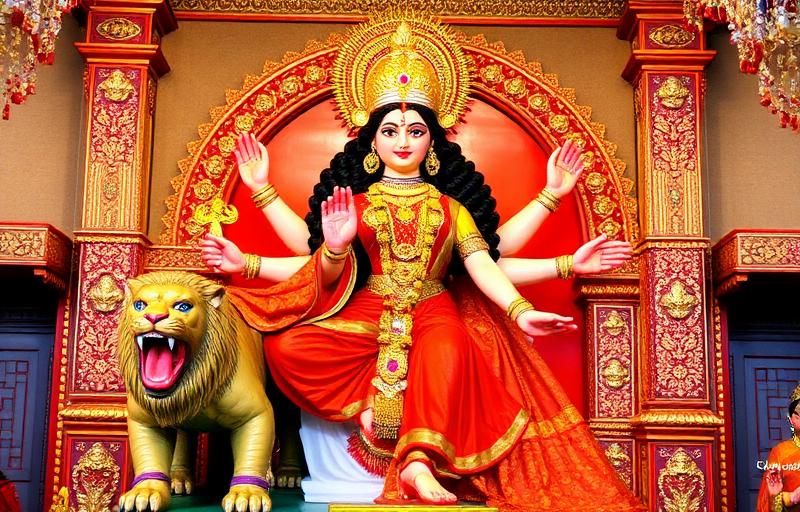
What Is Kanya Pujan
Kanya Pujan, also called Kumari Puja, is a cherished tradition observed during Navratri, most commonly on Ashtami or Navami, in which young girls, typically before the age of ten, are invited into the home, honoured with ritual worship, fed a festive meal, and given small gifts before touching their feet in respect.
Devotees consider these young girls, for the duration of this ritual, to be living representations of the Devi herself, each often associated with one of her forms depending on age, from Kumari to Malini and beyond in regional traditions.
Origin and Devotional Meaning
The practice draws from the broader Shakta belief that the Devi's presence is not confined to temples or idols but is alive in the world, including in the innocence and purity that tradition associates with childhood. A young girl, unburdened by worldly complexity, is seen as an especially clear vessel for the Devi's presence.
Some traditions trace an association with the Devi Mahatmya's closing verses, where the Goddess promises to be present wherever she is remembered with devotion, and Kanya Pujan is understood by many devotees as one tangible way of honouring that promise, seeing the divine in a living, breathing form.
How Kanya Pujan Is Performed
- Girls, usually two to nine or an odd number according to family custom, are invited and welcomed with their feet washed as a mark of respect.
- A tilak is applied on their forehead and a kalava (sacred thread) tied on the wrist.
- A festive meal, often including puri, halwa and chana, is served with care, echoing the offerings made to the Devi herself.
- Small gifts, sometimes clothes, coins or stationery, are given before the girls are asked for their blessing and their feet are touched.
Many families also include a young boy, honoured as Langoor or Bhairav, alongside the girls, completing the traditional set of the ritual.
Regional Flavours of the Tradition
While the core spirit remains the same, the day and exact customs vary regionally, many North Indian households perform it on Ashtami, while others prefer Navami. In parts of South India, a related tradition honours young girls during Bommai Golu displays with small gifts and sweets.
Across regions, the underlying devotion remains consistent, treating a child with the same reverence, care and humility one would offer the Devi in a temple.
The Takeaway
Kanya Pujan reminds devotees that the Devi's presence can be honoured not only in temples and idols but in the living innocence around them. Treating a young girl with reverence during this ritual is an offering of faith and humility, a reminder to see the divine everywhere, never a transaction.
Quick Answers
When is Kanya Pujan performed during Navratri?+
It is most commonly performed on Ashtami or Navami, the eighth or ninth day of Navratri, though the exact day can vary by family and regional custom.
How many girls are typically invited for Kanya Pujan?+
The number varies by family custom, often between two and nine, sometimes including a young boy honoured as Langoor or Bhairav alongside the girls.
What is the significance behind worshipping young girls?+
Tradition regards young girls as pure, unburdened vessels reflecting the Devi's presence. Honouring them during Navratri is seen as a tangible way of revering the Divine Feminine present in everyday life.
About the author
Pandit Mahesh Trivedi · Festival Traditions & Panchang
Pandit Mahesh leads the festival-date and Panchang content on Vandnaa. He cross-references multiple regional panchangs (Drik, Vaishnava, Bengali, Marathi) for every festival date published on the site.
Meet the Vandnaa editorial team →