Older Than the City
The Karmanghat Hanuman temple stands in the south east of Hyderabad, in what is now a dense urban neighbourhood, and it is among the oldest shrines in the city.
What is there:
- Hanuman, in a seated posture, which is unusual
- A temple complex that has grown a great deal in recent decades
- Subsidiary shrines
- A very large weekly traffic, particularly on Tuesdays and Saturdays
The chronology. This is the fact that makes the temple interesting.
- The temple is traditionally dated to the twelfth or thirteenth century, in the Kakatiya period
- Hyderabad was founded by Muhammad Quli Qutb Shah in 1591
- So the temple predates the city by around three hundred years
- When the city was founded, this was forest and open country outside it
- The city grew until it reached the temple, and then past it
The seated Hanuman. Most Hanuman images are standing, striding, flying, kneeling before Rama, or shown carrying the mountain.
A seated Hanuman, in a meditative or resting posture, is much less common, and the form here is one of the temple's distinguishing features.
The name. Karmanghat is derived, in the traditional account, from an incident described below, in which a phrase spoken at the temple became its name.
Why the temple matters in Hyderabad. It is one of the points at which the city's pre Islamic layer is visible.
Hyderabad is understood, correctly, as a Qutb Shahi and later Asaf Jahi foundation, with an architectural and cultural character shaped by those courts. The Charminar, Golconda, the Qutb Shahi tombs and the whole Deccani Urdu tradition are the city's signature.
Under and around that is an older Telugu Hindu landscape, of which this temple, along with the older shrines at Secunderabad and the rock hills, is a surviving part.
The Katha of the Hunting King
The temple's origin story is one of the more atmospheric in the Deccan.
As it is told:
- A Kakatiya king, generally named as Prataparudra, was hunting in the forest that covered this area
- Tired, he rested under a tree
- He heard the sound of chanting, Jai Sri Ram, coming from somewhere nearby, with nobody visible
- Following the sound, he found an image of Hanuman in the undergrowth
- That night, in a dream, Hanuman instructed him to build a temple at the place
- The king did so
What the story is doing. Several standard elements are present and each carries meaning.
- The forest setting, which places the deity outside settled society and before it
- The hunt, which is how kings encounter the sacred in a great many Indian stories
- The sound before the sight, which is a specifically Hanuman element, since he is the deity of the recited name
- The dream instruction, which transfers responsibility for the temple to the ruler
- The image found in the ground, which makes it swayambhu and not installed
The sound detail is the good one. Hanuman is found not by seeing him but by hearing the name of Rama being chanted with nobody there.
That is a precise piece of theology in narrative form. Hanuman is the one who repeats the name. The tradition holds that wherever the Ramayana is recited, Hanuman is present listening, which is why an empty seat is sometimes kept for him at a recitation.
So a king hearing chanting in an empty forest and finding Hanuman there is the story telling you exactly what this deity is.
The second story, and the name. A later episode is attached to the temple and accounts for its name.
As it is told:
- During the Mughal period, Aurangzeb, campaigning in the Deccan, is said to have ordered the temple demolished
- Soldiers were sent
- A voice was heard from the temple
- The soldiers were unable to proceed, and in some tellings were struck down or fled
- The phrase heard, or the phrase Aurangzeb subsequently used, is given as kar man ghat, understood as make your heart hard or harden your heart
- The name Karmanghat is derived from it
How to hold this story. Honestly, and with a few things said clearly.
- Aurangzeb did campaign extensively in the Deccan and did spend his last decades there, dying at Khuldabad in 1707
- Temple destruction under his reign is documented in some cases and is a real part of the historical record
- Stories of failed destruction, in which a temple is saved by divine intervention, are attached to a great many Indian temples, in numbers far exceeding any documented incidents
- Such stories are told about various rulers and are a recognisable narrative type
- Whether anything of the kind occurred here is not established by any source outside the temple's own tradition
What such stories are for. They serve a community that experienced real destruction elsewhere and needed to account for why their own shrine survived.
That is a genuine historical function and it should be understood as such, rather than either accepted as documentation or dismissed as fabrication.
And a note on using them. Stories of this kind are used in present day India to make claims about communities living now.
That is a misuse. A story about a seventeenth century emperor tells you nothing about your neighbour, and a temple that has stood in a mixed city for eight hundred years is evidence of coexistence rather than of anything else.
The City That Grew Around It
Karmanghat is now surrounded by Hyderabad, and the process by which that happened is worth describing because it is the story of every old shrine in every Indian city.
The sequence:
- A shrine is established outside a settlement, in forest, on a hill, at a tank or at a boundary
- The settlement grows toward it
- The shrine becomes a landmark at the edge, then a place people pass
- Development reaches it and surrounds it
- The shrine becomes an island in the built fabric, with its original setting entirely gone
- The neighbourhood takes the shrine's name, as Karmanghat has
What is lost:
- The setting, which was often the reason for the site. A forest shrine in a residential colony is not doing what it was built to do
- The approach, which was part of the experience. Walking to a temple through open country is different from turning off a main road
- The silence
- Frequently the water, since tanks are built over
- The trees, which were often the shrine itself in origin
What is gained:
- Accessibility, which is not nothing. A temple in a city is used by far more people
- Resources, since an urban congregation can fund maintenance a village cannot
- Continuity, since a temple that becomes a neighbourhood's identity is unlikely to be abandoned
Hyderabad's other absorbed shrines:
- Karmanghat Hanuman, this one
- Jagannath temple and various modern foundations, which are different in kind
- The Ujjaini Mahankali temple at Secunderabad, founded in the nineteenth century after a cholera epidemic, whose Bonalu festival is now the city's largest Hindu observance
- Peddamma temple at Jubilee Hills
- Numerous small grama devata shrines swallowed by the city's expansion, still visible at road junctions and under trees across Hyderabad
Bonalu. Since it comes up whenever Hyderabad's temples are discussed, it is worth a paragraph.
- A Telangana festival held in Ashada, generally July
- Women carry bonam, a pot of cooked rice with milk and jaggery, on their heads to the goddess
- Observed principally at Mahankali temples, with Secunderabad's Ujjaini Mahankali and the Golconda and Lal Darwaza temples as the principal sites
- The Rangam, in which a woman becomes the vehicle of the goddess and delivers prophecy, is performed
- It is now a state festival with official patronage and draws very large numbers
Its origin is generally traced to a cholera epidemic in the nineteenth century, after which the goddess was petitioned and the festival established in thanksgiving.
That is a useful reminder that not every important festival is ancient. Bonalu is around two centuries old, arose in response to a specific public health disaster, and is now central to Telangana's identity.
The grama devata layer. Across Telangana and the Telugu country, the older layer of worship is the village goddess, the grama devata, and these shrines are everywhere once you learn to see them.
- Pochamma, Maisamma, Ellamma, Peddamma, Mutyalamma and many others
- Usually at the village boundary or under a specific tree
- Often a stone rather than an anthropomorphic image
- Served by non brahmin priests from specific communities
- With their own festivals, their own animal offerings in some places, and their own relationship with the community
These are older than the temple traditions built above them, and in Telangana they remain vigorously alive.
Hyderabad's Layers
A visitor to Karmanghat is in a city with an unusually legible history, and it is worth knowing the sequence.
The layers:
- Kakatiya and earlier Telugu Hindu settlement, of which Karmanghat and the rock hills are the visible remains
- Golconda under the Bahmanis and then the Qutb Shahis, from the fourteenth century, when the fort city was built
- Hyderabad proper, founded in 1591 by Muhammad Quli Qutb Shah when Golconda ran short of water, with the Charminar at its centre
- Mughal conquest in 1687 under Aurangzeb
- The Asaf Jahi dynasty, the Nizams, from 1724, ruling as a Mughal successor state and then as a princely state under the British
- 1948 and the accession of Hyderabad State to India
- The post 1956 reorganisation, the capital of Andhra Pradesh, and from 2014 the capital of Telangana
What each layer left:
- Golconda fort, the Qutb Shahi tombs, and the Charminar, Mecca Masjid and Char Kaman from the Qutb Shahi period
- The Falaknuma, Chowmahalla and King Kothi palaces, the Salar Jung collection, Osmania University and Osmania General Hospital from the Nizams
- The Deccani Urdu literary tradition, which is distinct from the north Indian one
- A food culture, including the Hyderabadi biryani, haleem in Ramzan and the Irani cafes, which is the city's most exported product
- Temples of the older layer, of which Karmanghat is one
The city's character. Hyderabad has a long standing reputation as a place where communities lived alongside each other, and it is a reputation with a real basis and also with real exceptions.
- The Qutb Shahi court employed Telugu Hindus at senior levels and the state used Telugu as well as Persian
- Telugu literary patronage under the Qutb Shahis is documented, and Muhammad Quli Qutb Shah himself wrote poetry in Dakhni
- The Nizam's state was a Muslim ruled state with a large Hindu majority population, and the tensions inherent in that produced serious violence around 1947 and 1948, in which very large numbers were killed
- The city today is mixed, and Hyderabad's communal history is neither the untroubled harmony of the tourist brochure nor the unrelieved conflict of the partisan account
What that means for a visitor to Karmanghat. You are at a Hindu temple older than the Muslim founded city that grew around it, in a neighbourhood named after it, in a state whose emblem is a Kakatiya gateway, in a city whose signature building is a Qutb Shahi one.
All of that is true simultaneously. Any account of Hyderabad that requires you to pick one layer and discard the others is telling you less than the city is.
Where to see the layers in a day:
- Morning at Karmanghat or another old temple
- Golconda fort and the Qutb Shahi tombs
- The Charminar, Mecca Masjid and the Laad Bazaar
- Chowmahalla palace
- The Salar Jung museum, which is one of the great collections in India and is under visited
- Ujjaini Mahankali at Secunderabad
- Evening at Hussain Sagar or Necklace Road
The Forms of Hanuman
The seated Hanuman at Karmanghat is one of a number of distinct iconographic forms, and learning them makes every Hanuman shrine more legible.
The principal forms:
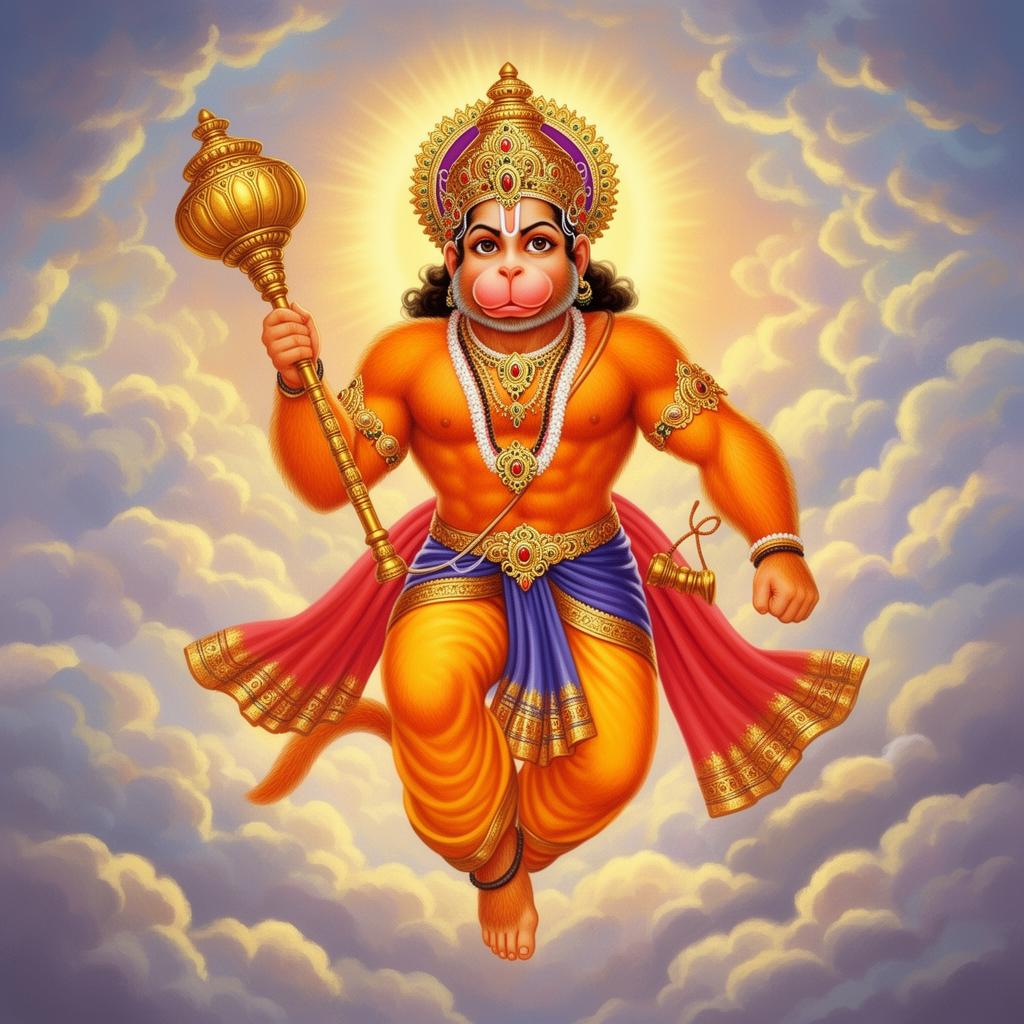
- Veera Anjaneya, the heroic form, standing, often with a mace, striding or in a fighting posture. The commonest
- Dasa Anjaneya or Bhakta Hanuman, kneeling or standing with folded hands before Rama, in the servant posture
- Sanjeevani Hanuman, flying with the mountain in one hand, which is the most narratively specific
- Panchamukha Hanuman, the five faced form, with the faces of Hanuman, Narasimha, Garuda, Varaha and Hayagriva, associated with a specific episode in the Ramayana traditions and used in tantric practice
- Dhyana or seated Hanuman, in meditation, which is the form here
- Abhaya Anjaneya, with the hand raised in the gesture of fearlessness
- Vishwaroopa, the cosmic form
What the seated form says. Every other form shows Hanuman doing something. This one shows him still.
- The seated posture is that of meditation and of the deity who has completed his work
- In the tradition Hanuman is a chiranjivi, one of the immortals, who remains on earth through the ages
- He is understood to be present wherever Rama's name is recited, listening
- A seated Hanuman is that Hanuman, the one who is waiting and attending rather than acting
That is a considerably more contemplative deity than the striding warrior, and it suits a temple whose origin story is about a king hearing chanting in an empty forest.
The chiranjivis. Hanuman is one of seven or eight figures the tradition holds to be immortal and still present.
- Hanuman
- Ashwatthama, cursed to wander
- Vibhishana, Ravana's brother
- Vyasa
- Kripacharya
- Parashurama
- Mahabali, who returns annually at Onam
- Markandeya in some lists
Why that matters devotionally. Most deities are approached as present in an image or a place. Hanuman is approached as present in a more literal sense, as somebody who is actually here, listening, at this moment.
That is the reason for the empty seat at Ramayana recitations, for the belief that he attends every reading, and for the particular intimacy of Hanuman devotion compared with worship of the great cosmic deities.
Practical worship:
- Tuesdays and Saturdays
- Hanuman Chalisa, forty verses, recited daily by very large numbers
- Sundara Kanda, the fifth book of the Ramayana, which is Hanuman's book and is recited as a complete unit for protection and for the resolution of difficulties
- Sindoor and oil
- Vada mala, a garland of vadas, in the south
- Betel leaves
- Bananas and jaggery
On Sundara Kanda parayanam. Reciting the Sundara Kanda over a fixed period, often nine days, is one of the most widespread devotional practices in the Telugu country and is undertaken specifically when a family is facing a difficulty.
It is the book in which Hanuman crosses the ocean, finds Sita, delivers Rama's message, is captured, burns Lanka and returns. It is a story about somebody completing an apparently impossible task alone, and that is exactly why it is read when things are hard.
Visiting Karmanghat
Getting there
- Karmanghat, south east Hyderabad, Telangana
- Off the Inner Ring Road, near Santoshnagar and Saroornagar
- About 10 km from the Charminar and roughly 15 km from Secunderabad
- Hyderabad metro does not reach it directly; buses and autos do
- Rajiv Gandhi International Airport is about 25 km
Timings
- The temple opens early and runs through the day with a break. Check locally
- Timings extend on Tuesdays and Saturdays
When to go
- Tuesdays and Saturdays if you want the temple at its most active, which also means at its most crowded
- Hanuman Jayanti, on Vaisakha Bahula Dasami in the Telugu calendar, generally May
- Ordinary weekday mornings for a quiet darshan
- October to February for weather
Practicalities
- Traditional dress is appropriate
- Footwear is left outside
- Traffic in this part of Hyderabad is heavy. Allow time
- Prasadam and offering materials are available at the temple
What to look at
- The seated form of the deity, which is the temple's distinguishing feature
- The older fabric, where visible under the modern expansion
- The subsidiary shrines
Combining the visit
- Charminar, Mecca Masjid and Laad Bazaar, about 10 km
- Golconda fort and the Qutb Shahi tombs
- Salar Jung museum
- Chowmahalla palace
- Ujjaini Mahankali at Secunderabad
- Birla Mandir on Naubat Pahad, a modern marble temple with the best view of the city
- Chilkur Balaji, on the outskirts, known as the visa temple, where devotees circumambulate 108 times and which accepts no money at all
- Keesaragutta, about 30 km
- Yadagirigutta, about 60 km
Chilkur deserves a note. The Chilkur Balaji temple near Hyderabad has an explicit policy of accepting no donations, no hundi and no paid darshan, which is close to unique among busy Indian temples.
Devotees make eleven circumambulations to make a vow and 108 to fulfil it. It became known as the visa temple because of the number of students petitioning for study abroad, which is a very contemporary use of a very old practice.
Whether or not the visa association appeals to you, a large temple that has refused money on principle for decades is worth seeing, because it demonstrates that the alternative arrangement is possible.
A closing thought. Karmanghat is a small point of continuity in a city that has changed hands, languages, rulers and countries repeatedly.
The forest is gone, the Kakatiyas are gone, the Qutb Shahis are gone, the Mughals are gone, the Nizams are gone, Andhra Pradesh is gone as it was, and there is a temple in a traffic filled neighbourhood in south east Hyderabad where somebody is still lighting a lamp on Tuesday evening.
Common Questions From Devotees
Where is the Karmanghat Hanuman temple?+
In south east Hyderabad, off the Inner Ring Road near Santoshnagar and Saroornagar, about 10 km from the Charminar and roughly 15 km from Secunderabad. The metro does not reach it directly but buses and autos do, and the airport is about 25 km away.
Is the temple older than Hyderabad?+
Yes. The temple is traditionally dated to the twelfth or thirteenth century in the Kakatiya period, while Hyderabad was founded by Muhammad Quli Qutb Shah in 1591, so the temple predates the city by around three hundred years. When the city was founded this was forest outside it, and the city later grew around and past the shrine.
What is the katha of Karmanghat?+
A Kakatiya king, generally named as Prataparudra, was hunting in the forest here and rested under a tree. He heard chanting of Jai Sri Ram with nobody visible, followed the sound, and found an image of Hanuman in the undergrowth. Hanuman instructed him in a dream to build a temple at the place, and he did.
Where does the name Karmanghat come from?+
A tradition holds that Aurangzeb, campaigning in the Deccan, ordered the temple demolished, that soldiers sent for the purpose were unable to proceed, and that the phrase kar man ghat, understood as harden your heart, was spoken. Stories of failed destruction are attached to a great many Indian temples and are a recognisable narrative type rather than documentation.
Why is the Hanuman here seated?+
Most Hanuman images are standing, striding, flying with the mountain or kneeling before Rama. A seated meditative Hanuman shows him still rather than acting. In the tradition Hanuman is a chiranjivi, an immortal who remains on earth and is present wherever Rama's name is recited, listening, and the seated form is that Hanuman, the one attending rather than acting.
What is Bonalu?+
A Telangana festival held in Ashada, generally July, in which women carry bonam, a pot of cooked rice with milk and jaggery, on their heads to the goddess. It is observed principally at Mahankali temples, with Secunderabad's Ujjaini Mahankali the principal site, and includes the Rangam in which a woman becomes the goddess's vehicle. Its origin is traced to a nineteenth century cholera epidemic.
About the author
Pandit Ravindra Sharma · Vedic Rituals & Bhakti, 22+ years
Pandit Ravindra is the Vandnaa editorial team's resident specialist on aarti, chalisa, and daily devotion. He has performed home and temple pujas across Varanasi and Delhi for over two decades and contributes the bhakti-focused articles on this site.
Meet the Vandnaa editorial team →