Two Vrats Often Confused, Rarely Identical
Karva Chauth and Hartalika Teej are two of the most widely observed vrats for married women in North India, and because both involve a day-long fast for a husband's health and long life, people often assume they are variations of the same festival. They are not. Each has its own place on the lunar calendar, its own fasting discipline, and its own founding legend, and the two are rarely observed in the same way even in neighbouring households.
Hartalika Teej arrives first in the annual cycle, usually in August or September, and carries a reputation as one of the more physically demanding vrats in the Hindu calendar. Karva Chauth follows roughly two months later, typically in October or November, and has become the more visible of the two thanks to its widespread observance across Punjab, Haryana, Delhi, Uttar Pradesh and Rajasthan, and its frequent depiction in film and television.
Both vrats share a common thread: they are acts of shringar, prayer and endurance undertaken in devotion to the marital bond, and both draw on the model of Goddess Parvati's devotion to Lord Shiva. But a devotee preparing for either fast benefits from knowing exactly how they diverge, from the tithi they fall on to the moment the fast is finally broken. This guide sets the two side by side so the differences are easy to hold in mind before vrat season arrives. Knowing exactly which festival is approaching, and what it specifically asks of you, is the first real step toward observing it with the right preparation, rather than borrowing rituals meant for the other day entirely.
Where Each Vrat Falls on the Lunar Calendar
The clearest structural difference between the two vrats is timing. Hartalika Teej falls on Bhadrapada Shukla Tritiya, the third day of the waxing moon in the month of Bhadrapada, and it lands just one day before Ganesh Chaturthi, which is why Ganesh idols are often already in the market when Teej arrives. In 2026, this places Hartalika Teej in the August-September window.
Karva Chauth, by contrast, falls on Kartik Krishna Chaturthi, the fourth day of the waning moon in the month of Kartik, arriving roughly nine days before Diwali. This puts it firmly in the October-November window, a full lunar cycle and more away from Teej.
- Hartalika Teej: Bhadrapada, Shukla Paksha, Tritiya (waxing moon, 3rd day)
- Karva Chauth: Kartik, Krishna Paksha, Chaturthi (waning moon, 4th day)
- Gap between the two: roughly seven to eight weeks in most years
- Both are single-day observances, not multi-day festivals
This calendar distance matters practically. In many households that observe both vrats, Hartalika Teej functions as the first major fast of the wedding-season stretch that runs through autumn, while Karva Chauth arrives closer to Diwali and is often treated as the emotional high point of that stretch, given its association with the karva (earthen pot), the sieve, and the moonrise ritual that closes it. Knowing the correct tithi each year matters because both dates shift on the Gregorian calendar annually, and devotees typically confirm the exact date and moonrise time through a local panchang or a reliable app closer to the date.
The Fasting Discipline: Moonrise vs a Full Day and Night
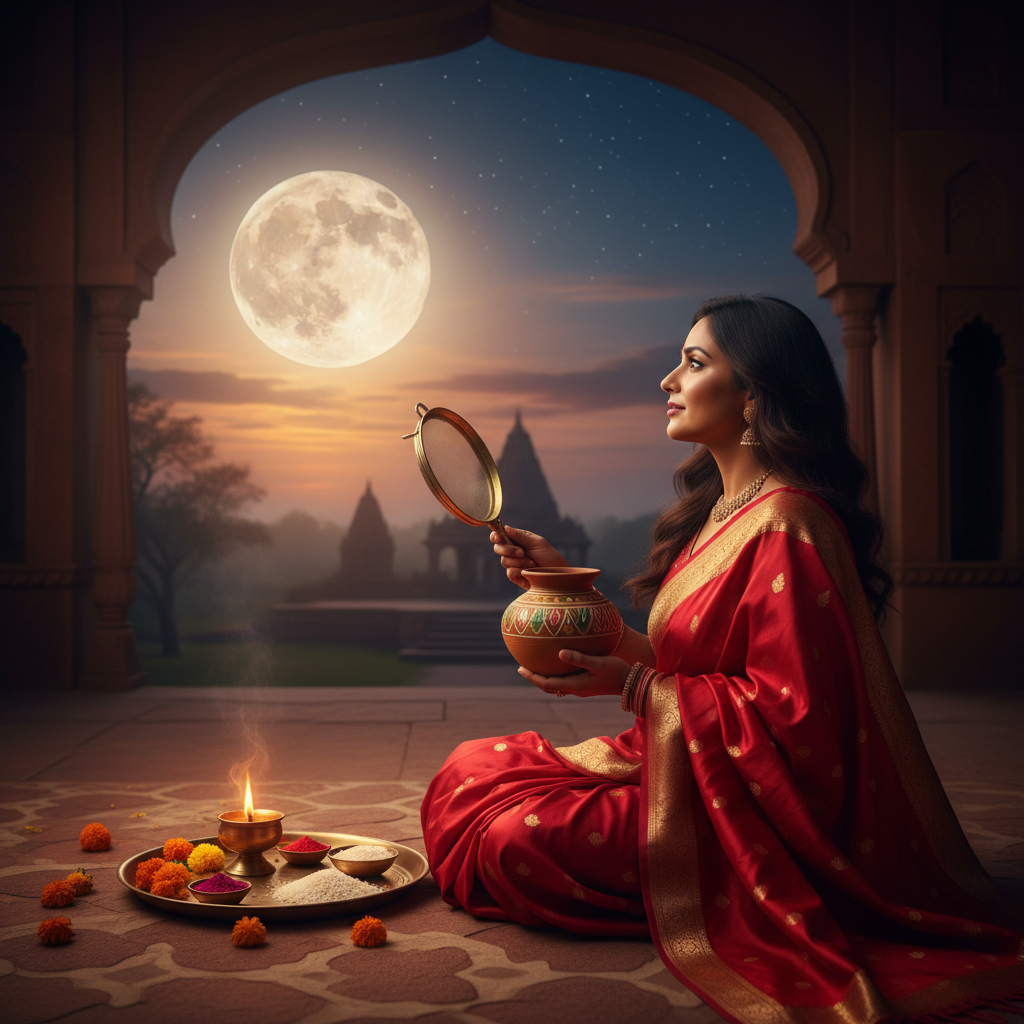
This is where the two vrats diverge most sharply, and where confusing them can genuinely mislead a first-time observer. Karva Chauth begins before sunrise with sargi, a meal traditionally sent by the mother-in-law to her daughter-in-law, eaten in the dark hours before dawn. From that point, the vrat becomes nirjala, meaning no food and no water, and it continues through the entire day. The fast is broken only after moonrise, when the woman views the moon through a sieve (chalni), then looks at her husband's face through the same sieve, after which he offers her the first sip of water and morsel of food.
Hartalika Teej is widely regarded as the more demanding of the two. Many observers begin the nirjala phase the previous evening and carry it through the entire following day and into the next morning, abstaining from both food and water for closer to twenty-four hours, though exact practice varies by family and region, and some households do permit water. A defining feature of Teej is the ratri jagran, an all-night vigil spent awake near the worshipped idols of Shiva, Parvati and Ganesh, singing bhajans and keeping watch until dawn. The fast is broken the next morning, only after the following day's puja is completed.
- Karva Chauth: sargi before sunrise, nirjala through the day, breaks at moonrise the same evening
- Hartalika Teej: nirjala often spanning a full day and night, breaks the next morning after puja
- Teej includes a mandatory overnight jagran; Karva Chauth does not
- Both are physically demanding, but Teej's duration is generally longer
Women with health conditions such as diabetes, low blood pressure or pregnancy are commonly advised by family elders and doctors alike to modify either fast with fruits or liquids rather than observe it strictly nirjala.
Different Legends Behind Each Fast
The two vrats also rest on entirely separate mythological foundations, which is part of why their rituals differ so much.
Hartalika Teej takes its name from two words: harat, meaning abduction, and alika, meaning female friend. The legend recounts how the young Parvati, determined to marry Lord Shiva against her father Himalaya's wish that she wed Lord Vishnu instead, was taken deep into the forest by her friends to escape the arranged match. There she undertook a long and severe tapasya, living without food or comfort for an extended period, until Shiva finally appeared and accepted her devotion. The vrat is a re-enactment of that penance, which is part of why it demands such physical endurance from those who observe it.
Karva Chauth draws on a different cluster of stories. The most commonly told is the legend of Veeravati, a devoted wife whose brothers, unable to watch her suffer through her first nirjala fast, tricked her into breaking it early by showing her a false moon, with tragic consequences that were only reversed through her unwavering devotion. The festival is also linked to the tale of Savitri, who won her husband Satyavan back from Yama, the god of death, through sheer determination, and to an episode in the Mahabharata where Draupadi observes the fast on Krishna's counsel to protect Arjuna during his time away.
- Hartalika Teej: rooted in Parvati's own penance to obtain Shiva as her husband
- Karva Chauth: draws on Veeravati, Savitri-Satyavan and Draupadi's fast for the Pandavas
- Both legends centre on a wife's devotion altering fate itself
- The karva (clay pot) in Karva Chauth and the sand idols in Teej each carry symbolic weight tied to these stories
How the Puja Rituals Differ
The visible rituals of each vrat reflect their different legends and different tones, one quietly domestic, the other more communal and elaborate.
On Karva Chauth, married women dress in bridal red, apply mehendi in the days before, and gather in groups to worship Goddess Gauri and Lord Ganesh in the evening. The Karva Chauth katha is read or narrated aloud, often by an elder woman, while participants pass around and exchange baya, small gifts of sweets or items placed inside the karva, the small earthen pot central to the ritual. The evening thali includes the sieve, a diya, sindoor, and often a small mirror, all used in the moonrise ritual that closes the fast.
Hartalika Teej centres on the worship of a Shiva-Parvati-Ganesh trio, traditionally shaped from clay, sand or river silt by the women themselves the evening before, rather than a purchased idol. Dressed in green or red with a full solah shringar, women perform the puja together, often at a temple or a shared community space, and remain awake through the night in jagran, singing devotional bhajans. The following morning, after a fresh round of puja, the clay idols are ceremonially immersed, mirroring the Ganesh Visarjan that follows just days later.
- Karva Chauth: red attire, Gauri-Ganesh puja, karva pot, sieve and moon-sighting ritual
- Hartalika Teej: self-made Shiva-Parvati-Ganesh idols, green attire, overnight jagran, morning visarjan
- Karva Chauth is typically a same-day, evening-centred ritual
- Hartalika Teej unfolds across an evening, a full night and the following morning
🪔 Vandnaa's app carries the vrat katha, puja vidhi and moonrise timing for both festivals in Hindi and English, so you can follow each ritual step without hunting for a printed booklet.
Which Is Tougher, and Where Each Is Most Observed
Devotees who have observed both fasts consistently describe Hartalika Teej as the more physically demanding of the two, largely because of its longer nirjala window and the mandatory overnight vigil, whereas Karva Chauth, though also nirjala, ends the same evening at moonrise, typically between 8 and 9 PM depending on the date and location. That said, difficulty is subjective, and a first-time observer of either fast should treat both with equal seriousness and appropriate preparation.
The two also differ in geographic emphasis, though there is significant overlap. Karva Chauth holds its strongest cultural presence in Punjab, Haryana, Delhi-NCR, Himachal Pradesh, Rajasthan and western Uttar Pradesh, and has become something of a pan-India phenomenon through cinema and television, observed today by many communities well beyond its traditional belt. Hartalika Teej is most deeply rooted in Rajasthan, Bihar, Jharkhand, eastern Uttar Pradesh, Madhya Pradesh and Nepal, where it is observed alongside its sister festivals, Hariyali Teej and Kajari Teej, together forming what is often called the "Teej season" of the monsoon and early autumn months.
- Hartalika Teej: generally longer and more physically demanding
- Karva Chauth: shorter duration, ends the same evening
- Both require sincere intention (sankalp) at the start of the day, regardless of difficulty
- Neither vrat should be attempted without basic precautions if you are unwell, pregnant, or managing a chronic condition
Whichever of the two falls next on your calendar, the details above should make it easier to prepare correctly rather than mixing up rituals meant for the other day.
Reader Questions Answered
Which vrat is more difficult, Karva Chauth or Hartalika Teej?+
Hartalika Teej is generally considered more demanding because the nirjala fast often extends through a full day and night with a mandatory overnight jagran, while Karva Chauth, though also nirjala, is broken the same evening at moonrise.
Can unmarried women observe Hartalika Teej or Karva Chauth?+
Unmarried women commonly observe Hartalika Teej, praying for a husband as devoted as Shiva, following the same tradition as Parvati's own penance. Karva Chauth is traditionally observed by married women, though some regions now see fiancées or engaged women observing it as well.
Do both vrats require a completely water-free fast?+
Both are traditionally nirjala, meaning no food or water. In practice, many families allow modifications for health reasons, especially for Hartalika Teej given its longer duration. Always consult family elders or a doctor if you have a medical condition.
How many weeks apart do Karva Chauth and Hartalika Teej usually fall?+
The two vrats are typically seven to eight weeks apart, with Hartalika Teej falling in Bhadrapada (August-September) and Karva Chauth falling later in Kartik (October-November), just before Diwali.
Is Hartalika Teej the same festival as Hariyali Teej?+
No, they are different. Hariyali Teej falls earlier, on Shravan Shukla Tritiya, and is a joyful, less austere celebration of the monsoon. Hartalika Teej falls about a month later, in Bhadrapada, and is the stricter of the two fasts.
About the author
Pandit Mahesh Trivedi · Festival Traditions & Panchang
Pandit Mahesh leads the festival-date and Panchang content on Vandnaa. He cross-references multiple regional panchangs (Drik, Vaishnava, Bengali, Marathi) for every festival date published on the site.
Meet the Vandnaa editorial team →Explore on Vandnaa
Related Articles
Karwa Chauth 2026: Date, Vrat Vidhi, Moon Timing & Complete Katha for Husband's Long Life
10 min read
Hartalika Teej 2026: Date, Vrat Vidhi, Parvati Katha & 7 Niyam for Married & Unmarried Women
10 min read
Vivah Sanskar: The Meaning Behind Core Hindu Wedding Rituals
8 min read
Pradosh Vrat vs Masik Shivratri: Two Monthly Shiva Observances Compared
7 min read