Karanja to Ganagapur
Nrisimha Saraswati, also Narasimha Saraswati, traditionally 1378 to 1458, born at Karanja in the Washim country of Vidarbha, Maharashtra, and counted as the second human avatara in the Datta sampradaya.
The life
Born Narahari, to Madhava and Amba Bhavani.
The tradition says he did not speak until his upanayana, his thread ceremony, and that when he did speak he recited the Vedas, which is the standard shape of a story about a child whose silence was not a defect.
He took sannyasa at Varanasi from Krishna Saraswati, which is where the Saraswati in his name comes from, that being one of the ten Dashanami orders.
And then a route down the Deccan, which is the reason there are four major shrines rather than one.
Audumbar, at Bhilavadi in Sangli district, where he kept a chaturmas.
Narsobawadi, Narsinhwadi, at the confluence of the Krishna and the Panchaganga in Kolhapur district, where the tradition says he stayed twelve years.
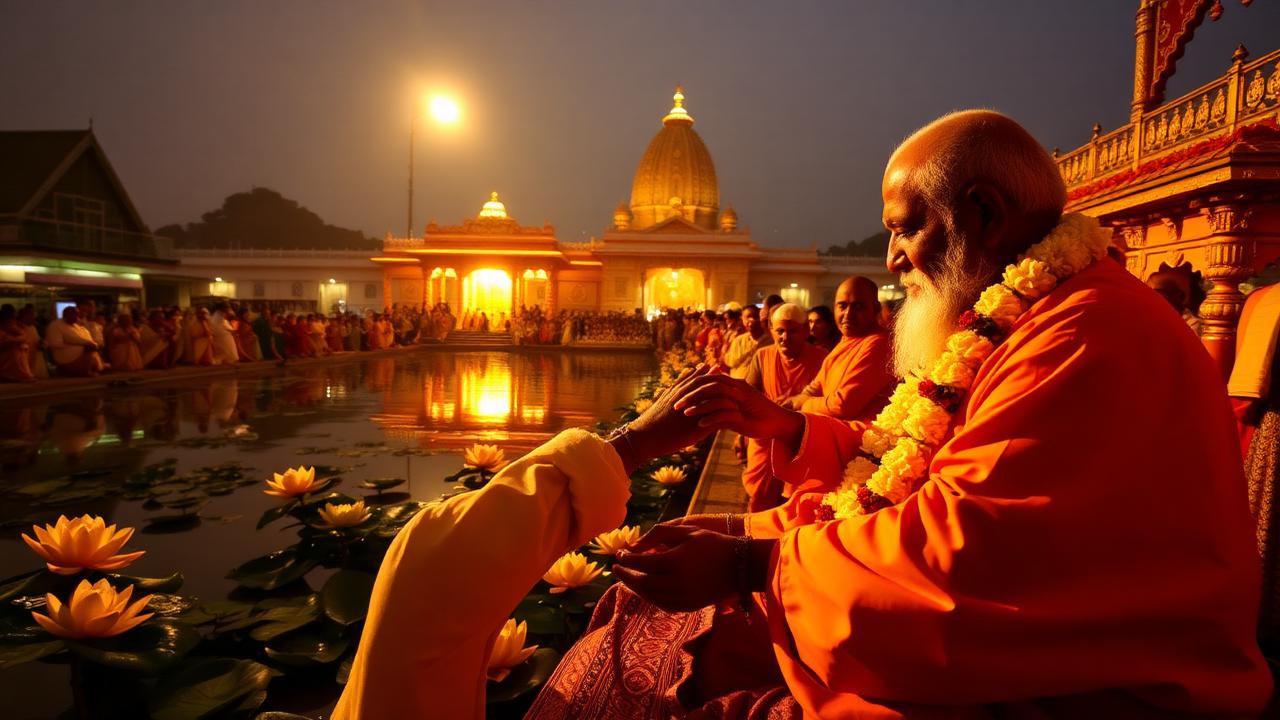
Ganagapur, in Kalaburagi district, Karnataka, at the confluence of the Bhima and the Amaraja, where he stayed longest, around twenty three years, and which is the principal centre.
And then Srishailam, where he is said to have departed into the kadali vana around 1458.
What is worshipped
Not an image.
The nirguna padukas.
At Ganagapur, at Narsobawadi and at Audumbar, the object of worship is a pair of sandals, and the word nirguna is doing work here: they are the mark of a presence rather than a depiction of a person, which is the whole logic of the Datta shrine.
Which makes these places unusual to visit. There is no face. There is a footprint, a tree, a river confluence, and a great many people.
The book
And the reason Nrisimha Saraswati matters far beyond the Datta sampradaya is that a book was written about him.
The Gurucharitra, by Saraswati Gangadhar, in Marathi ovi, in fifty one chapters, of roughly the fifteenth or sixteenth century.
The author was a descendant of Sayamdev, one of Nrisimha Saraswati's disciples, and the book is built as a narrative frame in which the story is told to a devotee.
It is one of the most read devotional texts in Maharashtra, in the same tier as the Jnaneshwari and the Dasbodh in household presence, and it is read not casually but under a discipline, which the next section is about.
The Parayan, and What It Is Not
The Gurucharitra is read as a saptah, a seven day observance, and the discipline around it is strict, and a very large number of people are frightened of it.
This section is for them.
What the saptah involves
Broadly, and households and traditions differ on details.
- Seven days, with the fifty one chapters divided across them in a set pattern
- A fixed time and a fixed seat, usually early morning, and the same asana each day
- One meal, or a restricted diet, with meat, alcohol, onion and garlic given up for the period in most observances
- Sleeping on the floor, and brahmacharya
- Not leaving the house or the town for the duration
- Completing it, with the concluding puja and the feeding of others on the eighth day
A three day form also exists, and reading it in the ordinary way outside any observance is also done.
What the discipline is for
It is a container.
A week in which the same thing happens at the same hour, in the same seat, with the ordinary appetites turned down, is a device for making a text land differently than it would if you read it on a phone between other things.
That is a real technique and it works and it is not superstition.
And here is the part that has to be said
People are told that breaking the rules of a saptah brings harm.
And that belief causes genuine suffering. People finish the seventh day in a state of dread because they slept badly on the fourth. Somebody falls ill in the middle and the family concludes it was the parayan. A person who had to travel for a funeral believes they have incurred something.
So, plainly.
A book is not a curse.
The Gurucharitra is a devotional text about a fifteenth century teacher, and reading it imperfectly does not injure you, your children or your household.
And this is not a modern reader overruling the tradition. The tradition itself provides for interruption. Illness, a death in the family, an unavoidable journey and ritual impurity in the household are all recognised grounds to stop and to begin again later, and any competent person at Ganagapur or Narsobawadi will tell you so.
A practice that produces terror is not doing what it was designed to do. If yours is, stop it, and do the daily reading without the observance instead, which is worth more than a week of fear.
And the other thing that has to be said
The Gurucharitra contains material a modern reader will find difficult.
There are episodes that turn on brahmanical status and ritual qualification. There are chapters on the duties of a wife that no honest reader can present as anything other than what they are. And there is a great deal of material in which observance produces outcomes, which sits uneasily beside everything the sant traditions in this series have argued about not bargaining with God.
Saying so is not an attack on the book.
It is the ordinary condition of reading any old text, and every reading tradition in the world has always done it in practice while often denying it in principle.
You are allowed to honour a text and disagree with parts of it.
The Varkari sants did exactly this with the material they inherited. Chokhamela, Soyarabai, Janabai and Tukaram all worked inside a tradition whose texts contained the rules that excluded them, and they kept the tradition and refused the rules, in writing, and the tradition kept them.
So a reader today can take the Gurucharitra's account of the guru, its discipline, its language and its extraordinary hold on Maharashtra, and decline its chapters on caste and on wives, without leaving the room.
How to actually read it
- In Marathi if you can, because the ovi metre is most of the experience
- In a good translation otherwise, of which there are several in Hindi and English
- Daily, a chapter at a time, without a saptah, if you want the book rather than the observance. This is entirely legitimate and nobody will stop you
- With a saptah, if the discipline helps you, and with the understanding that an interruption is an interruption and not a catastrophe
- And with an adult's reading eye, which is what this entry is asking for throughout
What People Come to Ganagapur For
And this needs saying because it is the largest single reason people go, and almost nobody writes about it honestly.
The place
Ganagapur, in Kalaburagi district, Karnataka, at the confluence of the Bhima and the Amaraja.
The nirguna padukas in the shrine. The sangam, where people bathe. The audumbar and the ashwattha. And the madhukari.
Madhukari
Which is the distinctive practice here and which is worth understanding.
A pilgrim at Ganagapur goes to five houses and asks for food.
Not five rupees. Cooked food, at the door, from strangers, in the manner of a mendicant.
And it is done by everybody, including people who arrived by car and are staying in a good room, and that is the point of it: for one afternoon, the person who normally provides stands at somebody else's door.
The name comes from the bee, madhukara, which takes a little from each flower and destroys none. You take a little from five houses.
It is one of the very few practices left in Indian religion that reverses a social position rather than confirming one, and it is the reason to go to Ganagapur even if nothing else about the place moves you.
And the other reason people come
They bring somebody.
Ganagapur, like several Datta shrines, is where families take a relative believed to be possessed.
And a devotional site that does not address this is failing the people who most need addressing.
What is usually happening
Not a spirit.
The presentations that get read as possession in India are, in the overwhelming majority of cases, one of a short list of conditions, all of which are diagnosable and most of which are treatable.
- Psychosis, including schizophrenia, where hearing voices and holding fixed false beliefs are the core symptoms
- Epilepsy, particularly temporal lobe epilepsy, which can produce altered states, automatic behaviour and intense fear or religious experience, and which is very frequently read as possession
- Dissociative disorders, where the presentation of a changed identity or voice is the condition itself, and which are strongly associated with past trauma
- Postpartum psychosis, which comes on fast in the weeks after childbirth, is a medical emergency, and is one of the most commonly misread of all
- Severe depression and mania
- Intellectual disability and autism, misread when a person cannot explain themselves in the expected way
- And plain physical illness: thyroid disorders, vitamin B twelve deficiency, brain infections, delirium from fever, and reactions to substances
What to do
Both. Not one.
Go to Ganagapur. Do the madhukari. Bathe at the sangam. Sit with the padukas. Nothing in this entry is arguing against that and the shrine does not ask you to stop treatment.
And go to a doctor.
- Every district in India has a District Mental Health Programme under the national health mission, which provides psychiatric care free or nearly free at the district hospital. Ask at the district hospital.
- Tele MANAS 14416, free, in many Indian languages, and it will tell you where to go
- Ayushman Bharat covers mental health treatment for eligible households
- Epilepsy is treated with medication and is very often fully controlled. A person having seizures needs a neurologist, not an exorcism
- Postpartum psychosis needs to be seen the same day. Do not wait
What is never acceptable
And this is the law and not an opinion.
Under the Mental Healthcare Act 2017, a person with mental illness has a right to treatment and a right not to be chained, confined or subjected to cruel or degrading treatment.
So: no beating. No chaining. No confinement in a room or at a shrine against the person's will. No withholding of food. No burning, branding or physical harm as treatment. No forced fasting.
Those are crimes, whoever is doing them and whatever they are called.
Police 112 if somebody is being held or hurt. Women's helpline 181. Childline 1098 if it is a child.
The Erwadi fire in Tamil Nadu in 2001, in which twenty eight chained people died because they could not run, is the reason that law exists.
Where to go
- Ganagapur, Kalaburagi district, Karnataka, at the Bhima Amaraja sangam
- Narsobawadi, Kolhapur district, at the Krishna Panchaganga sangam
- Audumbar, Bhilavadi, Sangli district
- Karanja, Washim district, his birthplace
- Srishailam, Andhra Pradesh
A daily practice from this entry
- Digambara Digambara Sripada Vallabha Digambara
- A chapter of the Gurucharitra, daily, without a saptah, which is a legitimate way to read it
- And the madhukari principle, which you can do anywhere: once, stand where you usually would not, and ask instead of giving
The Short Version
Who: Nrisimha Saraswati, traditionally 1378 to 1458, born Narahari at Karanja in the Washim country of Vidarbha to Madhava and Amba Bhavani, and counted as the second human avatara in the Datta sampradaya. The tradition says he did not speak until his thread ceremony and then recited the Vedas. He took sannyasa at Varanasi from Krishna Saraswati, which is where the Saraswati in his name comes from, that being one of the ten Dashanami orders. His route down the Deccan is why there are four major shrines rather than one: Audumbar at Bhilavadi in Sangli district, where he kept a chaturmas; Narsobawadi at the confluence of the Krishna and Panchaganga in Kolhapur district, where he stayed twelve years; Ganagapur in Kalaburagi district, Karnataka, at the confluence of the Bhima and Amaraja, where he stayed around twenty three years and which is the principal centre; and then Srishailam, where he is said to have departed into the kadali vana around 1458. What is worshipped at these places is not an image but the nirguna padukas, a pair of sandals, the mark of a presence rather than a depiction, so there is no face, only a footprint, a tree, a river confluence and a great many people.
The book: the Gurucharitra of Saraswati Gangadhar, in Marathi ovi, in fifty one chapters, of roughly the fifteenth or sixteenth century, written by a descendant of Sayamdev, one of Nrisimha Saraswati's disciples. It is one of the most read devotional texts in Maharashtra, in the same tier as the Jnaneshwari and the Dasbodh, and it is read under a discipline.
The saptah: seven days with the fifty one chapters divided across them, a fixed time and fixed seat usually early morning, one meal or a restricted diet with meat, alcohol, onion and garlic given up, sleeping on the floor, brahmacharya, not leaving the house or town, and completion with a concluding puja and the feeding of others on the eighth day. A three day form exists and ordinary reading outside any observance is also done. The discipline is a container: a week in which the same thing happens at the same hour in the same seat with the ordinary appetites turned down is a device for making a text land differently, and that is a real technique.
And the part that has to be said: people are told that breaking the rules brings harm, and that belief causes genuine suffering, with people finishing the seventh day in dread because they slept badly on the fourth, families concluding an illness came from the parayan, and a person who travelled for a funeral believing they have incurred something. A book is not a curse. The Gurucharitra is a devotional text about a fifteenth century teacher, and reading it imperfectly does not injure you, your children or your household. That is not a modern reader overruling the tradition, since the tradition itself provides for interruption: illness, a death in the family, an unavoidable journey and ritual impurity in the household are recognised grounds to stop and begin again later, and any competent person at Ganagapur or Narsobawadi will say so. A practice that produces terror is not doing what it was designed to do, and if yours is, stop it and do the daily reading instead.
And the other thing: the Gurucharitra contains material a modern reader will find difficult, with episodes turning on brahmanical status and ritual qualification, chapters on the duties of a wife that no honest reader can present as other than what they are, and a great deal of material in which observance produces outcomes, which sits uneasily beside everything the sant traditions argue about not bargaining with God. Saying so is not an attack on the book but the ordinary condition of reading any old text. You are allowed to honour a text and disagree with parts of it, and the Varkari sants did exactly this: Chokhamela, Soyarabai, Janabai and Tukaram all worked inside a tradition whose texts contained the rules that excluded them, and they kept the tradition and refused the rules, in writing, and the tradition kept them. Read it in Marathi if you can, in a good translation otherwise, daily a chapter at a time without a saptah if you want the book rather than the observance, which is entirely legitimate, or with a saptah if the discipline helps, understanding that an interruption is an interruption and not a catastrophe.
Ganagapur: the nirguna padukas, the sangam where people bathe, the audumbar and ashwattha, and the madhukari, which is the distinctive practice. A pilgrim goes to five houses and asks for cooked food at the door, from strangers, in the manner of a mendicant, and everybody does it including people who arrived by car, because for one afternoon the person who normally provides stands at somebody else's door. The name comes from the bee, madhukara, which takes a little from each flower and destroys none. It is one of the very few practices left in Indian religion that reverses a social position rather than confirming one.
And the other reason people come: they bring somebody believed to be possessed. What is usually happening is not a spirit but one of a short list of conditions, all diagnosable and most treatable: psychosis including schizophrenia; epilepsy, particularly temporal lobe epilepsy, which can produce altered states, automatic behaviour and intense fear or religious experience and is very frequently read as possession; dissociative disorders, strongly associated with past trauma; postpartum psychosis, which comes on fast in the weeks after childbirth, is a medical emergency and is one of the most commonly misread; severe depression and mania; intellectual disability and autism; and plain physical illness including thyroid disorders, vitamin B twelve deficiency, brain infections, delirium from fever and reactions to substances. Do both, not one: go to Ganagapur, do the madhukari, bathe at the sangam, sit with the padukas, since the shrine does not ask you to stop treatment; and go to a doctor, since every district has a District Mental Health Programme providing psychiatric care free or nearly free at the district hospital, Tele MANAS 14416 is free in many languages, Ayushman Bharat covers mental health treatment for eligible households, epilepsy is treated with medication and very often fully controlled, and postpartum psychosis needs to be seen the same day. Under the Mental Healthcare Act 2017 a person with mental illness has a right to treatment and a right not to be chained, confined or subjected to cruel or degrading treatment, so no beating, chaining, confinement against their will, withholding of food, burning or branding as treatment, or forced fasting: those are crimes whoever is doing them. Police 112, women's helpline 181, Childline 1098. The Erwadi fire of 2001, in which twenty eight chained people died because they could not run, is why that law exists.
Frequently Asked Questions
Who was Nrisimha Saraswati?+
Traditionally 1378 to 1458, born Narahari at Karanja in the Washim country of Vidarbha, and counted as the second human avatara in the Datta sampradaya after Sripada Srivallabha. The tradition says he did not speak until his thread ceremony and then recited the Vedas. He took sannyasa at Varanasi from Krishna Saraswati, which is where the Saraswati in his name comes from. His route down the Deccan is why there are four major shrines: Audumbar at Bhilavadi in Sangli district, where he kept a chaturmas; Narsobawadi at the Krishna and Panchaganga confluence in Kolhapur district, where he stayed twelve years; Ganagapur in Kalaburagi district, Karnataka, at the Bhima and Amaraja confluence, where he stayed around twenty three years and which is the principal centre; and Srishailam, where he is said to have departed around 1458. What is worshipped at these places is not an image but the nirguna padukas, a pair of sandals, the mark of a presence rather than a depiction.
What happens if I break the rules of a Gurucharitra saptah?+
Nothing. A book is not a curse. The Gurucharitra is a devotional text about a fifteenth century teacher, and reading it imperfectly does not injure you, your children or your household. And this is not a modern reader overruling the tradition, because the tradition itself provides for interruption: illness, a death in the family, an unavoidable journey and ritual impurity in the household are all recognised grounds to stop and to begin again later, and any competent person at Ganagapur or Narsobawadi will tell you so. The belief that breaking the rules brings harm causes genuine suffering, with people finishing the seventh day in dread because they slept badly on the fourth, families concluding that an illness came from the parayan, and people who had to travel for a funeral believing they have incurred something. A practice that produces terror is not doing what it was designed to do, and if yours is, stop it and do the daily reading without the observance instead, which is worth more than a week of fear.
What if parts of the Gurucharitra trouble me?+
Then say so, because they trouble any honest reader. The text contains episodes that turn on brahmanical status and ritual qualification, chapters on the duties of a wife that no honest reader can present as anything other than what they are, and a great deal of material in which observance produces outcomes, which sits uneasily beside everything the sant traditions argue about not bargaining with God. Saying so is not an attack on the book. It is the ordinary condition of reading any old text, and every reading tradition in the world has always done it in practice while often denying it in principle. You are allowed to honour a text and disagree with parts of it, and the Varkari sants did exactly this: Chokhamela, Soyarabai, Janabai and Tukaram all worked inside a tradition whose texts contained the rules that excluded them, and they kept the tradition and refused the rules, in writing, and the tradition kept them. So you can take the Gurucharitra's account of the guru, its discipline, its language and its extraordinary hold on Maharashtra, and decline its chapters on caste and on wives, without leaving the room.
What is madhukari at Ganagapur?+
The distinctive practice of the place. A pilgrim goes to five houses and asks for food: not money, but cooked food, at the door, from strangers, in the manner of a mendicant. And everybody does it, including people who arrived by car and are staying in a good room, which is the point, since for one afternoon the person who normally provides stands at somebody else's door. The name comes from the bee, madhukara, which takes a little from each flower and destroys none, so you take a little from five houses. It is one of the very few practices left in Indian religion that reverses a social position rather than confirming one, and it is a reason to go to Ganagapur even if nothing else about the place moves you.
Someone in my family is said to be possessed. What should I do?+
Both things, not one. Go to the shrine if it helps, and go to a doctor, because the shrine does not ask you to stop treatment. What is usually happening is not a spirit but one of a short list of conditions, all diagnosable and most treatable: psychosis including schizophrenia; epilepsy, particularly temporal lobe epilepsy, which can produce altered states, automatic behaviour and intense fear or religious experience and is very frequently read as possession; dissociative disorders, strongly associated with past trauma; postpartum psychosis, which comes on fast in the weeks after childbirth and is a medical emergency; severe depression and mania; intellectual disability and autism, misread when a person cannot explain themselves in the expected way; and plain physical illness including thyroid disorders, vitamin B twelve deficiency, brain infections, delirium from fever and reactions to substances. Every district in India has a District Mental Health Programme providing psychiatric care free or nearly free at the district hospital, so ask there. Tele MANAS on 14416 is free in many Indian languages and will tell you where to go. Ayushman Bharat covers mental health treatment for eligible households. Epilepsy is treated with medication and is very often fully controlled, so a person having seizures needs a neurologist. And postpartum psychosis needs to be seen the same day.
Is it legal to confine someone at a shrine for a cure?+
No. Under the Mental Healthcare Act 2017, a person with mental illness has a right to treatment and a right not to be chained, confined or subjected to cruel or degrading treatment. So there must be no beating, no chaining, no confinement in a room or at a shrine against the person's will, no withholding of food, no burning, branding or physical harm as treatment, and no forced fasting. Those are crimes, whoever is doing them and whatever they are called. Call police 112 if somebody is being held or hurt, the women's helpline on 181, and Childline on 1098 if it is a child. The Erwadi fire in Tamil Nadu in 2001, in which twenty eight chained people with mental illness died because they could not run, is the reason that law exists.
About the author
Pandit Ravindra Sharma · Vedic Rituals & Bhakti, 22+ years
Pandit Ravindra is the Vandnaa editorial team's resident specialist on aarti, chalisa, and daily devotion. He has performed home and temple pujas across Varanasi and Delhi for over two decades and contributes the bhakti-focused articles on this site.
Meet the Vandnaa editorial team →