What Are the Panchabhuta
In Hindu philosophy, the entire universe, including the human body, is believed to be composed of five fundamental elements known as the Panchabhuta or Pancha Mahabhuta. These are Prithvi (earth), Jal (water), Agni (fire), Vayu (air) and Akash (space or ether).
Tradition holds that every object, every living being and even the subtlest thought is a combination of these five elements in different proportions. This is why they are called mahabhuta, the great elements, the basic building blocks from which everything else is formed.
Scriptural Roots of the Five Elements
The idea of the Panchabhuta finds mention across the Upanishads, the Samkhya school of philosophy and later texts of Ayurveda. The Taittiriya Upanishad, for instance, describes creation unfolding from Akash, and from Akash arising Vayu, from Vayu arising Agni, from Agni arising Jal, and from Jal arising Prithvi.
This sequence is not treated as a scientific formula but as a way of understanding how the formless gives rise to form, how the subtle gives rise to the gross, an idea central to Hindu cosmology.
The Five Elements, One by One
Each element carries its own quality and association in tradition.
- Prithvi (earth) represents stability, patience and the sense of smell
- Jal (water) represents fluidity, taste and the flow of emotion
- Agni (fire) represents transformation, digestion and the sense of sight
- Vayu (air) represents movement, breath and the sense of touch
- Akash (space) represents expansiveness, silence and the sense of sound
Devotees are taught that a balanced life reflects a balance of these five elements, within the body as well as in one's surroundings.
How the Five Elements Appear in Worship

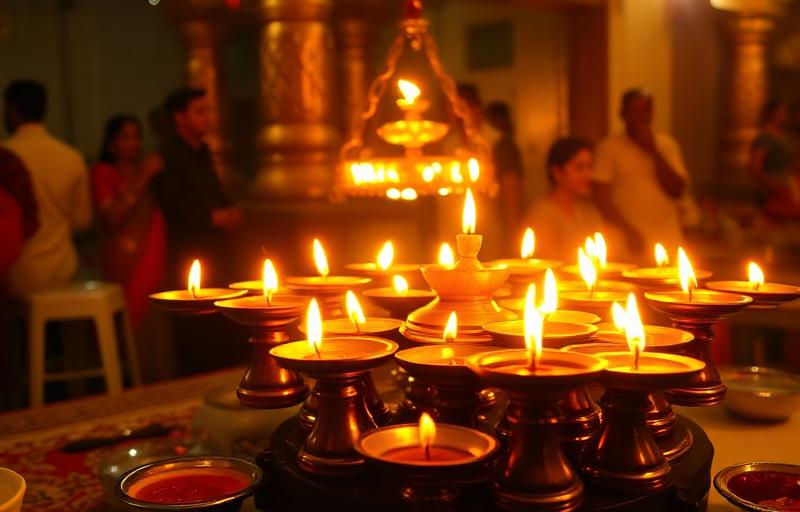
Hindu ritual worship is often described as an offering made through all five elements at once. A lit diya represents Agni, water offered in puja represents Jal, flowers and akshat placed before the deity represent Prithvi, incense smoke drifting upward represents Vayu, and the sound of the bell or a chanted mantra represents Akash.
This is one reason a simple puja is considered complete in itself, since it engages the same five elements believed to make up the worshipper and the universe alike.
The Everyday Takeaway
Understanding the Panchabhuta is not meant to be an abstract exercise. It is a gentle reminder that the body a devotee inhabits and the world a devotee moves through are made of the same five elements, and are therefore worthy of the same respect.
Many devotees find it meaningful to pause and offer gratitude to earth, water, fire, air and space each day, recognising them not as separate from the divine but as its visible forms. Worship is an act of faith and love, not a transaction, and the Panchabhuta remind us that this faith touches everything around us.
Reader Questions Answered
What are the Panchabhuta in Hindu philosophy?+
The Panchabhuta are the five great elements, earth (Prithvi), water (Jal), fire (Agni), air (Vayu) and space (Akash), which Hindu tradition holds to be the basic components of the entire universe and the human body.
Which scriptures describe the five elements?+
The Panchabhuta are described across the Upanishads, particularly the Taittiriya Upanishad, the Samkhya school of philosophy, and later Ayurvedic texts that build on this understanding of creation.
How do the five elements relate to puja rituals?+
Traditional puja is understood to engage all five elements together, a lamp for fire, water for the water element, flowers for earth, incense for air, and the sound of a bell or mantra for space.
About the author
Anjali Mehta · Editor, M.A. Religious Studies
Anjali is the managing editor for Vandnaa and oversees the festival and vrat coverage. She holds an M.A. in Religious Studies and reviews every published article for accuracy, accessibility, and tradition-fidelity.
Meet the Vandnaa editorial team →