What Is Ravivar Vrat and Who Keeps It?
Ravivar vrat is the weekly fast observed on Sundays in honour of Surya Dev, the visible deity who rises before our eyes every morning. Ravivar - the day of Ravi, the Sun - is considered His own day, just as Somvar belongs to Shiva and Mangalvar to Hanuman. The vrat is traditionally kept for health, strong eyesight, skin wellness, honour and respect in society, and the steady success that follows disciplined effort. It is among the most accessible vrats: a single meal, a sunrise arghya, a short katha. Devotees typically begin on the first Sunday of the Shukla Paksha of any month and continue for a vowed count - commonly twelve Sundays, sometimes thirty or a year - completing it with an udyapan. Men and women, young and old, all keep this vrat; no initiation is needed, only regularity and a heart that greets the morning sun as God.
Ravivar Vrat Katha - The Old Woman and the Courtyard
In a village lived a devout old woman who kept the Ravivar vrat with perfect faith. Every Sunday before sunrise she plastered her courtyard with cow dung, made it pure, worshipped Surya Dev, offered Him bhog and only then ate her single meal. Her home knew no want. Her envious neighbour, whose cow's dung the old woman used, grew spiteful and began tying her cow indoors. Finding no dung one Sunday, the old woman would not worship in an unpurified courtyard - so she neither offered bhog nor ate, and slept hungry. That night Surya Dev appeared in her dream: pleased with her unbroken niyam, He granted her a wish-fulfilling cow. At dawn a beautiful cow and calf stood in her courtyard. The cow gave gold instead of ordinary dung. The jealous neighbour swapped the gold dung with her own, until Surya Dev sent a storm that exposed the theft; the king punished the neighbour, honoured the old woman, and the whole kingdom took up the Sunday vrat. The katha teaches that Surya Dev sees every quiet act of devotion - even a courtyard swept clean for Him.
Ravivar Vrat Puja Vidhi - Arghya at Sunrise
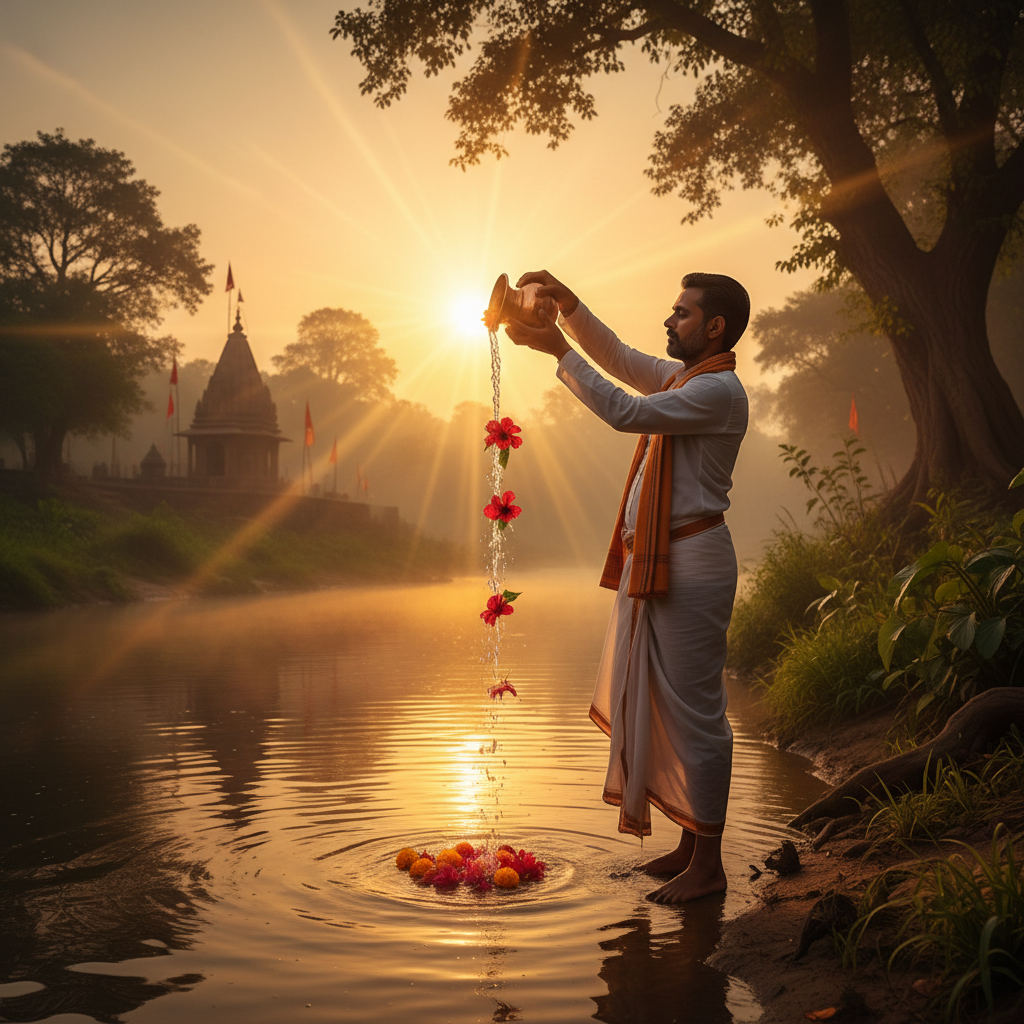
The heart of Sunday worship is the arghya - water offered to the rising sun. 1. Wake before sunrise, bathe, and wear clean clothes; red or saffron tones are considered dear to Surya Dev. 2. Fill a copper lota with clean water; add red flowers, roli (kumkum), akshat (rice grains) and, if available, a small piece of gud (jaggery). 3. Facing the rising sun, raise the lota above your head and pour the water in a slow, steady stream, gazing at the sun's reflection through the falling water - never directly at the sun. 4. While pouring, chant ॐ सूर्याय नमः (Om Suryaya Namah) or the longer mantras given below. 5. At home, light a ghee deepak before an image of Surya Dev, offer red flowers, gud and wheat, and read the Ravivar vrat katha. 6. Do aarti, distribute prasad of gud or wheat halwa, and take your single meal before sunset. If the sky is clouded, offer arghya in the sun's direction with the same faith; the offering is to the deity, not the weather.
What to Eat in Ravivar Vrat - The One-Meal Rule
Ravivar vrat is a one-meal fast, gentler than nirjala vrats but firm in its niyam. 1. Take a single meal, before sunset. Eating after sunset on the vrat day is traditionally avoided, as the day belongs to the sun. 2. Many devotees keep the meal without salt; the popular belief holds that saltless food on Sunday pleases Surya Dev and deepens the tapas of the vrat. Follow your family's tradition here. 3. Foods linked with the sun are preferred: wheat preparations, gud (jaggery), gud-wheat halwa or churma, milk and seasonal fruit. 4. Avoid tamasic items entirely - no meat, alcohol, onion or garlic on the vrat day. 5. Oil is generally not applied to the body, and many devotees also avoid oily, fried food. Those with health conditions, pregnant women and the elderly should adapt freely - a fruit-and-milk day or a normal sattvik meal offered first to Surya Dev keeps the vrat's spirit fully intact.
Surya Mantras for Sunday
Chant these during arghya and through the day. 1. ॐ सूर्याय नमः - Om Suryaya Namah - "Salutations to Surya." The simplest japa, ideal while offering arghya. 2. ॐ घृणिं सूर्य आदित्य - Om Ghrinim Surya Aditya - the revered Surya mantra invoking the radiant Aditya; chant 108 times, traditionally facing the morning sun. 3. ॐ ह्रां ह्रीं ह्रौं सः सूर्याय नमः - Om Hraam Hreem Hraum Sah Suryaya Namah - the Surya beej mantra, used by devotees who keep a longer japa discipline. 4. जपाकुसुम संकाशं काश्यपेयं महाद्युतिम्। तमोऽरिं सर्वपापघ्नं प्रणतोऽस्मि दिवाकरम्॥ - Japakusuma-sankasham kashyapeyam mahadyutim, tamo'rim sarva-papaghnam pranato'smi divakaram - "I bow to the Maker of day, radiant as the hibiscus flower, son of Kashyapa, enemy of darkness, destroyer of all sins." Reciting the Aditya Hridaya Stotra - the hymn sage Agastya gave Lord Ram on the battlefield - is considered the crown of Sunday devotion; even a weekly reading fills the heart with the sun's steadiness.
Niyam - Rules to Observe on the Vrat Day
Small disciplines protect the vrat's power. 1. Offer arghya before taking any food or tea; the sun is greeted first. 2. Keep the vowed count of Sundays unbroken; if a Sunday is missed due to illness or travel, add one at the end rather than abandoning the vow. 3. Do not cut hair or nails, and avoid applying oil to the body on the vrat day, per tradition. 4. Speak gently; the old woman of the katha won Surya Dev's grace by quiet steadiness, not display. 5. Donate on Sundays when possible - wheat, gud, copper items or red cloth given to the needy are considered dear to Surya Dev. 6. Complete the vowed Sundays with a simple udyapan: a final puja, katha, feeding of brahmins or the needy, and gratitude for the discipline received.
Benefits of Ravivar Vrat

The fruits associated with Sunday devotion to Surya Dev are practical and inward at once. 1. Health and vitality - Surya is the source of prana; His worship has always been linked with bodily strength and recovery from long illness. 2. Eyesight and skin wellness - tradition specially connects Surya aradhana with the health of the eyes and skin. 3. Honour and respect - devotees believe steady Sunday vrats bring maan-samman, dignity in work and society, as the katha's old woman was honoured by the king. 4. Steadiness of routine - rising before the sun once a week reorders the whole week's discipline. 5. Inner radiance - the worshipper of light slowly grows lighter: less lethargy, fear and gloom. Keep the vrat as devotion and self-discipline, and let results come as Surya Dev's prasad. For festival-specific Surya worship, see our Ratha Saptami and Chhath guides on Vandnaa.
Reader Questions Answered
How do I start the Ravivar vrat?+
Begin on the first Sunday of any month's Shukla Paksha. Bathe before sunrise, take a sankalp before Surya Dev stating the number of Sundays (commonly 12), offer arghya, read the katha, and take one meal before sunset. Continue every Sunday until the vow completes.
Why is salt avoided in Ravivar vrat food?+
Popular tradition holds that a saltless (alona) meal on Sunday pleases Surya Dev and adds tapas to the fast, since giving up taste is itself an offering. It is a belief and family custom rather than a scriptural absolute - follow the practice of your household.
What is the correct way to offer arghya to Surya Dev?+
At sunrise, fill a copper lota with water, add red flowers, roli and akshat, face the sun, raise the lota and pour a slow steady stream while chanting Om Suryaya Namah. Watch the sun's reflection in the falling water - never look directly at the sun.
Can I eat fruit and drink water during Ravivar vrat?+
Yes. Ravivar vrat is a one-meal fast, not nirjala - water and fruit through the day are generally accepted, with the main meal taken once before sunset. The key niyam are: arghya before eating anything, no food after sunset, and no tamasic items.
What are the benefits of keeping the Sunday fast?+
Tradition associates Ravivar vrat with health and vitality, good eyesight, skin wellness, honour and respect in society, and steady success. Beyond these, the weekly sunrise discipline itself builds routine, courage and inner brightness - the deeper prasad of Surya Dev.
Should I recite the Aditya Hridaya Stotra every Sunday?+
It is highly recommended but not compulsory. The Aditya Hridaya, given by sage Agastya to Lord Ram before his victory, is the most celebrated Surya hymn. If time is short, chant Om Ghrinim Surya Aditya 108 times and read the stotra on Sundays when you can.
About the author
Acharya Vinaya Kapoor · M.A. Sanskrit, Mantra & Stotra Studies
Acharya Vinaya holds an M.A. in Sanskrit from Banaras Hindu University and writes the mantra and stotra commentary on Vandnaa. Her focus is on accurate pronunciation, traditional context, and helping modern readers connect with classical texts.
Meet the Vandnaa editorial team →