The Goddess in the Anthill
Santeri, also written Sateri, is the most widely worshipped village goddess of Goa, and her shrines extend up the Konkan coast into Uttara Kannada and coastal Maharashtra.
What makes her worship distinctive is its form. In a Santeri temple, the sanctum holds a valmik, an anthill or termite mound, either a natural one around which the temple was built or a raised earthen form maintained in its place. Devotees worship the mound directly. Some temples keep a small murti alongside, added in later centuries, but the valmik remains the deity.
This places Santeri in the oldest identifiable layer of worship in the region:
- The earth itself is the deity, not a representation of her
- The mound is associated with fertility, the underground and the sustaining power of the soil
- Anthills are also the homes of serpents, which links this worship to the region's strong naga tradition
- There is no consecration of an image, and no iconography to interpret
Across Goa, most villages have a Santeri, and families identify her as their gram devata. In many villages she is identified with Shantadurga, and the two names are used for the same deity, which is one of the clearest examples in India of a local earth goddess and a Puranic Devi being understood as one.
Why an Anthill Became a Shrine
For a visitor, worshipping an anthill can seem puzzling until the logic of it is spelled out. In coastal and forest India it is entirely coherent.
- The anthill is built by the earth's own creatures, without human hands, which places it in the same category as swayambhu objects like the Narmada's banalingas
- It is made of soil, and soil is the source of food, which makes it a natural focus for a farming society's prayers about fertility and sustenance
- It grows, visibly, over years, which reads as a living presence rather than an inert object
- Serpents shelter in anthills, and nagas across India are associated with fertility, rain, family lineage and the protection of land
- It is cool and moist inside even in the hottest months, which in a hot climate is itself understood as a sign of the deity's nature
The naga link is worth following. Across the Konkan, Kerala and coastal Karnataka, serpent worship is one of the strongest devotional layers, with sacred groves, naga stones and dedicated shrines. Milk offered at an anthill, a practice found across India, sits at the meeting point of naga worship and earth goddess worship.
Santeri is where those strands come together in Goa. She is the earth, she is the mound, and the mound is where the serpents of the land live.
Santeri and Shantadurga: One Deity, Two Names
In many Goan villages the same deity is called Santeri by older devotees and Shantadurga in temple records, and understanding how that happened explains a good deal about Goan Hinduism.
Shantadurga is the Devi who, in the Puranic katha told in Goa, intervened between Vishnu and Shiva during a conflict and brought peace, from which she takes her name, the Durga who brings shanti. Her principal temple at Kavlem is among the most visited in the state.
What happened across Goa's villages was a layering rather than a replacement:
- The valmik and the local name stayed in the sanctum and in daily speech
- The Puranic identity was mapped onto her, giving her a place in the wider Hindu framework
- Temple architecture, priesthood and festival calendars followed the Puranic form
- Villagers continued to use both names, often in the same sentence
This pattern appears across India wherever an old land deity meets a pan Hindu one, but Goa preserves it unusually visibly, because the anthill is still physically there in the sanctum.
A useful way to see it: Shantadurga is who the deity is in the Puranic sense, and Santeri is who she has always been to the village. Goan families see no conflict between the two, and will tell you both without hesitation.
Worship in a Goan Village Temple
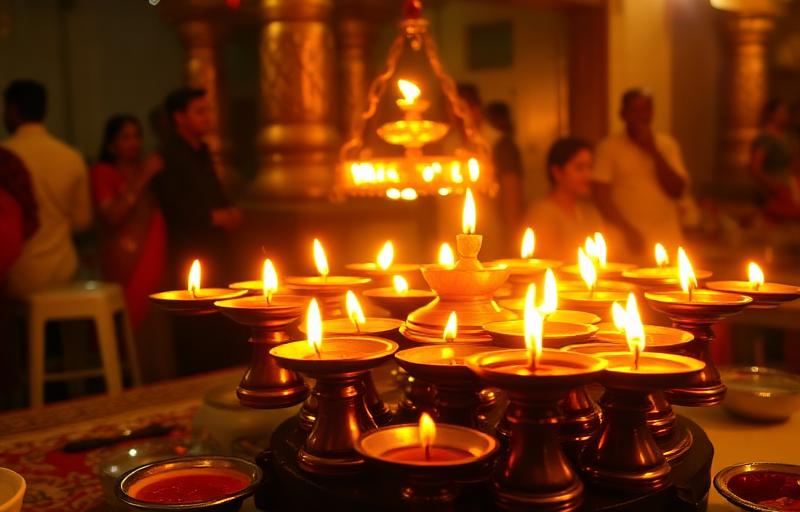
A Santeri temple functions as the centre of village life, and its worship follows the Goan temple pattern.
- The valmik in the sanctum receives daily worship, with water, flowers, haldi kumkum and a lamp
- Milk is offered at the mound, a practice connected to the naga tradition
- The temple keeps its parivar devatas around the main shrine, including guardian deities such as Ravalnath and Betal and the Bhumika of the land
- A deepstambha, the lamp tower typical of Goan temples, stands in the courtyard and is lit on festival evenings
- The zatra, the annual temple festival, brings the whole village together, with a palkhi procession and the participation of families holding hereditary roles
Two festivals in particular belong to this layer of worship:
- Shigmo, Goa's spring festival in Phalgun, with folk performance, drums and village processions
- Dhalo, the winter song and dance tradition performed by women over several nights, addressed to the gram devata, and one of the most distinctive women's devotional forms on the west coast
Navratri fills these temples as it does Devi temples everywhere, but the village's own zatra, Shigmo and Dhalo are what actually define its devotional year.
Santeri Along the Konkan Coast
Santeri is not only a Goan deity. Anthill worship of a goddess runs the length of the western coast, under different names.
- In Goa, she is Santeri or Sateri, and the valmik stands in the sanctum
- In Uttara Kannada and coastal Karnataka, similar anthill and naga shrines are found across village temples
- In Kerala, the closely related tradition appears in the sarpa kavu, the serpent grove kept in family compounds, and in temples such as Mannarasala where naga worship is central
- In coastal Maharashtra, village goddess shrines with earth and naga associations follow the same pattern
What connects them is a shared devotional grammar of the west coast: sacred groves left uncut, serpents treated as protectors of the land and lineage, milk offered at anthills, and the goddess understood as the soil rather than as a figure standing on it.
This is one of the reasons the Konkan retains so much tree cover in village settings. Groves attached to shrines have been protected by custom for centuries, and ecologists studying sacred groves along this coast have documented them as significant reservoirs of native species.
For devotees, the ecological argument is not the point, but it follows from the theology. If the earth is the goddess, cutting the grove is not a land use decision. It is an act against the deity.
Seeing This Tradition in Goa
Most visitors to Goa never see a Santeri shrine, because the tourist route runs along the coast and this tradition lives inland.
Where to look:
- Village temples across Ponda, Bicholim, Sanguem and Quepem talukas, where Sateri and Shantadurga temples are numerous
- Shantadurga at Kavlem, the state's best known temple of this deity, where the Puranic form is fully developed
- Smaller village shrines, where the valmik is plainly visible and the older layer is easier to recognise
- Zatra season, when temple festivals run and the village participation is visible
- Shigmo in Phalgun, when processions and folk performance fill the villages
Etiquette matters more than usual here. These are working village temples, not monuments.
- Dress modestly, as Goan temples require, and cover shoulders and legs
- Remove footwear well before the sanctum
- Do not photograph the valmik or the sanctum without explicit permission
- Do not touch the mound or take earth from it
- Ask before entering during a ritual, and follow whatever the mahajan or temple committee says
One closing observation for visitors. If you have seen only Goa's beaches and churches, an evening at a village temple with the deepstambha lit, the valmik in the sanctum and a Dhalo or zatra in progress will show you a Goa that is considerably older than anything on the coast.
Quick Answers
Who is Santeri?+
Santeri, also written Sateri, is the village goddess of Goa and the Konkan, worshipped in the form of a valmik or anthill placed in the sanctum. She represents the earth itself, and in many villages she is identified with Shantadurga.
Why is an anthill worshipped as a goddess?+
Because it is formed by the earth's own creatures without human hands, is made of the soil that sustains food, grows visibly over years, and shelters serpents, which are associated across India with fertility, rain and the protection of land and lineage.
Is Santeri the same as Shantadurga?+
In many Goan villages, yes. The older local name and the valmik stayed in the sanctum while the Puranic identity of Shantadurga was mapped onto the same deity. Villagers use both names, often in the same sentence.
What is offered to Santeri?+
Water, flowers, haldi kumkum and a lamp in daily worship, and milk offered at the mound in keeping with the naga tradition. Village festivals such as the zatra, Shigmo and Dhalo are the larger occasions of her worship.
What is Dhalo?+
Dhalo is a winter song and dance tradition of Goa performed by women over several nights, addressed to the gram devata. It is among the most distinctive women's devotional forms on the west coast.
Where can visitors see a Santeri shrine?+
In village temples across Ponda, Bicholim, Sanguem and Quepem talukas, and at Shantadurga in Kavlem where the Puranic form is fully developed. Modest dress, no photography of the sanctum and permission before entering during rituals are expected.
About the author
Anjali Mehta · Editor, M.A. Religious Studies
Anjali is the managing editor for Vandnaa and oversees the festival and vrat coverage. She holds an M.A. in Religious Studies and reviews every published article for accuracy, accessibility, and tradition-fidelity.
Meet the Vandnaa editorial team →