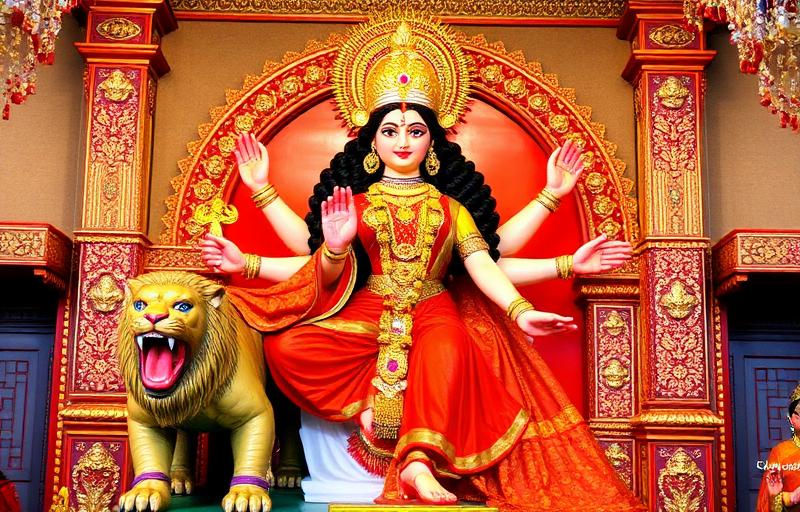
Saradamani
Sarada Devi, born Saradamani Mukhopadhyay on 22 December 1853 at Jayrambati in Bankura district, Bengal, and died at Bagbazar in Calcutta on 21 July 1920.
The family
Very poor brahmanas, her father Ramachandra Mukhopadhyay and her mother Shyamasundari Devi, in a village where the family's condition was hand to mouth and the children worked.
She had no schooling. She learned to read a little as an adult, slowly, and she remained functionally unlettered in the sense the word usually means.
The marriage
She was married at five, in 1859, to Gadadhar Chattopadhyay of Kamarpukur, who was twenty three.
He is Ramakrishna.
The note that belongs here and will be short because the previous entry gives it in full
Child marriage was the ordinary practice of that society and it is a crime now. The Prohibition of Child Marriage Act 2006 sets the minimum at eighteen for a woman and twenty one for a man, arranging one is punishable, and it applies whatever the family or community has agreed. Childline 1098. Police 112.
Why the marriage happened at all
Because his family thought it would settle him.
Gadadhar was already exhibiting the states that made his family think he was unwell: absorptions, weeping, indifference to his own condition, and behaviour that alarmed the village. A marriage was the standard remedy proposed for such a young man, and it was arranged for that reason.
She stayed at Jayrambati through her childhood, as brides did, and went to him at Dakshineswar at around eighteen, in 1872.
What she found there
A man whom a great many people regarded as mad.
Ramakrishna was in the middle of the most extreme period of his practice. He had done the Tantric disciplines under the Bhairavi, was doing Vedanta under Totapuri, was subject to prolonged states in which he did not respond, was not eating normally, and was the subject of open discussion in Calcutta about whether he was deranged.
She was eighteen, from a village, with no education, and this was her husband.
25 May 1872
On the night of the Phalaharini Kali Puja, Ramakrishna seated her on the asana meant for the deity and worshipped her.
The Shodashi Puja. He performed the full rite to her as the Divine Mother, and at the end he placed the fruits of his entire sadhana, everything he had done, at her feet.
Which is the event the whole of the Ramakrishna movement's position on women rests on, and it happened between two people in a room in 1872 with almost nobody watching.
The marriage itself
It was never consummated, and both of them observed brahmacharya for life.
Her own recorded statement is that he never once looked at her as a woman, and she said it plainly, later, to disciples who asked.
She was not sent away, not divorced, not replaced, and not treated as a failure, and she stayed his wife in every legal and social sense for fourteen years while the arrangement was this.
The Nahabat
Where she lived at Dakshineswar, and this is the part that should be looked at directly.
The room
The nahabat is a music tower, a small structure at the temple compound built to house the musicians who play at the hours, and the ground floor room she was given is around nine feet across.
She lived there for years.
With her possessions, her cooking, her few clothes, and a curtain, in a room a fit adult can cross in four steps.
What she did
She cooked.
Ramakrishna's diet was particular and difficult, his stomach was bad for years, and he could not eat what most people ate. And the visitors came in a continuous stream and were fed, and the numbers grew as his reputation grew, and somebody was cooking for all of them.
She rose at three in the morning. She did the day's work. She stayed largely out of sight, because a young wife did, and because the arrangement at Dakshineswar meant that visitors were coming to see him.
A great many people who spent years at Dakshineswar barely saw her.
What to notice here
Two things, and the second one is uncomfortable.
One. The tradition venerates her enormously and it is not empty. She is Sri Ma, the Holy Mother, and the position she holds in the Ramakrishna movement is not honorific: she is worshipped, her birthday is a major observance, and the order's own theology places her as the Divine Mother in the same sense the Shodashi Puja placed her.
Two. And she spent those years doing unpaid, invisible domestic labour in a nine foot room, starting at three in the morning, for a household of men who were having a religious experience.
Both of those are true at once and the second does not become acceptable because of the first.
And it was the ordinary condition
Which is the point.
She was not treated worse than other women of her class and period. She was treated exactly like them, and that is the observation: the woman the entire movement now worships lived the standard life of a Bengali brahmana wife in a small town in the 1870s, and the standard life was cooking from three in the morning in a room the size of a shed.
A reader can draw the conclusion for their own household, and this article will only note that the labour that keeps a religious household running has usually been done by somebody whose name is not on the building.
She did not complain about it
And a modern reader should be careful with that.
Not complaining is a virtue when it is chosen and a trap when it is expected, and the difference is whether anybody would have listened if she had.
Her later recorded conversations, when she did have people who listened, are full of ordinary human complaint about ordinary human difficulties, which the section on Radhu takes up, and it is a better picture of her than the silent one.
After 1886
Ramakrishna died of throat cancer on 16 August 1886. She was thirty two.
The widow's regime
And the first thing that happened is the thing this entry most wants you to know.
A Bengali brahmana widow in 1886 entered a system with rules. White cloth without a border. No ornaments. No fish, no meat, no onion, no garlic. One meal on certain days and none at all on ekadashi, including no water. Head shaved in some communities. Exclusion from every auspicious occasion. A social position close to invisibility, for the rest of her life, beginning the day her husband died.
She began to remove her bangles.
And the tradition records that Ramakrishna appeared to her and told her he had not gone anywhere, that he had only moved from one room to another.
She kept the bangles and the bordered cloth.
What that meant in 1886
It was a refusal, in public, of a regime that every widow around her was subject to.
And the point is not whether a reader accepts the vision. The point is that she declined, that she had a reason she could state, that she held it for thirty four more years in a society that would have preferred otherwise, and that thousands of women watched her do it.
The previous batch's entry on the ten Mahavidyas notes that the tradition contains a goddess who is a widow, Dhumavati, worshipped as she is. Sarada Devi is the same argument made by a living woman in a Bengal village.
She became the head
The young disciples had lost their teacher and had no institution, no money and no plan.
They turned to her, and the accounts of the following years show them referring decisions to her, seeking her permission, and treating her sanction as the thing that made an action legitimate.
Vivekananda wrote to her for her blessing before going to America and said her approval mattered more to him than anything else, and it is a matter of record that he did not go until he had it.
She gave initiation
And this deserves stating flatly.
A woman with no education, no Sanskrit and no institutional position gave diksha to hundreds of people, over decades, in Bengal, from the 1890s.
She gave mantras. People came from a long way for it. Men took initiation from her, including men who went on to lead the order.
Which was not a normal thing for a woman to be doing and was not particularly argued about, because she did it without announcing a position and the results were self evident to the people who received it.
Amjad
The best known single incident, and worth telling properly.
Amjad was a Muslim man of the locality at Jayrambati, from a community labelled criminal, who did rough work.
She fed him. She served him herself, on the veranda, and after he had eaten she cleaned the place herself rather than have somebody else do it.
A relative objected, on both counts, the caste one and the religious one.
Her recorded answer: Sarat is my son, and so is Amjad.
Sarat is Swami Saradananda, one of the senior monks of the order.
She said it once, in a village, in Bengali, to a family member, and it has outlasted a great deal of formal theological writing on the subject.
Her last teaching
Recorded shortly before her death in July 1920, given to a woman disciple who asked what she should hold on to.
If you want peace of mind, do not find fault with others. Rather see your own faults. Learn to make the whole world your own. No one is a stranger, my child. This whole world is your own.
Sri Sarada Math
In 1954 the Ramakrishna order established a separate and fully independent monastic order for women, with its own governance, its own line of sannyasa, and its own institutions, not as a women's wing reporting to a men's order but as an autonomous body.
Which was the first of its kind in modern Hinduism, and it exists because of her.
Radhu, and the Cost
This section is the reason a reader with an ordinary difficult life should read her rather than admire her.
The family
Her natal family at Jayrambati was large, poor, quarrelsome and dependent on her.
Brothers, sisters in law, nieces and nephews, with the ordinary catalogue of village family life: money disputes, marriages to arrange, illnesses, feuds, and a constant expectation that she would handle it.
And she did handle it. For decades, while also being the head of a religious movement, she ran a difficult extended household in a village with no resources.
Radhu
Her niece, the daughter of her brother Abhaycharan, and she brought her up.
Radhu had a mental illness.
The accounts describe unstable and difficult behaviour over many years, periods of derangement, demands, dependency, and episodes that consumed the household.
And Sarada Devi cared for her.
Not at a distance and not by arrangement. She kept her, travelled with her, managed her, arranged her marriage and then dealt with the consequences of it, and she did this for the rest of her life.
What she said about it
And this is why it matters.
She complained.
Her recorded conversations contain plain statements of how hard it was: that Radhu was her bondage, that she was tied by this, that she could not put it down. She said it to disciples, out loud, more than once.
She also said that this was the arrangement, that she had taken it on, and that she would carry it, and she did.
Why a reader should have this
Because the useful version of a saint is the one who found it hard.
A very large number of people reading this are looking after somebody: a parent with dementia, a sibling with a psychiatric illness, a child with a disability, a spouse after a stroke. The work is unending, it is mostly invisible, it does not resolve, and the person doing it is usually a woman.
And devotional writing tends to hand such a person the image of serene selfless service, which is worse than useless, because it adds guilt to exhaustion.
Sarada Devi did not do it serenely. She did it, and she said it was heavy, and both of those are in the record, and the second one is the part that helps.
And the practical part
Caregiver strain is a real and recognised condition, it is treatable, and the caregiver is entitled to help in their own right rather than only as the patient's attendant.
- Tele MANAS 14416, free, all hours, in Indian languages, and it will talk to the carer and not only about the patient
- A government hospital psychiatry department will see the caregiver, and the district mental health programme exists in most districts
- Elderline 14567 for issues involving an older person, including support for the family
- Childline 1098 where a child is involved
And three things that are worth saying to a carer directly
One. You are allowed to find it hard, and saying so is not disloyalty.
Two. The person you are looking after should be under medical care and not only devotional care, and the Bamakhepa entry in the previous batch sets out at length what happens to people with untreated mental illness in families that take them to a shrine instead of a doctor.
Three. Ask for relief before you need it. Rotas, paid help for a few hours, a sibling taking a week. Nobody hands it to a carer who has not asked, and Sarada Devi had a household full of people and still carried it largely alone.
Where to go
- Jayrambati, Bankura district, her birthplace, with the Matri Mandir
- Kamarpukur, five kilometres away, Ramakrishna's birthplace, and the two are visited together
- Dakshineswar, Kolkata, and the nahabat, which you can look at
- Udbodhan at Bagbazar, Kolkata, the Mother's house, where she died
- Belur Math, across the river
- Sri Sarada Math, Dakshineswar, the women's order
When
- Her birth anniversary, in December, celebrated on the tithi
- Durga Puja at Belur Math, which follows the order's own arrangement
A daily practice from this entry
- Sri Ma, or Jai Ma
- Her last instruction, which is short enough to keep: do not look for fault in others, look at your own, and make the world your own
- And the household question she never got to ask: who in this house is doing the work that nobody sees, and when did anybody last offer to take it
The Short Version
Who: Sarada Devi, born Saradamani Mukhopadhyay on 22 December 1853 at Jayrambati in Bankura district, Bengal, to very poor brahmanas, with no schooling and only a little reading learned slowly as an adult. She died at Bagbazar in Calcutta on 21 July 1920.
The marriage: she was married at five, in 1859, to Gadadhar Chattopadhyay of Kamarpukur, aged twenty three, who is Ramakrishna. The marriage was arranged because his family thought it would settle him, since he was already exhibiting the states that made them think he was unwell. Child marriage was ordinary then and is a crime now under the Prohibition of Child Marriage Act 2006: Childline 1098, police 112. She went to him at Dakshineswar at eighteen in 1872, at the most extreme point of his practice, when a great many people in Calcutta regarded him as deranged.
25 May 1872: on the night of the Phalaharini Kali Puja he seated her on the asana meant for the deity and performed the Shodashi Puja to her as the Divine Mother, then placed the fruits of his entire sadhana at her feet. The marriage was never consummated and both observed brahmacharya for life, and her own recorded statement is that he never once looked at her as a woman.
The nahabat: the music tower room she was given at Dakshineswar is about nine feet across, and she lived there for years with her possessions, her cooking and a curtain. She rose at three in the morning, cooked for Ramakrishna, whose diet was particular and whose stomach was bad for years, and for the continuous stream of visitors, and stayed largely out of sight, so that many people who spent years at Dakshineswar barely saw her. Two things are true at once: the tradition venerates her enormously and not emptily, and she spent those years doing unpaid invisible domestic labour in a nine foot room for a household of men who were having a religious experience. She was not treated worse than other women of her class and period; she was treated exactly like them, which is the observation.
1886: Ramakrishna died of throat cancer and she was thirty two. A Bengali brahmana widow then entered a regime of white unbordered cloth, no ornaments, no fish or meat or onion or garlic, one meal on certain days and none at all with no water on ekadashi, exclusion from every auspicious occasion and near social invisibility for life. She began removing her bangles and the tradition records that Ramakrishna appeared and told her he had only moved from one room to another. She kept the bangles and the bordered cloth. Whether or not a reader accepts the vision, she declined the regime in public, held it for thirty four more years, and thousands of women watched her do it.
What followed: the young disciples had no institution, money or plan and turned to her, referring decisions to her and treating her sanction as what made an action legitimate, and Vivekananda did not sail for America until he had her blessing. She gave diksha to hundreds of people over decades from the 1890s, a woman with no education, no Sanskrit and no institutional position giving mantras to men who went on to lead the order. She fed and personally served Amjad, a Muslim man of a community labelled criminal, cleaned up after him herself, and when a relative objected on both caste and religious grounds said: Sarat is my son, and so is Amjad. Her last recorded teaching was that if you want peace of mind you should not find fault with others but see your own faults, and learn to make the whole world your own, since no one is a stranger. In 1954 the order established Sri Sarada Math, a fully independent women's monastic order with its own governance and line of sannyasa, the first of its kind in modern Hinduism, and it exists because of her.
Radhu: her niece, whom she brought up, had a mental illness, with unstable and difficult behaviour over many years, periods of derangement, demands and dependency. Sarada Devi kept her, travelled with her, managed her, arranged her marriage and dealt with the consequences, for the rest of her life. And she complained: her recorded conversations state plainly that Radhu was her bondage, that she was tied by this and could not put it down, said out loud to disciples more than once, alongside her saying that she had taken it on and would carry it. That is the useful version of a saint, because a very large number of readers are looking after somebody and devotional writing usually hands them an image of serene selfless service, which adds guilt to exhaustion. Caregiver strain is real, recognised and treatable, and the carer is entitled to help in their own right: Tele MANAS 14416, a government hospital psychiatry department, Elderline 14567, Childline 1098. You are allowed to find it hard. The person you are caring for should be under medical and not only devotional care. And ask for relief before you need it, because nobody offers it unasked.
What People Ask Most
Who was Sarada Devi?+
The wife of Ramakrishna and the figure the Ramakrishna movement calls Sri Ma, the Holy Mother. She was born Saradamani Mukhopadhyay on 22 December 1853 at Jayrambati in Bankura district, Bengal, to very poor brahmanas, had no schooling, and learned to read a little only as an adult. She was married at five to Gadadhar Chattopadhyay, joined him at Dakshineswar at eighteen in 1872, lived in the nine foot nahabat room and cooked for the household, and after Ramakrishna's death in 1886 became the effective head of the movement, giving initiation to hundreds of people over the following decades. She died at Bagbazar in Calcutta on 21 July 1920.
What was the Shodashi Puja?+
On the night of the Phalaharini Kali Puja, 25 May 1872, Ramakrishna seated Sarada Devi on the asana meant for the deity and performed the full worship to her as the Divine Mother, and at the end placed the fruits of his entire sadhana, everything he had done, at her feet. It is the event on which the whole of the Ramakrishna movement's position on women rests, and it happened between two people in a room in 1872 with almost nobody watching. Their marriage was never consummated and both observed brahmacharya for life, and her own recorded statement to disciples who asked was that he never once looked at her as a woman.
Why did Sarada Devi not follow the widow's rules?+
When Ramakrishna died in 1886 she was thirty two and faced the regime every Bengali brahmana widow faced: white cloth without a border, no ornaments, no fish or meat or onion or garlic, one meal on certain days and none at all including no water on ekadashi, exclusion from every auspicious occasion, and near social invisibility for the rest of her life. She began removing her bangles, and the tradition records that Ramakrishna appeared to her and told her he had not gone anywhere but had only moved from one room to another. She kept the bangles and the bordered cloth. Whether or not a reader accepts the vision, what matters is that she declined the regime in public, had a reason she could state, held it for thirty four more years in a society that would have preferred otherwise, and that thousands of women watched her do it.
What did Sarada Devi say about Amjad?+
Amjad was a Muslim man of the locality at Jayrambati, from a community labelled criminal, who did rough work. She fed him, served him herself on the veranda, and after he had eaten cleaned the place herself rather than have somebody else do it. A relative objected on both counts, the caste one and the religious one, and her recorded answer was that Sarat is my son, and so is Amjad, Sarat being Swami Saradananda, one of the senior monks of the order. She said it once, in a village, in Bengali, to a family member, and it has outlasted a great deal of formal theological writing on the subject.
Who was Radhu and why does she matter?+
Radhu was Sarada Devi's niece, the daughter of her brother Abhaycharan, whom she brought up and who had a mental illness, with unstable and difficult behaviour over many years, periods of derangement, demands and dependency, and episodes that consumed the household. Sarada Devi cared for her not at a distance but directly: she kept her, travelled with her, managed her, arranged her marriage and dealt with the consequences, for the rest of her life. She matters because Sarada Devi complained about it, and said so out loud to disciples more than once, that Radhu was her bondage and that she was tied by this and could not put it down, while also saying that she had taken it on and would carry it. That is the useful version of a saint, because a very large number of readers are looking after somebody and devotional writing usually hands them an image of serene selfless service, which adds guilt to exhaustion.
Where can I get help if I am caring for somebody?+
Caregiver strain is a real and recognised condition, it is treatable, and the carer is entitled to help in their own right rather than only as the patient's attendant. Tele MANAS 14416 is free at all hours in Indian languages and will talk to the carer rather than only about the patient. A government hospital psychiatry department will see the caregiver, and the district mental health programme exists in most districts. Elderline 14567 covers issues involving an older person including support for the family, and Childline 1098 where a child is involved. Three things worth saying directly: you are allowed to find it hard and saying so is not disloyalty; the person you are looking after should be under medical care and not only devotional care; and ask for relief before you need it, with rotas, paid help for a few hours or a sibling taking a week, because nobody hands it to a carer who has not asked.
About the author
Pandit Ravindra Sharma · Vedic Rituals & Bhakti, 22+ years
Pandit Ravindra is the Vandnaa editorial team's resident specialist on aarti, chalisa, and daily devotion. He has performed home and temple pujas across Varanasi and Delhi for over two decades and contributes the bhakti-focused articles on this site.
Meet the Vandnaa editorial team →