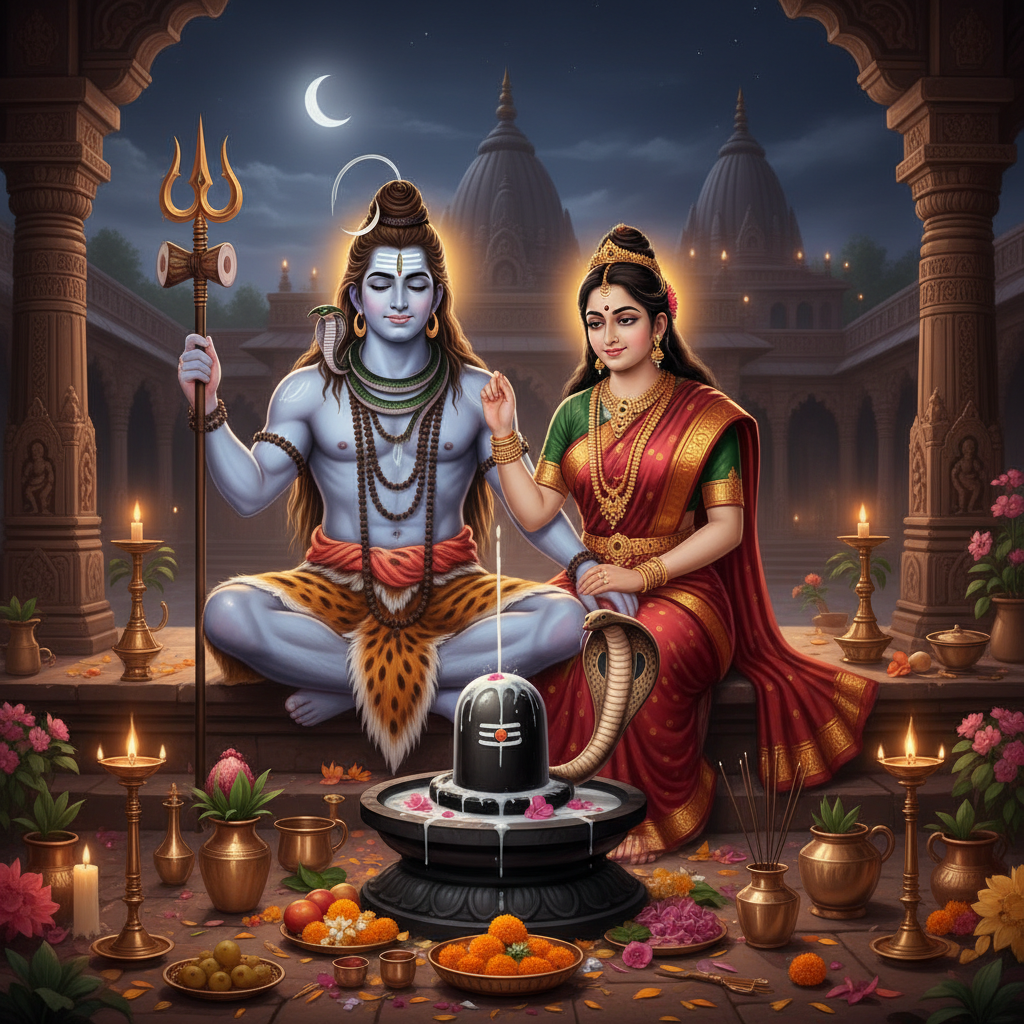
Two Different Observances, Often Confused as Rivals
A question that surfaces every Sawan, usually somewhere around the middle of the month once devotees have a few Mondays behind them and Shivratri approaching, is which of the two observances actually matters more. It's a natural question, but it rests on a slightly mistaken premise: that Sawan Somwar and Sawan Shivratri are competing for the same spiritual purpose, when in fact they were never designed to do the same job.
Sawan Somwar refers to the four Mondays that fall within the Sawan month, this year 3, 10, 17 and 24 August 2026, and its significance comes from the general association of Monday with Shiva across the Hindu calendar, intensified specifically because it falls within Shiva's own sacred month. It is a recurring, rhythm-based observance, its power lies partly in repetition and consistency across four weeks.
Sawan Shivratri, falling this year on Tuesday, 11 August 2026, is a specific tithi (lunar date), the Chaturdashi of the Krishna Paksha within Sawan, and belongs to the broader family of Shivratri observances that occur every month (Masik Shivratri), with the Sawan occurrence and the annual Maha Shivratri carrying the greatest weight among them. It is a single-night, high-intensity observance, traditionally associated with a night-long vigil (jagran) rather than a daytime fast repeated weekly.
The difference is structural, not a matter of one being a stronger or weaker version of the other. Comparing them for "which matters more" is a little like asking whether a daily walking habit or one focused, intense training session matters more for fitness, the honest answer is that they serve different purposes and most serious practitioners do both rather than choosing one over the other.
This year, the two observances sit close together on the calendar, with Shivratri falling between the second and third Sawan Somwar, giving devotees who observe both an unusually compact stretch of the month to experience each one's distinct character back to back.
What Sawan Somwar Is Specifically Suited For
Sawan Somwar's core strength is cumulative discipline. Because it repeats four times across the month rather than happening once, it is structured around building a sustained relationship with practice, showing up week after week, rather than a single peak moment of devotion.
This makes it particularly well suited for:
- Devotees working on a specific ongoing intention: marriage prospects, family harmony, a health concern, career stability, since traditional teaching holds that the repeated sankalp across four Mondays reinforces the vow each week, similar to how any habit strengthens with repetition rather than a single attempt.
- Building or restoring a devotional routine: for someone whose daily puja has lapsed, Sawan Somwar offers a low-pressure, calendar-backed reason to reestablish the habit, with built-in structure (four specific dates) rather than an open-ended, easy-to-postpone resolution.
- Family and community participation: because it falls on a predictable weekly date across a well-known month, Sawan Somwar is what most temple crowds, family puja gatherings and the Kanwar Yatra pilgrimage organise around, making it inherently more social and communal than a single-night observance.
- A gentler entry point for beginners: someone new to vrat can choose to observe just one or two of the four Mondays rather than needing to commit to an entire month upfront, and can calibrate strictness (nirjal, phalahar, single-meal) individually for each Monday based on how the previous one went.
The unmarried girls' and married women's traditional focus on Somwar vrat for a good spouse or marital harmony specifically (as distinct from Shivratri) draws on this cumulative structure too, the idea that consistent weekly devotion across the month, not a single night's intensity, is what shapes a sustained outcome like a marriage or a household's harmony.
In short: Sawan Somwar rewards consistency over four weeks, and its merit, in traditional understanding, compounds specifically because it is repeated, not despite it.
What Sawan Shivratri Is Specifically Suited For
Sawan Shivratri's core strength is concentrated intensity on a single, precisely timed night. Falling this year on Tuesday, 11 August 2026, it belongs to a tithi believed to be when Shiva is most accessible in a single, unbroken window, making it less about sustained routine and more about a focused, high-commitment act of devotion.
This makes it particularly well suited for:
- Devotees seeking deep, immediate spiritual focus: the traditional four-prahar puja (worship performed across four segments of the night, roughly every three hours from evening to dawn) is unique to Shivratri and isn't replicated on an ordinary Somwar, giving practitioners a structured way to spend an entire night in progressively deepening worship.
- Those drawn to the specific mythology of the night: Shivratri specifically commemorates the night Shiva performed his cosmic dance of creation, preservation and destruction (Tandava), and separately, in some traditions, the night of Shiva and Parvati's wedding, giving it a distinct narrative focus that ordinary Mondays don't carry.
- A once-a-month reset for serious practitioners: because Masik Shivratri occurs every lunar month, not just in Sawan, dedicated devotees often use the monthly rhythm (independent of Sawan) to maintain a deeper practice year-round, with the Sawan occurrence simply being the most emphasised instance of a pattern they already keep.
- Nirjal (waterless) vrat attempts: Shivratri, more than an ordinary Somwar, is the occasion on which experienced devotees traditionally attempt a full nirjal fast, since it spans roughly 24 hours from one sunrise to the next rather than requiring four repetitions.
What Shivratri does not offer is Somwar's cumulative, weekly structure, it is one night, not a month-long rhythm, and devotees who skip Shivratri for genuine reasons (illness, unavoidable travel) are not considered to have missed something Somwar could have replaced. Each observance stands on its own footing.
🙏 The Vandnaa App has a dedicated Sawan Shivratri puja vidhi and four-prahar timing guide for 11 August 2026, useful for planning the night in advance.
The Scriptural Basis: What the Puranas Actually Emphasise
Devotees looking for a definitive scriptural ranking between the two observances generally won't find one, because the Puranic texts that discuss them, primarily the Shiva Purana and Skanda Purana, treat Somwar and Shivratri as belonging to different categories of vrat altogether rather than competing entries on the same list.
The Shiva Purana's Shivratri Mahatmya (the section specifically praising Shivratri) describes the night in cosmological terms, linking it to the moment Shiva first manifested as the infinite jyotirlinga (a pillar of light without beginning or end) to settle a dispute between Brahma and Vishnu over supremacy. This origin story gives Shivratri its specific character as a night of revelation and cosmic significance, which is why the four-prahar vigil exists, devotees stay awake through the night specifically to "witness" this manifestation in a devotional sense.
Somwar's significance, by contrast, isn't traced to one originating cosmic event. It draws instead from the broader, widely held association across Puranic and folk tradition of each weekday with a presiding deity, Monday with Shiva and the moon (Chandra, also linked to Shiva through the crescent moon he wears), reinforced further by its placement within Sawan specifically. Its authority comes from accumulated tradition and consistency rather than a single foundational myth.
What both textual traditions agree on, explicitly and repeatedly, is that bhakti (devotion) and shraddha (sincere faith) outweigh the specific ritual chosen. The Shiva Purana itself states in several places that even a single sincere act of Shiva-devotion, offering a bel patra with genuine feeling, chanting Om Namah Shivaya once with full attention, carries real merit, regardless of which calendar occasion it occurs on.
This is worth sitting with for anyone caught up in the "which is better" framing: the scriptures that gave us both observances were far more concerned with sincerity than with devotees ranking one practice above the other.
This Year's Overlap: Making Sense of 11 August 2026
Sawan 2026 offers a genuinely useful case study for the "which matters more" question, because the calendar this year places Sawan Shivratri (Tuesday, 11 August) roughly midway between the second Sawan Somwar (10 August) and the third (17 August), giving devotees an unusually compressed stretch to feel the difference between the two forms of observance directly rather than in the abstract.
A notable additional overlap: 11 August 2026 also falls on a Mangala Gauri Vrat Tuesday (the Sawan Tuesdays this year are 4, 11, 18 and 25 August), meaning married and unmarried women observing Mangala Gauri vrat for marital wellbeing and devotees observing Sawan Shivratri are, on this specific date, both drawing on the same 24-hour window for two distinctly different observances.
How devotees commonly handle this convergence:
- Most treat the day as primarily a Shivratri observance, given its specific tithi-based significance and the four-prahar structure, while still performing a Gauri puja as part of the daytime ritual rather than as a fully separate fast
- Since Mangala Gauri vrat is typically a daytime observance and Shivratri's most significant rituals happen at night, the two schedules don't actually conflict in practice, they occupy different parts of the same day
- Devotees who find the combined day too demanding physically are generally advised to prioritise Shivratri's night vigil, since it is the less frequent, more specifically significant of the two this month, and observe a lighter, symbolic version of the Tuesday vrat
With only 10 to 11 days of Sawan remaining by the time this overlap has passed, most devotees treat 11 August as one of the month's more demanding but also more spiritually concentrated days, a useful marker of how far into Sawan's rhythm they've come, with the final Somwar (24 August) and Raksha Bandhan (28 August) still ahead.
So Which Should You Prioritise? A Practical Answer
After laying out the structural, mythological and scriptural differences, the practical question remains for devotees who genuinely cannot do everything, limited time, health constraints, work demands, real life. Here is a straightforward way to decide, based on what priests most commonly advise rather than an abstract ranking.
Choose Sawan Somwar as your priority if:
- You're building or restoring a consistent devotional habit and need the repeated structure to make it stick
- Your intention is long-term and relational, marriage, family harmony, sustained career stability, something that benefits from repeated, weekly reinforcement
- You have family or community puja traditions built around Monday that you'd genuinely miss participating in
- A single all-night vigil isn't practical for you due to work, health or caregiving responsibilities
Choose Sawan Shivratri as your priority if:
- You're drawn to a single, deeply immersive night of practice rather than a spread-out monthly commitment
- You have a specific, urgent intention that feels suited to concentrated, high-intensity devotion rather than gradual reinforcement
- You already maintain some form of regular weekly or monthly Shiva practice and want Sawan's occasion to mark something distinct from your usual rhythm
- You can realistically set aside a night, even a shortened version of the four-prahar structure, without major disruption
The advice nearly every priest converges on: if you can only do one, do whichever one you can do with full sincerity rather than the one that sounds more prestigious. A half-hearted attempt at both is traditionally considered less valuable than one observance kept with genuine devotion. And if circumstances allow, most devotees find that doing both, in whatever modified form fits their life, is entirely possible precisely because the two observances don't actually compete for the same kind of effort.
With Sawan now in its final stretch, whichever you choose for the remaining days matters far less than simply choosing, and following through with attention.
What People Ask Most
Is Sawan Shivratri more important than Sawan Somwar?+
Neither is scripturally ranked above the other. They serve different purposes, Somwar builds consistency across four weekly observances, while Shivratri offers one night of concentrated, high-intensity devotion. Most priests recommend choosing based on what you can do with sincerity, not prestige.
Can I only observe Shivratri and skip all four Sawan Mondays?+
Yes, this is entirely acceptable. The two observances are independent, and skipping Somwar for genuine reasons while keeping Shivratri, or vice versa, is not considered an incomplete or lesser form of devotion.
What is the four-prahar puja observed on Shivratri?+
It is worship performed across four roughly three-hour segments of the night, each with a fresh round of abhishek and prayer, structured around staying awake through the night in devotion. It is unique to Shivratri and not part of an ordinary Somwar puja.
Why does Sawan Somwar repeat four times but Shivratri happens only once in the month?+
Somwar's significance comes from the weekday-deity association repeated every week of the month, while Shivratri is tied to a specific lunar tithi (the Krishna Paksha Chaturdashi), which occurs only once per lunar month by definition.
This year Sawan Shivratri falls near a Mangala Gauri Tuesday. How should that be handled?+
On 11 August 2026, the two coincide on the same date. Since Mangala Gauri vrat is a daytime observance and Shivratri's main rituals happen at night, the two don't actually conflict, most devotees perform both within the same day without difficulty.
If I can only choose one occasion this Sawan, which should it be?+
Choose whichever you can observe with genuine sincerity rather than whichever sounds more significant. Most priests agree that one wholehearted observance carries more merit than two half-hearted attempts.
About the author
Pandit Mahesh Trivedi · Festival Traditions & Panchang
Pandit Mahesh leads the festival-date and Panchang content on Vandnaa. He cross-references multiple regional panchangs (Drik, Vaishnava, Bengali, Marathi) for every festival date published on the site.
Meet the Vandnaa editorial team →Explore on Vandnaa
Related Articles
Sawan Shivratri 2026: Date, Puja Vidhi, Significance & Mantras
9 min read
Sawan Somwar 2026: Dates, Vrat Vidhi, Shiv Mantras & Why Mondays in Sawan Are So Powerful
10 min read
Mangala Gauri Vrat - Shravan Tuesdays Puja Vidhi, Katha & Benefits
9 min read
Sawan Ends, But These 5 Shiva Practices Continue Year-Round
7 min read