The Temple in the Forest
The Thirunelli temple stands in Wayanad district, Kerala, in the Brahmagiri hills, surrounded on all sides by forest.
What is there:
- A temple in the Kerala style, with a stone base, a tiled roof and a walled compound
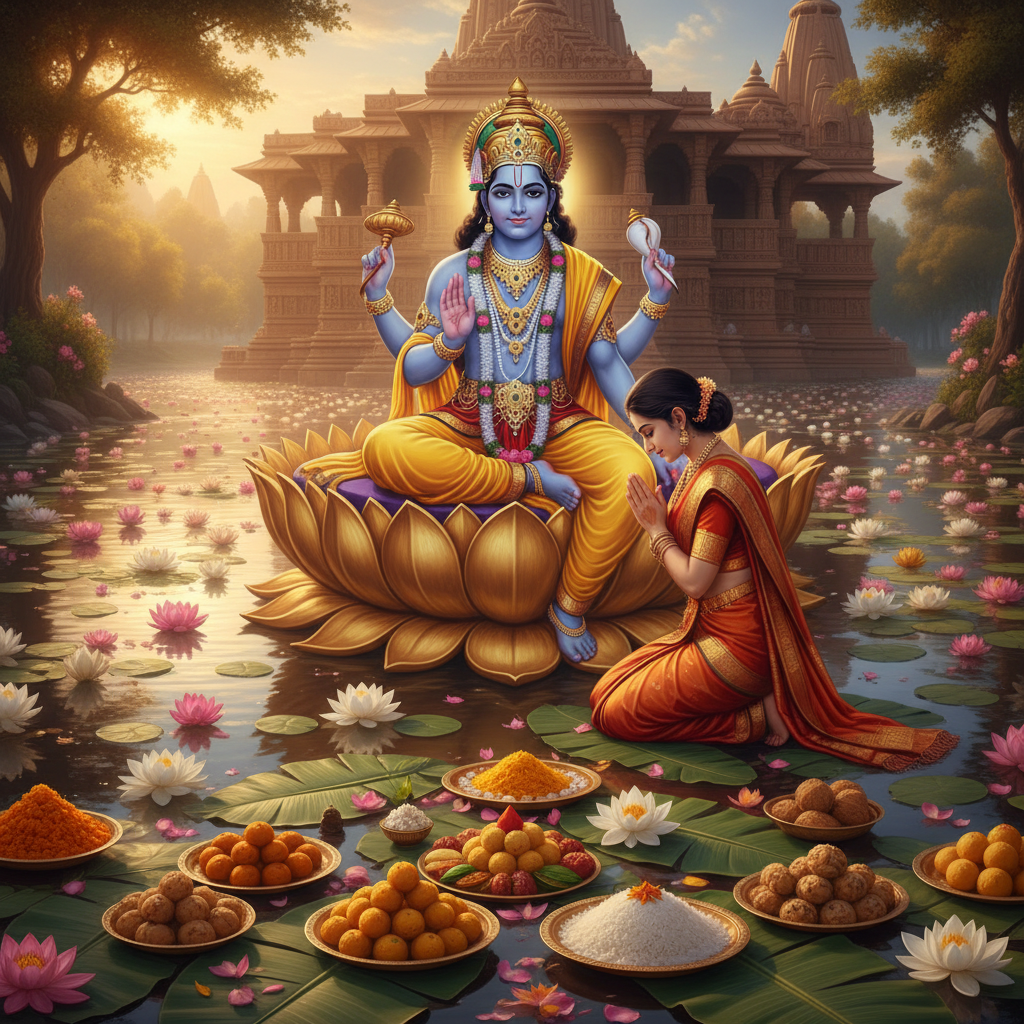
- The deity Maha Vishnu, known here as Thirunelli Perumal
- The Papanasini, a stream coming down from the hills a short walk away
- A remarkable stone aqueduct carrying water to the temple from the stream
- Forest in every direction, and no town
The name. Nelli is the Indian gooseberry, the amla, and Thirunelli is the sacred amla place. The katha holds that the image was found beneath an amla tree.
What the temple is for. Thirunelli is among the principal places in Kerala for pitru karma, the rites performed for the dead, and that is why most people come.
Families arrive, bathe in the Papanasini, perform the rites on the rocks beside it, and go. The temple is not a place of festival crowds and processions in the way many Kerala temples are. It is quiet, and the quiet is the point.
Getting there means driving through forest, and the road passes through country with elephants in it. That is worth knowing before you set out and is dealt with below.
The Katha of Brahma and the Amla Tree
The story attached to Thirunelli concerns Brahma, which is unusual, since Brahma temples are rare and Brahma rarely appears as the founder of a shrine.
As it is told:
- Brahma was travelling on his hamsa, the swan, across the Sahya hills
- He came upon an image of Vishnu beneath a nelli tree, the amla
- The image was held to have been made by Vishnu himself, or to have manifested there
- Brahma consecrated it and established worship
- He asked Vishnu that the place be a tirtha where rites for the dead would be effective, and the request was granted
Why the amla. The amla, Phyllanthus emblica, occupies a particular place in Indian tradition.
- It is one of the most important plants in Ayurveda, and is the principal ingredient of chyawanprash
- It is associated with Vishnu and is treated as sacred
- Amla Ekadashi, in Phalguna, is observed with worship of the amla tree
- It is one of the few fruits that is both intensely sour and considered cooling and restorative, and the tradition made a good deal of that
Why Brahma matters here. Brahma has famously few temples, Pushkar in Rajasthan being the best known.
The usual explanation involves a curse, in one telling from Shiva and in another from Brahma's own consort, following an episode in which he behaved badly, and the result is that he is not to be widely worshipped.
What that means for a place like Thirunelli. Brahma is not the deity here. He is the founder, and the deity is Vishnu.
That is the usual pattern for Brahma in Indian sacred geography. He turns up, establishes something, and then the shrine belongs to somebody else. The creator is credited with the beginning and then leaves.
Rites for the Dead
Understanding what people are doing at the Papanasini requires knowing what pitru karma is, and it is worth setting out properly.
What the rites are:
- Bali tarpanam and related offerings made for the pitrus, the ancestors
- Performed by a descendant, generally a son, though practice varies and many families have adapted
- They involve offerings of water, sesame and rice balls, called pinda, given with a specific procedure
- They are performed at a tirtha, generally at flowing water
When they are performed:
- On the anniversary of a death, the shraddha
- During Pitru Paksha, the fortnight in Bhadrapada devoted to the ancestors
- On Karkidaka Vavu, the new moon of the Malayalam month of Karkidakam, which is the principal occasion in Kerala and brings very large numbers to Thirunelli and other sites
- At the immersion of ashes
What the tradition understands by it. This is the part that is worth taking seriously rather than treating as superstition.
- The dead are held to depend on the living for a period, and the rites are a discharge of obligation rather than a request for anything
- The relationship runs in one direction. The descendant gives, and expects nothing back
- Three generations are named, and the offering is made to them specifically
- Failing to perform them is regarded as a serious lapse
What it does for the living. Anyone who has performed these rites, whatever they believe, will recognise what they are actually for.
A death leaves people with an unbearable amount of nothing to do. The rites give them something specific to perform, at a fixed time, in a fixed place, with a procedure someone else specifies.
Sitting on a rock in a forest stream, being told what to say and when to pour, is a very effective structure for grief. It is not accidental that virtually every human culture has built one.
The Papanasini
The stream is where most of what happens at Thirunelli actually happens.
What it is:
- A stream coming down off Brahmagiri, a short walk from the temple
- The name means the destroyer of sins, papa nashini
- It runs over rock, in forest, with pools among the boulders
- Devotees bathe here, perform the rites, and immerse ashes
The stone aqueduct. One of the more remarkable things at Thirunelli is easy to walk past.
A channel cut in stone carries water from the stream to the temple, running for a considerable distance. It is old, it is well made, and it means the temple's water comes directly from the Papanasini.
That is a practical arrangement with a theological purpose. The water used in the temple is not drawn from a well. It is the same water people are bathing in downstream, coming down off the same hills.
Panchatheertham. Thirunelli is associated with a set of tirthas in the surrounding hills, of which the Papanasini is the principal, and the others include Gunnika, Sahasratheertham, Varaha theertham and Rukmini theertham.
Why running water. The requirement of flowing water for these rites is not incidental, and the logic is worth stating.
- Offerings made into flowing water are carried away, which is the point. They are not left as a deposit
- The direction of flow gives the ritual its structure. Something is handed over and it goes
- Standing water would not do, because the offering would still be there afterwards
That is why the great sites for these rites in India are all on moving water. Gaya on the Phalgu, Prayagraj at the sangam, Haridwar, Rameswaram at the sea, Thirunavaya on the Bharathappuzha, and Thirunelli on a forest stream.
Safety at the stream. It is a hill stream in a monsoon region. Levels rise fast after rain upstream, rocks are slippery, and the pools are deeper than they look. Do not bathe alone, keep children held, and do not go into the water at all if it is running high or coloured.
A Temple Inside a Forest
Thirunelli's setting is not incidental, and it has consequences for a visit.
Where it is:
- In the Brahmagiri hills in northern Wayanad, near the Karnataka border
- Surrounded by reserve forest, with the Tholpetty range of Wayanad Wildlife Sanctuary nearby and Nagarhole across the border
- The approach road runs through forest for a considerable distance
- There is no settlement of any size at the temple
Wildlife on the route. This needs stating plainly.
- This is elephant country, and elephants use the roads and cross them
- Sightings on the approach are common, and encounters are not rare
- Tigers, leopards, gaur, deer and wild dogs are present in the wider area
What to do about it:
- Do not travel these roads at night. Many forest roads in the region are closed after dark, and where they are not it is still a bad idea
- If you meet an elephant on the road, stop, keep your distance, do not sound the horn, and reverse away slowly if you can. Do not try to pass
- Never get out of the vehicle for a photograph
- Do not feed any animal
- Follow forest department signage and any closure
Why the forest matters religiously. The setting is part of what the temple is.
Kerala has a strong tradition of kavus, sacred groves, patches of forest attached to shrines and left uncut. They are among the most important surviving fragments of the state's original vegetation, and their protection is entirely religious in origin.
A temple in deep forest, reached through elephant country, for rites concerning the dead, is a very coherent arrangement. The place is deliberately outside the settled world, which is where the dead are too.
That also explains the quiet. Thirunelli does not have the noise, the shops or the pressure of a major Kerala temple. It has trees, water and people doing something difficult.
Visiting Thirunelli
Getting there
- Thirunelli, Wayanad district, Kerala, in the Brahmagiri hills
- About 30 km from Mananthavady, which is the nearest town
- Roughly 100 km from Kozhikode and 110 km from Mysuru
- Kozhikode and Kannur have airports and railway stations
- The last stretch is a forest road. A car is necessary. Buses to Thirunelli are limited
Timings
- The temple opens in morning and evening sessions with a midday closure. Check locally
- For rites, arrive early in the morning. The procedure takes time and the temple's arrangements run to a schedule
When to go
- October to March for the most comfortable weather
- Karkidaka Vavu, the new moon of Karkidakam, generally in July or August, is the principal occasion for pitru rites in Kerala and brings very large numbers here
- Pitru Paksha in Bhadrapada
- The monsoon, June to September, makes Wayanad extraordinarily green, and the Papanasini runs full, though travel is harder and the stream may be unsafe
If you are performing rites
- Arrange the priest in advance through the temple rather than at the gate
- Ask what is required, what to bring and how long it takes
- Bring a change of clothes and a towel, since you will be bathing
- Different families have different practices. Ask your elders what yours are before you travel
Dress and conduct
- Kerala temples have specific rules. Men are generally required to remove upper garments and to wear a mundu, and this is enforced
- Women should wear a sari or salwar. Check current rules
- Non Hindus are not permitted inside many Kerala temples, and this rule is applied. Check before travelling if it affects your party
- Photography inside is not permitted
- Leave footwear and, where required, phones at the counters
Safety
- Do not travel the forest roads at night
- Follow the elephant guidance above
- The stream rises fast after rain. Do not enter it if it is running high
- Carry water, food and fuel. There is very little on this route
Combining the visit
- Tholpetty wildlife sanctuary is close, with safaris that must be booked
- Pakshipathalam, a trek in the Brahmagiri hills, needs forest department permission
- Kuruva Island, a river island in the Kabini, is nearby
- Edakkal caves, with their prehistoric petroglyphs, are in the district
- Mananthavady and Kalpetta are the towns for accommodation
A closing thought. Most temples in this series are about asking for something. This one is not. People drive four hours through a forest to sit in a cold stream and give water to somebody who is not there, expecting nothing at all in return, and then drive home. It is the most straightforwardly generous thing anyone does at a temple.
Reader Questions Answered
Where is Thirunelli temple?+
In the Brahmagiri hills of Wayanad district, Kerala, surrounded by forest, about 30 km from Mananthavady, roughly 100 km from Kozhikode and 110 km from Mysuru. The last stretch is a forest road, a car is necessary, and buses are limited.
What is the temple known for?+
It is among the principal places in Kerala for pitru karma, the rites performed for the dead. Families bathe in the Papanasini stream nearby, perform the rites on the rocks beside it and immerse ashes. The temple is quiet rather than a place of festival crowds.
What is the katha of the temple?+
Brahma, travelling on his hamsa across the Sahya hills, came upon an image of Vishnu beneath a nelli or amla tree, held to have been made by Vishnu himself. He consecrated it and asked that the place be a tirtha where rites for the dead would be effective, and the request was granted.
When is the main occasion for rites?+
Karkidaka Vavu, the new moon of the Malayalam month of Karkidakam, generally in July or August, is the principal occasion for pitru rites in Kerala and brings very large numbers to Thirunelli. Pitru Paksha in Bhadrapada is also observed, along with death anniversaries and the immersion of ashes.
Why must these rites be performed at flowing water?+
Because offerings made into flowing water are carried away, which is the point, and they are not left as a deposit. The direction of flow gives the ritual its structure, since something is handed over and it goes. That is why the great sites for these rites in India are all on moving water.
What should I know about the forest route?+
This is elephant country and elephants use and cross the roads. Do not travel these roads at night, since many are closed after dark. If you meet an elephant, stop, keep your distance, do not sound the horn and reverse away slowly rather than trying to pass. Never leave the vehicle for a photograph.
About the author
Pandit Ravindra Sharma · Vedic Rituals & Bhakti, 22+ years
Pandit Ravindra is the Vandnaa editorial team's resident specialist on aarti, chalisa, and daily devotion. He has performed home and temple pujas across Varanasi and Delhi for over two decades and contributes the bhakti-focused articles on this site.
Meet the Vandnaa editorial team →