Mangaon to Garudeshwar
Vasudevananda Saraswati, universally called Tembe Swami, 1854 to 1914, born Vasudev Ganesh Tembe at Mangaon in the Sawantwadi country of the Konkan, in what is now Sindhudurg district, Maharashtra.
Before sannyasa
A Konkan brahmana household, and a very substantial Sanskrit education.
He was married, he lived as a householder, and he was already known locally for learning and for Datta devotion.
His wife died, and in 1891 he took sannyasa, becoming Vasudevananda Saraswati, the Saraswati again marking the Dashanami order.
The rule
And this is the thing he is remembered for as much as anything he wrote.
After sannyasa he did not stay anywhere.
One night in a village, and then walk.
The single exception was chaturmas, the four months of the rains, when a sannyasi is required by the traditional rule to remain in one place, and which he observed strictly.
For the remaining eight months of every year, for twenty three years, he moved. Across Maharashtra, Karnataka, Gujarat, the Narmada country, and north India, on foot.
What that rule does
It makes an institution impossible.
Which is worth saying plainly, because it is the exact inverse of how religious authority is normally built.
An establishment forms around a person who stays. People come, then more people come, then there is a building, then there is land, then there is money, then there is a trust, then there is a succession dispute. This series has recorded that sequence a great many times.
A man who leaves in the morning cannot accumulate any of it.
No ashram was built around him in his lifetime. No property was assembled. No management committee was formed. He was scrupulous about not accepting money, and he kept nothing.
And the cost was real. He walked in the heat and in the cold, he was frequently ill, he had no fixed medical care, and he died at fifty nine.
Garudeshwar
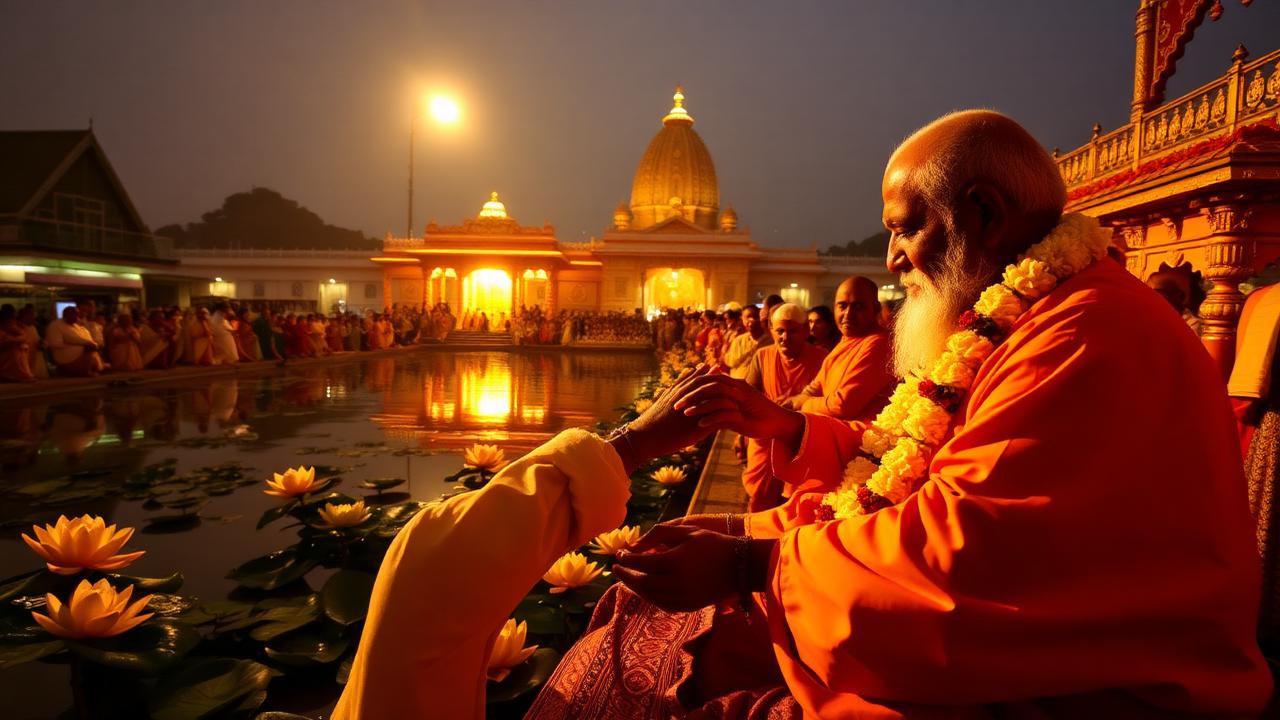
He died in 1914 at Garudeshwar on the Narmada, in what is now Narmada district, Gujarat, and his samadhi is there.
Which is the place that grew after him rather than around him, and is now the principal centre associated with him.
What he wrote
A very large body of work, in Sanskrit and Marathi both, which is unusual and which reflects the scholarship.
- The Datta Purana and Datta Mahatmya
- The Dwisahasri Gurucharitra, a Sanskrit condensation of the Marathi Gurucharitra in two thousand verses, which is what put that text into a pan Indian language
- The Samshlokhi Gurucharitra
- Works on dharmashastra and ritual
- And the stotras, which is what most people actually have of him, and which the third section covers
He is generally credited with reviving the Datta sampradaya in the modern period, and the claim is defensible: the shrines existed before him, and the corpus that organises them into a single tradition is substantially his.
Two Things in One Person
And this entry is not going to smooth over the part that a reader who has come through this series will notice immediately.
He was rigorously orthodox.
On varnashrama. On ritual eligibility. On who may do what and when. On the observances of caste and of the stages of life. He wrote on dharmashastra and he applied it, and he was not a reformer and did not present himself as one.
And the tradition he belonged to contains Chokhamela.
And Soyarabai, who took ritual purity apart in four lines. And Sena the barber. And Narahari the goldsmith. And Kurmadas. And Janabai.
How to hold both
Not by reconciling them, because they do not reconcile.
Three things instead.
One. A tradition is not one person's opinion.
Hinduism has never been a single position and has never required its figures to agree. Shankara and Ramanuja disagree about the nature of reality. The Varkari sants and the smarta jurists disagree about who may approach a deity. Both are inside.
A reader who expects internal consistency from a religion of this size is asking for something no religion of this size has ever had.
Two. You may take part of a person.
This entry has already argued the same thing about a text, in the Gurucharitra section of the previous entry, and it applies to people at least as strongly.
You can sing the Karunatripadi every evening and decline his position on caste. You are not stealing. You are reading.
And this is what everybody actually does, in every tradition, including the people who say they do not.
Three. And be honest in both directions.
Which is the part that gets skipped.
It is easy to name the thing you disagree with and stop. The honest version also names what was genuinely admirable, and in his case there is a great deal.
He would not take money. He would not accumulate. He would not allow an establishment to grow around him. He held himself to a rule that cost him his health and gave him no comfort and produced no property, for twenty three years, without exception.
A very large number of people who talk a better line about equality have not given up anything at all.
So: the social positions are of their period and this entry does not endorse them. The discipline is exceptional and this entry says so. Both statements are true and a reader is allowed to hold them at once.
And there is a further point worth making
The rule he kept is a structural protection.
Everything this series has warned about, in the Garibdas entry, in the Niloba entry, in the entries on captured corpora and manufactured successions, requires one condition: somebody stays in one place long enough for money, property and authority to gather.
Tembe Swami made that impossible by an act of personal discipline.
Which is not a proposal that every teacher should walk. It is an observation about what the walking prevented, and it is worth holding up against any modern arrangement in which a teacher stays, and the buildings rise, and the accounts are not published.
The Stotras, and the River
What most people actually have of him is two prayers, and they are sung every day across Maharashtra and Karnataka.
The Karunatripadi
A three part Marathi prayer, addressed to Datta, beginning shant ho Shri Gurudatta, be at peace, Shri Gurudatta.
It is sung at Datta shrines in the evening, and it is one of those compositions that a person who grew up in a Datta household will know before they know they know it.
Its subject is straightforward and it is why it lasts. It asks the guru to be appeased, acknowledges the faults of the person asking, and does not pretend to have earned anything.
The Ghorakashtoddharana stotra
The name means the removal of terrible difficulty, and it is addressed to Sripada Srivallabha.
And it is the single most recited thing Tembe Swami wrote, because people in trouble reach for it.
Which requires an honest note.
It is a prayer. It is not a mechanism.
A stotra recited a specified number of times does not compel an outcome, and the tradition at its best has never claimed it does. Everything this series has recorded from the sants points the same way: Chokhamela did not get his entry, Kurmadas did not get his legs, Tukaram lost his family in the famine, Namdev's group was scattered, and Paltu Sahib, by his tradition's own account, was burned.
What a stotra actually does is available and worth having.
It gives a person in fear something to do with their voice at three in the morning. It puts words in a mouth that has run out of them. It is a hundred generations of other frightened people having said the same thing, which is not nothing.
And if somebody tells you that reciting it a certain number of times will fix a specific problem and asks you for money to arrange it, that is the thing this series has warned about in every batch.
Use it. Do not bargain with it. And keep doing the practical things: the doctor, the lawyer, the police complaint, the loan restructuring, the conversation you have been avoiding.
Garudeshwar and the Narmada
His samadhi is at Garudeshwar, on the north bank of the Narmada in Narmada district, Gujarat, and it is a working Datta centre with accommodation and daily worship.
It is near Kevadia and the Statue of Unity, which has changed the access and the crowds considerably, and which means the area now has proper roads and hotels and also has restricted zones and controlled entry in places. Check current arrangements before you go.
And it sits on the Narmada, which means the parikrama.
The Narmada parikrama
Which is one of the most demanding religious undertakings anybody in India does, and which is worth describing accurately because people set out underprepared.
It is a circumambulation of the entire river, down one bank and back up the other, from the mouth to the source and around, on foot, and it is well over three thousand kilometres and takes months.
The traditional rule is that you do not cross the river during it.
If you are considering it:
- It is a months long walk in a hot country. Heat stroke is the main killer. Walk early, rest through the middle of the day, and drink far more than you think
- Register locally and tell your family where you are, and carry identity documents and a working phone with a charged power bank
- The Narmada is dammed and controlled. Water levels change without warning when releases happen. Do not camp in a riverbed
- The monsoon stretches are genuinely dangerous and most people break the walk for them
- Ashrams and villages along the route feed parikramavasis by long tradition, which is real and which you should not abuse
- Carry basic medicine, and treat blisters and diarrhoea immediately rather than walking through them
- Ambulance 108. Police 112. Tourist helpline 1363
People die on the parikrama every year, of heat, of road accidents on the highway sections, and of drowning. It is a serious undertaking and it deserves preparation rather than enthusiasm.
Where to go
- Garudeshwar, Narmada district, Gujarat, where his samadhi is
- Mangaon, Sindhudurg district, Maharashtra, his birthplace, where there is a Datta temple
- Narsobawadi, Audumbar and Ganagapur, which are the shrines his writing organised into one tradition
A daily practice from this entry
- The Karunatripadi, in the evening, which takes a few minutes
- The Ghorakashtoddharana stotra, when you need it, as a prayer and not as a lever
- Digambara Digambara Sripada Vallabha Digambara
- And his test, which you can apply to any teacher living or dead: what did they refuse to accumulate
The Short Version
Who: Vasudevananda Saraswati, universally called Tembe Swami, 1854 to 1914, born Vasudev Ganesh Tembe at Mangaon in the Sawantwadi country of the Konkan, now Sindhudurg district, Maharashtra, into a Konkan brahmana household with a very substantial Sanskrit education. He married and lived as a householder, was already known locally for learning and Datta devotion, and after his wife died he took sannyasa in 1891.
The rule: after sannyasa he did not stay anywhere. One night in a village, then walk. The single exception was chaturmas, the four months of the rains when a sannyasi is required by traditional rule to remain in one place, which he observed strictly. For the remaining eight months of every year, for twenty three years, he moved on foot across Maharashtra, Karnataka, Gujarat, the Narmada country and north India. That rule makes an institution impossible, which is the exact inverse of how religious authority is normally built: an establishment forms around a person who stays, people come, then a building, then land, then money, then a trust, then a succession dispute, and a man who leaves in the morning cannot accumulate any of it. No ashram was built around him in his lifetime, no property was assembled, no management committee was formed, he was scrupulous about not accepting money, and he kept nothing. The cost was real: he walked in heat and cold, was frequently ill, had no fixed medical care and died at fifty nine, at Garudeshwar on the Narmada in what is now Narmada district, Gujarat, where his samadhi is.
What he wrote: a very large body in both Sanskrit and Marathi, including the Datta Purana and Datta Mahatmya, the Dwisahasri Gurucharitra, a Sanskrit condensation of the Marathi Gurucharitra in two thousand verses which put that text into a pan Indian language, the Samshlokhi Gurucharitra, works on dharmashastra and ritual, and the stotras. He is generally credited with reviving the Datta sampradaya in the modern period, and the claim is defensible, since the shrines existed before him but the corpus that organises them into a single tradition is substantially his.
Two things in one person: he was rigorously orthodox on varnashrama, on ritual eligibility, on who may do what and when, and on the observances of caste and the stages of life; he wrote on dharmashastra and applied it, and was not a reformer. And the tradition he belonged to contains Chokhamela, Soyarabai, Sena, Narahari, Kurmadas and Janabai. Hold both without reconciling them, because they do not reconcile. First, a tradition is not one person's opinion, since Hinduism has never been a single position and has never required its figures to agree, and a reader who expects internal consistency from a religion of this size is asking for something no religion of this size has ever had. Second, you may take part of a person, exactly as you may take part of a text: you can sing the Karunatripadi every evening and decline his position on caste, and that is not stealing but reading, and it is what everybody actually does. Third, be honest in both directions, which is the part that gets skipped, since it is easy to name the thing you disagree with and stop. He would not take money, would not accumulate, would not allow an establishment to grow around him, and held himself to a rule that cost him his health and gave him no comfort and produced no property, for twenty three years without exception, while a very large number of people who talk a better line about equality have given up nothing at all. And the rule is a structural protection: everything this series has warned about, captured corpora and manufactured successions, requires that somebody stay in one place long enough for money, property and authority to gather, and he made that impossible by personal discipline.
The stotras: two prayers, sung daily across Maharashtra and Karnataka. The Karunatripadi, a three part Marathi prayer to Datta beginning shant ho Shri Gurudatta, sung at Datta shrines in the evening, which asks the guru to be appeased, acknowledges the faults of the person asking, and does not pretend to have earned anything. And the Ghorakashtoddharana stotra, the removal of terrible difficulty, addressed to Sripada Srivallabha, which is the single most recited thing he wrote because people in trouble reach for it. That one needs an honest note: it is a prayer, not a mechanism, since a stotra recited a specified number of times does not compel an outcome, and the tradition at its best has never claimed it does, as Chokhamela did not get his entry, Kurmadas did not get his legs, Tukaram lost his family in the famine, and Paltu Sahib by his own tradition's account was burned. What a stotra does is give a person in fear something to do with their voice at three in the morning and put words in a mouth that has run out of them, which is not nothing. If somebody says reciting it a certain number of times will fix a specific problem and asks for money to arrange it, that is the thing this series has warned about in every batch. Use it, do not bargain with it, and keep doing the practical things.
Garudeshwar and the Narmada parikrama: his samadhi is at Garudeshwar on the north bank in Narmada district, Gujarat, a working Datta centre with accommodation and daily worship, near Kevadia and the Statue of Unity, which has changed access and crowds considerably and means proper roads and hotels but also restricted zones, so check current arrangements. The parikrama is a circumambulation of the entire river, down one bank and back the other, from mouth to source and around, on foot, well over three thousand kilometres, taking months, with the traditional rule that you do not cross the river during it. If you are considering it: heat stroke is the main killer, so walk early, rest through the middle of the day and drink far more than you think; register locally, tell your family where you are, and carry identity documents and a charged phone; the Narmada is dammed and levels change without warning, so do not camp in a riverbed; the monsoon stretches are genuinely dangerous and most people break the walk for them; ashrams and villages feed parikramavasis by long tradition, which you should not abuse; carry basic medicine and treat blisters and diarrhoea immediately; and ambulance 108, police 112, tourist helpline 1363. People die on the parikrama every year, of heat, road accidents on highway sections and drowning.
Frequently Asked Questions
Who was Tembe Swami?+
Vasudevananda Saraswati, 1854 to 1914, born Vasudev Ganesh Tembe at Mangaon in the Sawantwadi country of the Konkan, now Sindhudurg district, Maharashtra, into a Konkan brahmana household with a very substantial Sanskrit education. He married and lived as a householder, was known locally for learning and Datta devotion, and took sannyasa in 1891 after his wife died. He wrote a very large body of work in Sanskrit and Marathi, including the Datta Purana, the Datta Mahatmya, the Dwisahasri Gurucharitra, a Sanskrit condensation of the Marathi Gurucharitra in two thousand verses, works on dharmashastra, and the stotras that are still sung daily. He is generally credited with reviving the Datta sampradaya in the modern period, and the claim is defensible, since the shrines existed before him but the corpus that organises them into a single tradition is substantially his. He died at Garudeshwar on the Narmada in 1914, where his samadhi is.
Why did he never stay more than one night anywhere?+
Because the rule makes an institution impossible, which is the exact inverse of how religious authority is normally built. An establishment forms around a person who stays: people come, then more people, then there is a building, then land, then money, then a trust, then a succession dispute, and this series has recorded that sequence a great many times. A man who leaves in the morning cannot accumulate any of it. So no ashram was built around him in his lifetime, no property was assembled, no management committee was formed, he was scrupulous about not accepting money, and he kept nothing. The single exception to the rule was chaturmas, the four months of the rains when a sannyasi is required by traditional rule to remain in one place, which he observed strictly. The cost was real: he walked in heat and cold, was frequently ill, had no fixed medical care, and died at fifty nine.
How do I hold his orthodoxy alongside sants like Chokhamela?+
Without reconciling them, because they do not reconcile. He was rigorously orthodox on varnashrama, on ritual eligibility, on who may do what and when, and on the observances of caste and the stages of life; he wrote on dharmashastra and applied it, and was not a reformer. And the same tradition contains Chokhamela, Soyarabai, Sena, Narahari, Kurmadas and Janabai. Three things instead of reconciliation. A tradition is not one person's opinion, since Hinduism has never been a single position and has never required its figures to agree, and expecting internal consistency from a religion of this size is asking for something no religion of this size has ever had. You may take part of a person, exactly as you may take part of a text: you can sing the Karunatripadi every evening and decline his position on caste, which is not stealing but reading, and it is what everybody actually does. And be honest in both directions, which is the part that gets skipped: he would not take money, would not accumulate, would not allow an establishment to grow around him, and held himself to a rule that cost him his health for twenty three years without exception, while a great many people who talk a better line about equality have given up nothing at all.
What are the Karunatripadi and the Ghorakashtoddharana stotra?+
The two things most people actually have of Tembe Swami, sung daily across Maharashtra and Karnataka. The Karunatripadi is a three part Marathi prayer addressed to Datta, beginning shant ho Shri Gurudatta, be at peace Shri Gurudatta, and it is sung at Datta shrines in the evening. Its subject is why it lasts: it asks the guru to be appeased, acknowledges the faults of the person asking, and does not pretend to have earned anything. The Ghorakashtoddharana stotra, whose name means the removal of terrible difficulty, is addressed to Sripada Srivallabha and is the single most recited thing he wrote, because people in trouble reach for it.
Will reciting a stotra a fixed number of times solve my problem?+
No, and the tradition at its best has never claimed it does. A stotra is a prayer, not a mechanism, and reciting one a specified number of times does not compel an outcome. Everything this series has recorded from the sants points the same way: Chokhamela did not get his temple entry, Kurmadas did not get his legs, Tukaram lost his family in the famine, Namdev's group was scattered, and Paltu Sahib, by his own tradition's account, was burned. What a stotra actually does is available and worth having: it gives a person in fear something to do with their voice at three in the morning, it puts words in a mouth that has run out of them, and it is a hundred generations of other frightened people having said the same thing, which is not nothing. If somebody tells you that reciting it a certain number of times will fix a specific problem and asks you for money to arrange it, that is exactly the thing this series has warned about in every batch. Use it, do not bargain with it, and keep doing the practical things: the doctor, the lawyer, the police complaint, the loan restructuring, the conversation you have been avoiding.
What should I know before attempting the Narmada parikrama?+
That it is one of the most demanding religious undertakings anybody in India does, and people set out underprepared. It is a circumambulation of the entire river, down one bank and back up the other, from the mouth to the source and around, on foot, well over three thousand kilometres, taking months, and the traditional rule is that you do not cross the river during it. Heat stroke is the main killer, so walk early, rest through the middle of the day and drink far more than you think. Register locally and tell your family where you are, and carry identity documents and a working phone with a charged power bank. The Narmada is dammed and controlled, and water levels change without warning when releases happen, so do not camp in a riverbed. The monsoon stretches are genuinely dangerous and most people break the walk for them. Ashrams and villages along the route feed parikramavasis by long tradition, which is real and which you should not abuse. Carry basic medicine and treat blisters and diarrhoea immediately rather than walking through them. Ambulance 108, police 112, tourist helpline 1363. People die on the parikrama every year, of heat, of road accidents on the highway sections, and of drowning.
About the author
Pandit Ravindra Sharma · Vedic Rituals & Bhakti, 22+ years
Pandit Ravindra is the Vandnaa editorial team's resident specialist on aarti, chalisa, and daily devotion. He has performed home and temple pujas across Varanasi and Delhi for over two decades and contributes the bhakti-focused articles on this site.
Meet the Vandnaa editorial team →