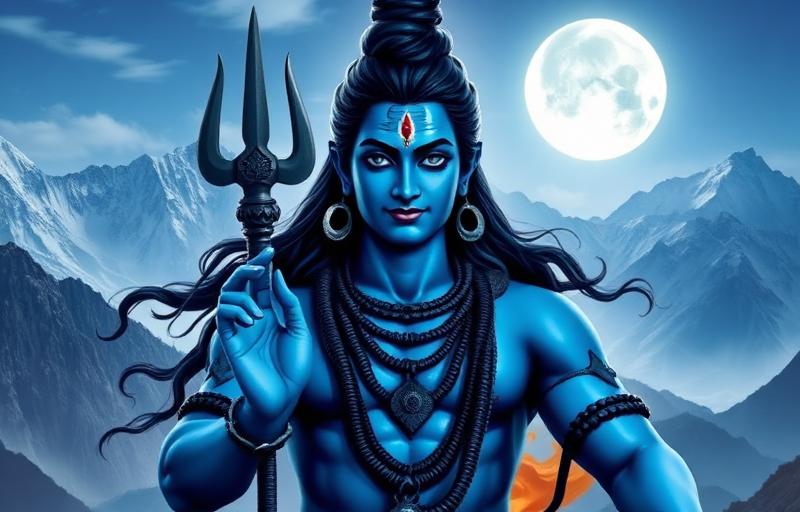
The Third Eye of Mahadev
Among all the marks of Lord Shiva, the third eye (trinetra) on his forehead is one of the most striking. It is normally closed, a vertical eye resting in stillness. The two outer eyes see the world of duality, but the third eye is said to be the eye of inner wisdom and supreme fire - when it opens, it can burn away whatever stands against truth.
Why does Mahadev have this eye, and when did it first blaze open? The answer lies in the beloved katha of Kamadeva, the deva of desire, who once tried to disturb the Lord's deepest meditation.
The Katha of Kamadeva
After the loss of Sati, Lord Shiva withdrew into deep meditation on Mount Kailash, untouched by the world. Meanwhile a powerful asura named Tarakasura had received a boon that only a son of Shiva could slay him. The devas knew that for the world to be saved, Shiva must one day unite with Parvati, the reborn Sati, and a son must be born.
Parvati served Shiva with great devotion, but the Lord remained absorbed in samadhi. The devas, desperate, sent Kamadeva, the deva of love and desire, to awaken longing in Shiva's heart. Kamadeva, with his bow of sugarcane and flower-tipped arrows, crept near and loosed an arrow of desire at the meditating Lord.
The moment his stillness was disturbed, Shiva's anger blazed. His third eye opened, and a stream of fire poured out and burnt Kamadeva to ashes in an instant. This event is remembered as Kama Dahan - the burning of Kama. Later, moved by the pleas of Rati, Kamadeva's grieving wife, Shiva restored Kamadeva, though in a formless way, which is why he is also called Ananga, the bodiless one.
What the Third Eye Means
The third eye is far more than a weapon of destruction. It is the eye of inner vision and wisdom (gyan chakshu), which sees beyond appearances to the truth within.
The burning of Kamadeva is a deep teaching. Kama (uncontrolled desire) is what most disturbs the calm of the mind. When the third eye - the power of awareness - opens, it burns away the grip of blind desire, not love itself, but the restless craving that pulls the soul away from peace.
For the devotee, the third eye is a symbol that true power is the power to master oneself. Shiva, the supreme yogi, shows that one who rules the inner world fears nothing in the outer world.
Lessons from the Katha

- Master desire, do not be mastered by it: Kama burnt because it tried to overpower the Lord of yoga. Desire that is disciplined becomes love; desire that rules us brings downfall.
- Inner stillness is strength: Shiva's deep meditation was not weakness but the highest power. The opening of the third eye flowed from that stillness.
- Grace follows justice: Though Kama was burnt, Shiva later granted him a formless life out of compassion for Rati. Divine anger is brief; divine mercy is lasting.
- The forehead eye is awareness: In our own lives, the third eye reminds us to pause, see clearly, and not act blindly from craving or anger.
Quick Answers
Why did Shiva's third eye open?+
Shiva's third eye opened when Kamadeva, the deva of desire, shot an arrow to disturb his deep meditation on Kailash. The fire from the third eye burnt Kamadeva to ashes in an instant.
Who is Kamadeva and what happened to him?+
Kamadeva is the deva of love and desire, who carries a bow of sugarcane and flower arrows. He was burnt to ashes by Shiva's third eye, an event called Kama Dahan. Later, moved by his wife Rati, Shiva restored him in a formless way, so he is also called Ananga, the bodiless one.
What does Shiva's third eye symbolise?+
The third eye symbolises inner wisdom and awareness (gyan chakshu) that sees beyond appearances to the truth. Its fire represents the power to burn away ignorance and uncontrolled desire, showing that the highest strength is mastery over oneself.
Why is Shiva called Tryambaka?+
Shiva is called Tryambaka, the three-eyed one, because of the third eye on his forehead in addition to his two ordinary eyes. The famous Mahamrityunjaya Mantra begins with 'Om Tryambakam Yajamahe', honouring this very form.
About the author
Anjali Mehta · Editor, M.A. Religious Studies
Anjali is the managing editor for Vandnaa and oversees the festival and vrat coverage. She holds an M.A. in Religious Studies and reviews every published article for accuracy, accessibility, and tradition-fidelity.
Meet the Vandnaa editorial team →