Who Dih Baba Is
Dih Baba, also called Dihwar or Dih Babu, is the guardian deity of the village itself in eastern Uttar Pradesh, Bihar and parts of Jharkhand. The word dih means an old habitation mound, the raised ground on which a settlement stands. The deity of that ground is Dih Baba.
He is not a Puranic deity with a long mythology. He belongs to the layer of Hindu worship that is older than temple building and closer to the land, the same layer that produced gram devtas across India. His role is specific and territorial:
- He guards the boundary and the wellbeing of the village as a settlement, not of individuals
- He is invoked when something new begins - a marriage, a birth, a house, a shop, the first sowing
- He is thanked when something passes safely - a good harvest, a recovery, a return from a long journey
In many villages a related deity, Brahm Baba, sits beside or near him. Brahm Baba is understood as a revered forefather of the village, most often a Brahmin ancestor whose memory became a protective presence. Families in the Bhojpuri belt often speak of the two in one breath, as the deities of their own soil.
The Than: A Deity Without a Temple
Dih Baba's seat is called a than or chaura, and it looks nothing like a temple.
Most thans are a raised platform of mud or brick under an old tree, usually a peepal, neem or pakar. There may be a rough stone smeared with sindoor, a trishul, a few clay elephants or horses left as vows, and coloured flags tied to branches. There is rarely a murti, almost never a roof, and no daily priest.
This simplicity is not neglect, it is the form of the tradition:
- The tree is part of the deity's presence, which is why cutting it is treated as a serious matter and why these trees survive in villages that have otherwise lost their groves
- The stone is not shaped, because Dih Baba is understood as the presence of the place rather than a personality to be sculpted
- The clay horses and elephants left at the than are vow markers. A family that received what it asked for leaves one behind, and over the years hundreds accumulate
Worship is done by the family itself, or by an elder of the village who knows the customary words. The absence of ritual specialists is exactly why the practice has survived quietly for so long.
Dih Pujan: When the Village Turns to Him First
In Purvanchal households, Dih Baba is remembered before the family deity and before the wedding rituals proper begin.
- Before a marriage - the matmangar or matkor party goes to the than, invites Dih Baba, and only then does the mandap work begin. Many families take the bride and groom to the than after the wedding as well.
- Mundan and chhathi - the child's first hair offering or sixth day ceremony often includes a bow at the than
- Griha pravesh - before entering a newly built house, the family offers at the than for the settlement's permission
- New sowing and harvest - the first grain of the season is offered before it is sold or eaten
- Departure and return - families with members working in cities or abroad tie a flag or offer sweets on their safe return
The common thread is permission and gratitude. Dih Baba is not asked for wealth or spiritual liberation. He is asked to let the household's plans go through without harm, in the place where the family lives.
What Is Offered at the Than
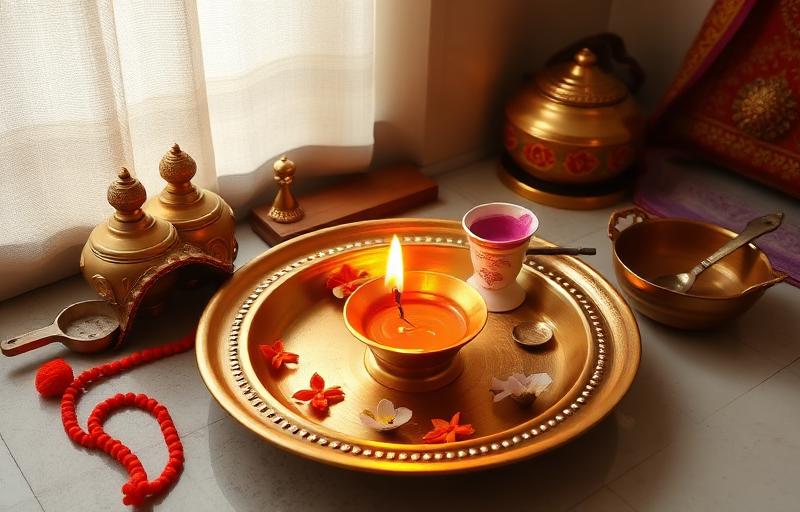
The offerings are deliberately modest, and most of them come from the household kitchen.
- Batasha, gud, laiya and khichdi of the season
- Milk, water and sindoor poured or applied on the stone
- A red or saffron flag tied to the tree when a vow is fulfilled
- Clay horses, elephants and lamps, bought from the local potter
- Malpua, puri and kheer during larger village pujas
- A coconut, increasingly the standard offering where families have moved away from older customs
Some villages historically offered animal sacrifice at folk shrines. Across much of Purvanchal that practice has quietly given way to coconut, batasha and laddoo offerings, and many families today are firm that nothing living should be offered at the than.
If you visit a than as an outsider, the courtesies are simple. Remove footwear before stepping on the platform, do not photograph while a family is offering, do not sit on the chabutra, and never break a branch or pick a flag as a souvenir. The tree and the flags belong to vows that other families made.
Brahm Baba and the Other Deities of the Boundary
Dih Baba rarely stands alone. A Purvanchal village usually keeps a small circle of protective deities, each with a defined job.
- Brahm Baba - a revered ancestor of the village, worshipped at a than of his own, often with a lamp lit on Thursdays
- Kali Mai - the village Devi, approached during epidemics, difficult childbirth and family crises
- Bandi Maa and Sheetla Mata - invoked for children's health, especially in Chaitra
- Goraiya and Sokha Baba - guardians of the outskirts and of cattle, remembered by herding families
- Bhairav Baba - the fierce guardian at the edge, often at a crossroads
What is worth noticing is how neatly this local layer sits inside mainstream Hindu practice rather than competing with it. The same family that bows at the than on the morning of a wedding will complete a full Ganesh puja, a kul devi puja and the saat phere the same evening. The village deities handle the ground, the household deities handle the lineage, and the Puranic deities handle the larger world.
Why This Worship Is Still Alive
Village deities were expected to fade as families moved to cities. In the Bhojpuri belt they did not, and the reason is practical.
Dih Baba is tied to a place, and migration made that place more important, not less. Families settled in Delhi, Surat, Mumbai or the Gulf return for weddings and mundan, and the than is the first stop when they reach the village. For many young people who grew up outside, bowing at the than is the moment that makes the visit feel like a homecoming.
A few practices worth preserving carefully:
- Keep the tree protected. If the old tree dies, villages usually plant a sapling at the same spot rather than shift the than.
- Keep the offerings simple and vegetarian, in line with how most families now worship there.
- Record the customary words and songs from the elders. The Dih pujan geet exist mostly in memory and are the part most at risk.
- Do not turn the than into a concrete temple unless the village decides together. Much of its meaning lies in its open, unowned form.
For devotees who now live far away, the tradition permits a simple substitute. Offer a lamp at home on the day of a family event and remember the than by name. The deity of the soil is understood to accept the remembrance of those who left it.
What People Ask Most
Who is Dih Baba?+
Dih Baba is the guardian deity of the village settlement in eastern Uttar Pradesh, Bihar and parts of Jharkhand. The word dih means the habitation mound on which a village stands, and he is worshipped as the protective presence of that ground.
What is the difference between Dih Baba and Brahm Baba?+
Dih Baba is the deity of the village land itself, while Brahm Baba is understood as a revered forefather of the village whose memory became a protective presence. Many villages keep separate thans for the two, close to each other.
Why is Dih Baba worshipped before a wedding?+
Tradition treats him as the owner of the ground on which the family lives, so his permission is sought before the mandap is raised. In many families the matkor party visits the than first, and the couple is brought there after the wedding as well.
What is offered to Dih Baba?+
Batasha, gud, laiya, milk, sindoor, a coconut, clay horses or elephants from the local potter, and a flag tied on the tree when a vow is fulfilled. Most families today keep the offering entirely vegetarian.
Does worshipping a village deity conflict with worshipping Puranic gods?+
No. In practice the layers work together. The same family bows at the than in the morning and completes Ganesh puja, kul devi puja and the main rituals the same day. Village deities are understood to look after the place, not to replace the larger pantheon.
How can families living in cities keep this tradition?+
Most families visit the than during weddings, mundan or annual trips home. When that is not possible, lighting a lamp at home on the day of the family event and remembering the than by name is accepted as a sincere substitute.
About the author
Anjali Mehta · Editor, M.A. Religious Studies
Anjali is the managing editor for Vandnaa and oversees the festival and vrat coverage. She holds an M.A. in Religious Studies and reviews every published article for accuracy, accessibility, and tradition-fidelity.
Meet the Vandnaa editorial team →Explore on Vandnaa
Related Articles
Kuldevta / Kuldevi - How to Find Your Family Deity, Why It Matters & Worship Vidhi
10 min read
Peepal Tree Worship: Meaning and Significance in Hinduism
7 min read
Kaval Deivam: The Guardian-Deity Tradition of Tamil Nadu Villages
7 min read

Grama Devate: Karnataka's Village Deity Worship Tradition
6 min read