Janmashtami 2026 Date & Vrat Significance
Krishna Janmashtami 2026 falls on August 5, 2026 (Wednesday) - the Ashtami tithi of Krishna Paksha in Bhadrapada month. The celebration peaks at midnight (12:00 AM) - the precise moment of Lord Krishna's birth.
Why it's the biggest Vaishnava fast: Krishna devotees consider this day sacred above all others. While Vaikuntha Ekadashi is significant, Janmashtami is the birth-anniversary of the divine - it's like attending the deity's actual birthday.
The vrat is not just about food rules. It is about:
- Recreating Krishna's birth in your home (jhula/cradle ceremony)
- Singing bhajans till midnight
- Breaking fast at the moment of Krishna's birth
- Distributing Krishna-special prasad (chappan bhog)
2026 specific timings:
- Ashtami tithi begins: August 4, 9:14 PM
- Ashtami tithi ends: August 5, 11:42 PM
- Rohini Nakshatra (Krishna's birth nakshatra): August 5, 8:24 PM to August 6, 9:00 PM
- Nishita kaal (midnight puja): 12:00 AM August 6 (the moment of Krishna's birth)
- Parana (fast-breaking) time: August 6 morning after sunrise
Smaartha vs Vaishnava difference:
- Smaartha tradition observes Janmashtami if Ashtami + Rohini overlap during night
- Vaishnava tradition observes on the day Ashtami is during midnight + sunrise
- In 2026, both fall on the same day (August 5) - no confusion
Why it matters in 2026: August 5 is a Wednesday - most working professionals can plan for the night vigil. Schools are typically closed. Many companies grant half-day. Plan early.
🦚 The Vandnaa App's Janmashtami module has 2026-specific timings, jhula ceremony guide, chappan bhog list, Krishna mantras for midnight, and bhajan playlists.
Three Types of Janmashtami Vrat
Devotees observe Janmashtami at different intensity levels:
Type 1 - Phalahaar Vrat (Mild) - Most Popular
- Fruits and milk during the day
- Single small meal of vrat-friendly foods (sabudana, kuttu, makhana) at evening
- Continue fast until midnight
- Break at 12:00 AM with prasad
- Suitable for working professionals
Type 2 - Nirjal Vrat (Strict) - For Devoted
- No food AND no water for 24 hours
- Begin: morning of August 5 (after sunrise)
- Break: morning of August 6 (after sunrise)
- Recommended only for healthy adults
- Avoid if diabetic, pregnant, or elderly
Type 3 - Khichri Vrat (Single-meal) - For Most Devoted
- One meal of khichri (rice + dal + ghee) at evening
- No food after sunset until midnight
- Break at 12:00 AM with sweet prasad
- Continue light eating only on August 6
- Common in ISKCON tradition
Choosing your vrat:
- First-timer: Phalahaar (easiest)
- Experienced devotee with health: Nirjal
- Serious sadhaka: Khichri or Nirjal
- Diabetic / pregnant / child: Phalahaar with extra fruits + dairy
The rules across all types:
- No non-veg, no alcohol, no garlic-onion
- Wear yellow/orange/white
- Avoid deep argument or anger
- Maintain pure thought
- Sing/listen to Krishna bhajans throughout the day
The midnight break: At 12:00 AM precisely, do the jhula ceremony (rocking baby Krishna's cradle), perform Krishna aarti, then break fast with prasad. This timing matters - break too early, vrat is incomplete; break too late, body suffers.
Special: Nishita Kaal Puja The midnight puja is the heart of Janmashtami. Even those who can't fast should attempt the midnight puja:
- 12:00 AM - Birth ceremony of Krishna
- Bath the murti (abhishek)
- Sing Aarti Kunj Bihari Ki
- Offer chappan bhog (or simplified bhog)
- Distribute prasad to all family members
Janmashtami Vrat Foods - Complete List
ALLOWED foods (Phalahaar):
Fruits (any):
- Banana, apple, mango, papaya, grapes, pomegranate, watermelon, orange
- All varieties of melons, berries, citrus
Dairy:
- Cow's milk, buffalo milk
- Curd (sweet, fresh)
- Paneer
- Buttermilk, lassi
- Ghee
- Butter
Vrat-special grains:
- Sabudana (tapioca pearls) - sabudana khichri, sabudana vada
- Kuttu (buckwheat) flour - kuttu poori, kuttu pakora
- Singhara (water chestnut) flour - singhara halwa
- Makhana (fox nuts) - makhana kheer, roasted makhana
- Amaranth flour - rajgira ladoos
Other allowed:
- Potato (with rock salt only)
- Sweet potato (shakarkand)
- Coconut (fresh and dry)
- Dry fruits (almonds, cashews, raisins, dates)
- Honey, jaggery, ghee
- Ginger, cumin, green chili (in moderation)
- Rock salt (sendha namak) - NOT regular table salt
- Lemon
Krishna's special prasad items (cooked for midnight bhog):
- Makhan (white butter) - Krishna's signature prasad
- Mishri (rock sugar) - paired with makhan
- Panchamrit (5-nectar mix) - milk + curd + ghee + honey + sugar
- Panjiri - wheat flour roasted in ghee with sugar and dry fruits
- Kheer - milk-rice sweet (yes, rice IS allowed in midnight prasad in some traditions)
FORBIDDEN foods on Janmashtami vrat:
- ❌ Regular table salt (use rock salt only)
- ❌ Wheat in ordinary form (only kuttu, singhara, rajgira flours allowed)
- ❌ Dal/lentils (except moong dal in some traditions)
- ❌ Onion, garlic, asafoetida (hing)
- ❌ Non-vegetarian - fish, eggs, meat
- ❌ Alcohol, tobacco, drugs
- ❌ Coffee, tea (some traditions allow)
- ❌ Processed/packaged junk food
- ❌ Restaurant food (unless verified vrat-friendly)
Sample meal plan for Phalahaar Vrat:
- Morning (after sunrise): Glass of milk + 2-3 fruits
- Noon: Banana lassi or buttermilk + handful of dry fruits
- Evening (around 6 PM): Sabudana khichri OR Kuttu pakora with potato + curd
- 9 PM: Glass of milk
- 12 AM (Krishna's birth): Break vrat with Panjiri + Makhan-Mishri prasad
- August 6 morning: Resume normal sattvic diet (no non-veg for 24 hours)
🍯 The Vandnaa App's Janmashtami module has detailed vrat recipes with cooking videos for sabudana khichri, kuttu pakora, panjiri, and the complete chappan bhog list with ingredient quantities for 4-6 people.
Midnight Krishna Janma Celebration
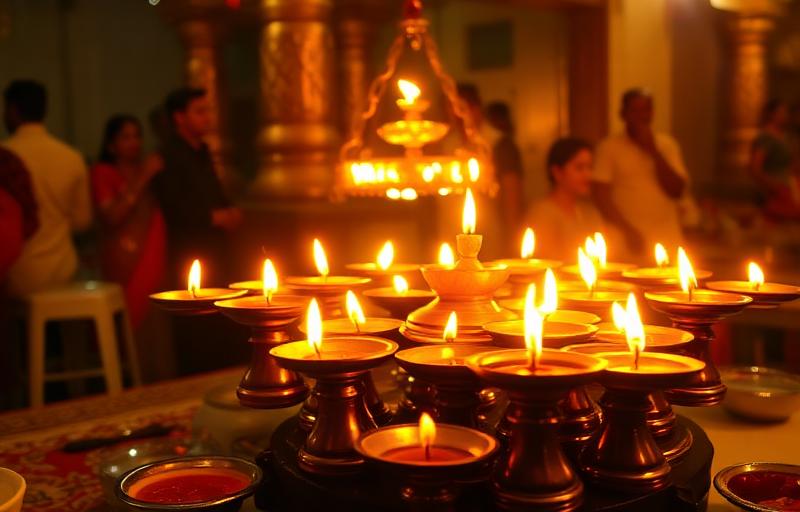
The midnight ceremony is the heart of Janmashtami. Every detail commemorates Krishna's actual birth in Mathura's prison.
Setup (do this by 9 PM):
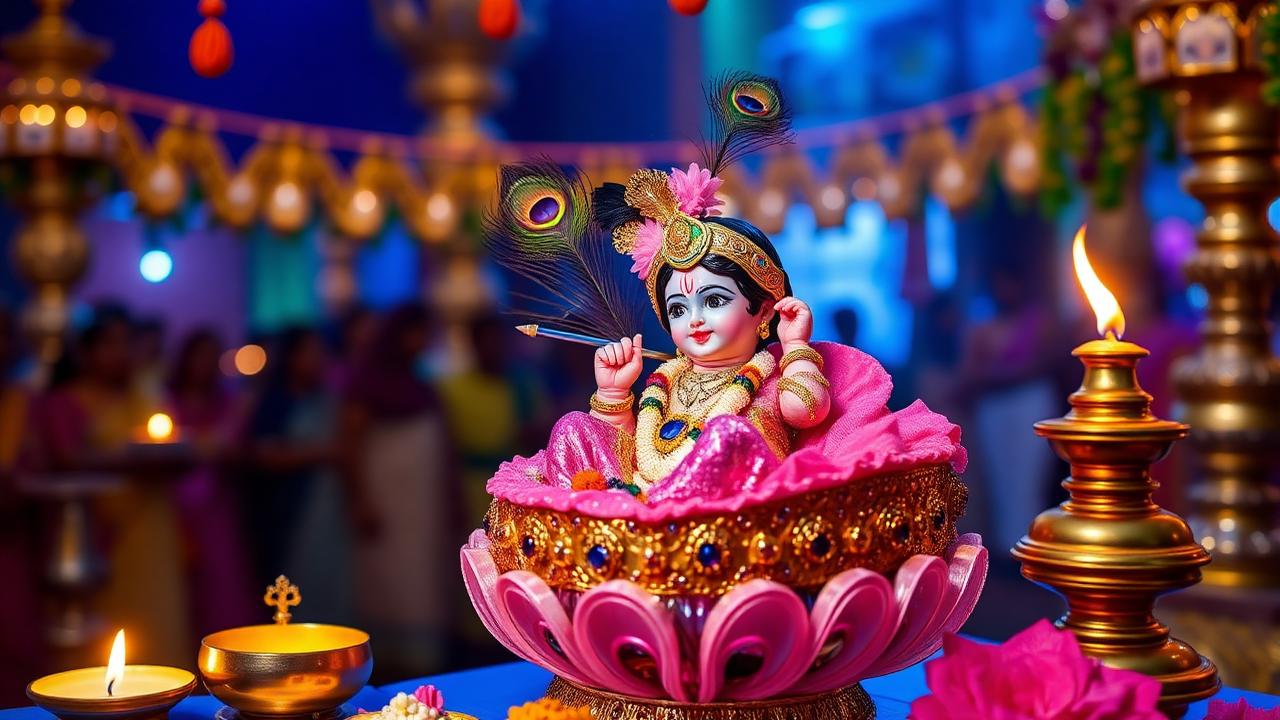
1. Bal Krishna murti / Laddoo Gopal - small Krishna baby idol 2. Jhula (cradle) - decorated with flowers and ribbons 3. Yellow cloth for the jhula 4. Peacock feathers - Krishna's signature 5. Tulsi leaves - fresh, mandatory 6. Yellow flowers (marigold, lotus) 7. Ghee diya + camphor 8. Bell for aarti 9. Bhog items - makhan, mishri, panchamrit, panjiri (minimum) 10. Conch (shankh) if available
The hour-by-hour ceremony:
9-10 PM - Krishna Bhajan time:
- Family gathers in the puja room
- Sing bhajans - 'Govinda Bolo Hari Gopal Bolo', 'Achyutam Keshavam', 'Gopala Gopala'
- Chant Hare Krishna mahamantra: 'Hare Krishna Hare Krishna Krishna Krishna Hare Hare, Hare Rama Hare Rama Rama Rama Hare Hare'
10-11 PM - Story time:
- Read Krishna's birth story from Bhagavata Purana
- Children especially benefit
- Discuss Krishna's life lessons
11-11:50 PM - Final preparation:
- Bath the Bal Krishna murti with panchamrit
- Wipe gently, dress in yellow
- Apply chandan + sindoor tilak
- Place in jhula
- Cover with yellow blanket (representing Yashoda's wrap)
- Light extra diyas
- Final flowers and Tulsi
11:50 PM-12:00 AM - Build-up:
- Continuous chanting of 'Govinda Bolo Hari Gopal Bolo'
- Ring the bell rhythmically
- Blow the conch shell
- Create festive atmosphere
12:00 AM PRECISELY - KRISHNA'S BIRTH:
- At the exact moment, blow conch shell loudly
- Ring bell vigorously
- Shout 'Krishna avtaar' / 'Jai Shri Krishna'
- Begin rocking the jhula gently
- All family members rock the cradle one by one
- Sing 'Aarti Kunj Bihari Ki'
- Offer panchamrit to murti
- Light camphor and circle the murti
- Offer ALL bhog items at this moment
12:30 AM - Distribution:
- Take ghee + sugar prasad first (most sacred)
- Distribute panjiri to all family
- Drink panchamrit
- Eat makhan-mishri
- This breaks the vrat!
12:45 AM-1:30 AM - Continued bhajan:
- Some families continue bhajans till 2-3 AM
- Read Bhagavad Gita Chapter 10 (Vibhuti Yoga)
- Or discuss Krishna lila
1:30-6 AM - Sleep:
- Most families rest
- Jhula stays in puja room
- Murti stays dressed
Morning (August 6):
- Wake before sunrise
- Bath
- Light puja with fresh flowers
- Take parana - first food after vrat-breaking
- Continue sattvic eating for the day
Chappan Bhog - The 56-Item Krishna Offering
Krishna receives the most elaborate bhog in Hindu tradition - chappan bhog (56 items). The story:
When young Krishna lifted the Govardhan mountain to protect Vrindavan from Indra's wrath, he held it up for 7 days and 7 nights. During this time, he ate nothing. The villagers, after the protection ended, prepared him 8 meals × 7 days = 56 items to make up. This became the chappan bhog tradition.
Full traditional 56 items:
Sweets (16 items): 1. Kheer 2. Rabdi 3. Halwa 4. Mohanthal 5. Pedhe 6. Barfi 7. Laddoo (besan) 8. Imarti 9. Rasgulla 10. Jalebi 11. Mathri (sweet) 12. Murabba 13. Panjiri 14. Mishri 15. Honey 16. Jaggery
Dry items (8 items): 17. Roasted dry fruits 18. Cashew 19. Almond 20. Pistachio 21. Walnut 22. Date 23. Raisin 24. Coconut barfi
Fresh items (8 items): 25. Banana 26. Mango 27. Apple 28. Pomegranate 29. Grapes 30. Watermelon 31. Cucumber 32. Coconut water
Cooked savory (8 items): 33. Khichri 34. Sabzi (mixed vegetable) 35. Kachori 36. Samosa 37. Pakora 38. Mathri (savory) 39. Papad 40. Bhature (special vrat-friendly version)
Dairy items (8 items): 41. Makhan (white butter) 42. Ghee 43. Curd 44. Paneer 45. Buttermilk 46. Cream (malai) 47. Yogurt drink 48. Milk
Beverages (8 items): 49. Lassi 50. Sherbet (rose, kewra) 51. Coconut water 52. Sugarcane juice 53. Lemon water 54. Aam panna 55. Buttermilk 56. Plain milk
Modern simplified chappan bhog (12 items): If 56 is impractical, the simplified version: 1. Makhan-Mishri 2. Kheer 3. Panjiri 4. Mathri 5. Halwa 6. Banana 7. Apple 8. Mango 9. Coconut water 10. Ghee 11. Curd 12. Panchamrit
Even 12 items prepared with love is acceptable.
The principle: Chappan bhog is not about quantity but completeness - every food category represented. The lesson is to offer Krishna everything you have - not selectively your best, but the totality of nourishment. He, like a beloved child, accepts all.
For ISKCON-style devotees: Many ISKCON temples display all 56 items at the altar on Janmashtami midnight. Photos go viral on social media. The total preparation takes 4-5 days of family cooking - making it a multi-generational bonding event.
Common Janmashtami Vrat Mistakes
1. Eating regular salt by accident. Many vrat-foods at restaurants use regular salt. Always cook at home or verify ingredients.
2. Breaking fast before midnight. The whole point is to break at Krishna's birth moment. Breaking at 11:30 PM or 11:55 PM means missing the vrat's purpose. Wait till 12:00 AM precisely.
3. Eating non-veg the day before. The vrat actually starts spiritually 24 hours before. Non-veg on August 4 contaminates the August 5 vrat.
4. No Tulsi in Krishna offerings. Tulsi is mandatory. Even just one fresh leaf must be present in midnight bhog.
5. Skipping the jhula ceremony. Many people just do aarti without the cradle ritual. The jhula is what makes Janmashtami unique - recreating Krishna's birth scene.
6. Wearing dark colors. Yellow is Krishna's signature color. Saffron, white, light pink also acceptable. Avoid black/dark blue.
7. Missing the Hare Krishna mahamantra. Continuous chanting between 11 PM-12 AM amplifies the energy. Silent waiting feels less powerful.
8. Eating heavily after midnight. Body has fasted 12-24 hours. Heavy food causes stomach issues. Start with prasad only, then light food on August 6 morning.
9. Treating it as routine. Janmashtami requires the full emotional engagement - the joy of welcoming a divine child. Mechanical observation gives mechanical results.
10. Not involving children. This is THE festival children love most - Krishna's birth, the jhula, the prasad. Involve them at every step. Family memories of Janmashtami last lifetimes.
11. Forgetting peacock feathers. Krishna's signature ornament. Even one feather in puja invokes him strongly.
12. Skipping Bhagavad Gita reading. Reading Chapter 10 (Vibhuti Yoga) on Janmashtami connects you to Krishna's actual teaching, not just his birth story.
Make Janmashtami 2026 a Lifelong Memory
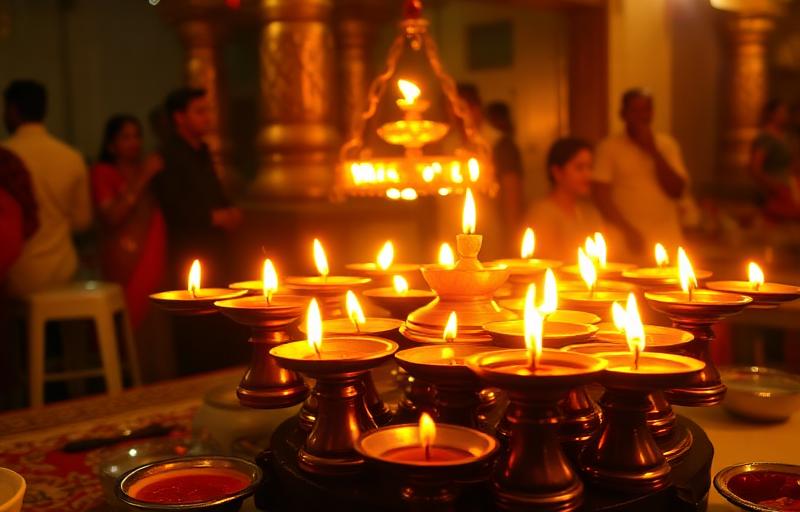
Janmashtami is the most family-centered Hindu festival. Unlike Diwali (consumer-driven) or Holi (color-driven), Janmashtami is about creating an emotional memory of welcoming a divine child into the home.
Three commitment levels:
Level 1 - The Family Devotee:
- Phalahaar vrat
- Simplified midnight ceremony with jhula + bhog
- Children involved throughout
- 4-hour evening commitment (8 PM-12 AM)
- Sustainable yearly practice
Level 2 - The Devoted:
- Nirjal vrat
- Full midnight ceremony with extended bhajans
- Visit local Krishna temple if possible
- 6-8 hour commitment (8 PM-2 AM)
Level 3 - The Sadhaka:
- Khichri vrat
- Full chappan bhog preparation
- Bhagavad Gita reading + bhajans + jhula + abhishek
- Full vigil till sunrise
- ISKCON-style elaborate celebration
Preparation timeline:
- July 25-30: Buy items (jhula, peacock feather, Krishna murti if needed)
- August 1-3: Plan the menu, prepare vrat foods
- August 4 evening: Begin sattvic eating, no non-veg
- August 5 morning: Begin vrat
- August 5 9 PM: Begin family ceremony
- August 5 12:00 AM: Krishna's birth - the moment
- August 6 morning: Parana, normal sattvic day
A final reflection:
When you watch a small child's eyes light up at 12:00 AM as the family rocks the cradle and shouts 'Krishna avtaar!' - you understand why Hindu families have done this for thousands of years. This memory enters the child's deepest layers. Years later, when the child becomes a parent, they recreate the same scene for their child. The chain of bhakti across generations is unbroken.
Krishna doesn't need your wealth, austerities, or theological sophistication. He needs your family's joy. Janmashtami is the night to give him that.
At 12:00 AM on August 6, 2026, may every reader's home echo with: 'Jai Shri Krishna! Krishna avtaar!'
Hare Krishna. Govinda Bolo. Radhe Radhe.
🦚 The Vandnaa App's Janmashtami 2026 module: countdown to August 5 midnight, jhula ceremony video tutorial, chappan bhog recipe collection, family bhajan playlist, and 11-Janmashtami sankalpa tracker.
Frequently Asked Questions
When exactly should I break my Janmashtami vrat?+
At 12:00 AM precisely on the night of Janmashtami (technically the start of August 6, 2026). This is Krishna's birth moment. Break with the prasad - panjiri, panchamrit, makhan-mishri.
Can diabetics observe Janmashtami vrat?+
Light Phalahaar vrat is acceptable with doctor's approval. Eat regularly throughout the day with vrat-friendly foods. Skip the night-long fast - break at evening time. The spirit matters more than strict observance for those with health issues.
Is Janmashtami fasting suitable for children?+
Children below 10 should NOT do strict vrat. They can participate in the celebration - wear yellow, sing bhajans, help with jhula ceremony, eat vrat-friendly foods like fruits and milk through the day. The midnight celebration is what they remember most.
Can I do Janmashtami at home if I can't visit a temple?+
Absolutely yes. Home Janmashtami is actually MORE personal than temple visit. With Krishna murti, jhula, family bhajans, and midnight ceremony at home, you create direct family-bonding bhakti. Temple visit is supplementary, not necessary.
What is the difference between Smaartha and Vaishnava Janmashtami?+
Both observe Krishna's birth on Bhadrapada Krishna Ashtami. Smaartha tradition observes when Ashtami + Rohini overlap during night. Vaishnava observes the day when Ashtami covers midnight + sunrise. In 2026, both fall on August 5.
Can I eat rice during Janmashtami vrat?+
Regular rice is forbidden. However, kheer (made with rice + milk + sugar) is allowed and even preferred as midnight bhog in some traditions. Sabudana (tapioca) and rajgira are rice-substitutes for the day.
About the author
Pandit Mahesh Trivedi · Festival Traditions & Panchang
Pandit Mahesh leads the festival-date and Panchang content on Vandnaa. He cross-references multiple regional panchangs (Drik, Vaishnava, Bengali, Marathi) for every festival date published on the site.
Meet the Vandnaa editorial team →Explore on Vandnaa
Related Articles
Krishna Janmashtami 2026: Date, Midnight Puja Vidhi, Mantras & Complete Vrat Guide
11 min read
Krishna Aarti Lyrics in Hindi & English - Aarti Kunj Bihari Ki
9 min read
108 Names of Lord Krishna: Complete List with Meaning, Benefits & How to Chant Daily
12 min read
Hare Krishna Maha Mantra – Lyrics, Meaning & Benefits
9 min read
Govardhan Puja 2026: Date, Annakut Bhog Vidhi, Krishna's Mountain-Lifting Katha & Mantras
11 min read
Tulsi Vivah 2026: Date, Katha, Puja Vidhi & Why This Marriage Begins Wedding Season
9 min read