The Third of the First
Pey Alvar is the third of the twelve Alvars and the last of the three Mudhal Alvars.
His appearance:
- At Mylapore, now in Chennai, at the Adi Kesava Perumal temple
- Not from a womb, like the other two
- In a red lily, a senkazhuneer flower, in a well
- He is taken as an amsha of the Nandaka, Vishnu's sword
The name. Pey in Tamil means a spirit or a possessed being, and by extension somebody who behaves as though out of their senses.
Why he is called that. Because of how he behaved once he had seen.
The tradition holds that after his vision he went about in a state that looked, to onlookers, like madness: absorbed, unconcerned with ordinary conduct, speaking of what he had seen to anybody at all.
His other names are Mahathahvayar and Bhrantayogi, the yogi who appears deranged.
On the word. It is worth being clear that this is a compliment in the tradition and not a diagnosis.
The category of the God intoxicated person who appears mad is a recognised one across Indian devotion: the avadhuta, the paramahamsa, the unmatta state.
The idea is that somebody who has genuinely seen will not be able to maintain ordinary social performance, and that this is evidence rather than a problem.
A necessary caution alongside it. Because this is the kind of idea that can be used badly.
The tradition's category of divine madness is not a reason to leave a person who is genuinely unwell without care. Somebody who is not eating, not sleeping, at risk of harm, or in distress needs help, and the fact that a tradition has a category for ecstatic states does not change that.
If you are worried about somebody, Tele MANAS is 14416, free, in many Indian languages. The saints' biographies are not a treatment plan.
Mylapore. His place deserves a note.
- One of the oldest parts of Chennai, older than the city
- The Kapaleeshwarar temple, the great Shiva temple with its gopuram and tank, is there
- The Adi Kesava Perumal temple, where Pey Alvar appeared, is nearby
- The name is generally read as mayil arpu, the cry of the peacock, connected to Parvati having worshipped Shiva there in the form of a peahen
- It was a port and a centre of Tamil learning long before the colonial city
So the third Alvar came from what is now a neighbourhood of Chennai, a short walk from a temple tank that people still sit beside in the evening.
I Saw the Lady
The opening verse of the Moondram Thiruvandhadhi is the most quoted single verse of the three Mudhal Alvars, and every word of it is doing work.
What it says:
I saw Thiru, the Lady. I saw the golden form. I saw the colour of the rising sun. I saw the shining discus, and I saw the conch. And I saw all of it, here.
Why it is remarkable. Four things.
One. It is a list of perceptions, not an argument. Poigai and Bhutham both constructed something: a lamp, a set of instruments, a purpose. Pey does not construct. He reports.
That is the third position and it is the strongest. The other two are still doing something. He has stopped doing anything.
Two. He names Sri first. Before the golden form, before the colour, before the weapons, he says he saw Thiru, which is Lakshmi.
This is a doctrinal point of the first order in Sri Vaishnavism and it is not incidental.
Three. The order of what follows is a body being assembled in front of him: first the Lady, then the form, then the colour, then the discus, then the conch.
That is how sight actually works in low light. You resolve one thing, then another. The verse reproduces the experience rather than describing it.
Four. The last word is here. Not somewhere, not in a vision, not in heaven. Here, in this place, in the passage, in the dark, in the rain.
The theological weight of Sri. Since it matters and since most readers will not know it, here it is plainly.
In Sri Vaishnavism:
- Sri, or Lakshmi, is inseparable from Vishnu
- She is the purushakara, the one who intercedes, who recommends the devotee to the Lord
- The tradition holds that the Lord's justice would be unbearable without her mercy, and that she is the reason a fault is overlooked
- The Dwaya mantra, the central mantra of the tradition, begins with taking refuge at the feet of Narayana with Sri
- The very name of the tradition, Sri Vaishnavism, carries her
The Ramanuja formulation. She is the mother, he is the father, and a child in trouble goes to the mother, who then speaks to the father.
That is why Pey Alvar sees her first, and why the tradition treats his verse as a foundational statement rather than as a stylistic choice.
On the whole sequence again. Read together, the three verses are:
- I built a lamp out of the world so I could praise
- I built a lamp out of myself so I could praise
- I saw her, and then him, and it was here
The first two are about the effort to approach. The third is about what happens when approach stops being necessary.
And the tradition put them in that order, as the first three items of a four thousand verse canon, which means it understood exactly what it had.
The Moondram Thiruvandhadhi
His work: the Moondram Thiruvandhadhi, the Third Sacred Antadi, a hundred verses, the third item of the Prabandham.
The form: the same antadi ring as the other two, with the last word of each verse opening the next and the hundredth closing back to the first.
What the hundred contain:
- The avataras, with Trivikrama, Krishna, Rama, Varaha and Narasimha recurring
- The temples, named and praised
- Sri, more prominently than in the other two Mudhal works
- The name and its sufficiency
- The poet's own condition, and his insistence on what he has seen
A distinguishing feature. Pey returns repeatedly to sight as the operative verb.
Other Alvars sing, remember, serve, long for and take refuge. Pey sees. His verbs are visual to an unusual degree and the whole hundred keeps returning to what has been placed in front of him.
That is consistent with the biography, and it is why the tradition calls his the most direct of the three works.
On the Lord as accessible in temples. All the Alvars hold this, but it is worth stating properly because it is the doctrinal heart of the whole tradition.
Sri Vaishnavism holds that the Lord is present in five modes:
- Para, the supreme form in Paramapadam
- Vyuha, the emanations
- Vibhava, the avataras, which are past
- Antaryami, the inner controller within each being
- Archa, the image in the temple
Archa is the one that matters here.
The tradition's claim is that the temple image is not a symbol of the Lord and not a reminder of him. It is him, present, having accepted that form, having limited himself to it, so that people who cannot reach the other four modes can reach this one.
And the reason that claim is credible within the tradition is precisely because the Alvars said they had seen him there.
Pey Alvar's verse is evidence in that argument. He says he saw the golden form, the discus and the conch, here.
So when the tradition later has to explain why a stone image is treated as a person, it can point to a poet who reported seeing.
On the accessibility argument more broadly. This is the Sri Vaishnava emphasis and it is worth carrying away.
The Para form is too far. The vyuhas are abstract. The avataras are over. The antaryami is inside you but you cannot find it.
Archa is available, at a fixed address, at fixed hours, to anybody who walks in.
The tradition regards that as the greatest of the five, because it is the one that involves the most descent: the supreme reality accepting the limits of a stone form in a town, and waiting there.
That is what the Alvars were singing to, and it is why the 108 Divya Desams are addresses rather than ideas.
Mylapore
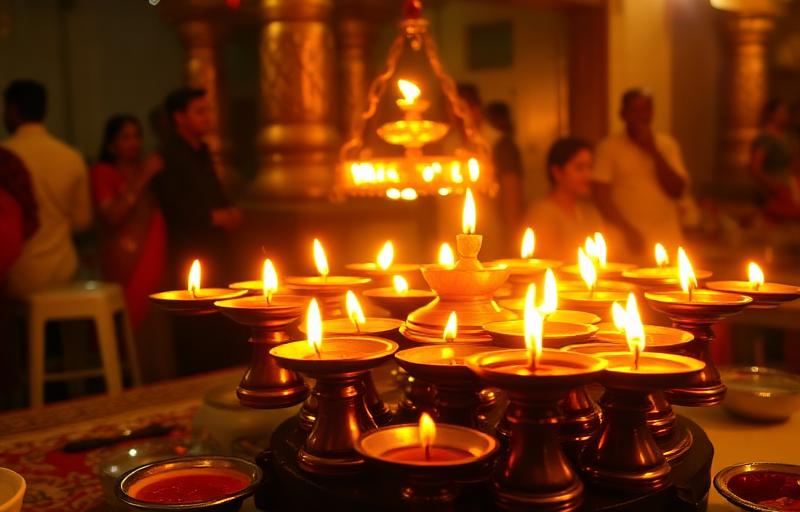
The neighbourhood where Pey Alvar appeared is worth a visit in its own right and is one of the most walkable pieces of devotional geography in India.
What is there:
- Kapaleeshwarar temple, the great Shiva temple, with its 37 metre gopuram and the tank
- Adi Kesava Perumal temple, where Pey Alvar appeared
- The Mylapore tank, with steps, used and sat beside daily
- Madhava Perumal temple
- Ramakrishna Math
- San Thome basilica, a short walk away
- Luz Church
- The Kapaleeshwarar streets, with the four mada veedhis, the processional streets around the temple
Kapaleeshwarar. Since anybody visiting will go there:
- The name means the Lord of the kapala, the skull, which is Shiva as Bhairava, connected to the story of Brahma's severed head
- The story of the place is that Parvati worshipped Shiva here in the form of a peahen, a mayil, which gives the name Mylapore
- The temple as it stands is largely of the sixteenth and seventeenth centuries; the older temple is understood to have been near the shore and was destroyed
- Arupathimoovar, the festival of the sixty three Nayanars, in Panguni, March or April, is the great festival here, when images of all sixty three Shaiva saints are taken in procession
Arupathimoovar is worth timing for. The sixty three Nayanars, the Shaiva counterparts of the Alvars, are carried through the streets of Mylapore in a single day.
Among them is Karaikkal Ammaiyar, and among them is Nandanar, and among them are kings and farmers and a hunter.
It is one of the great street festivals of south India and it happens in a Chennai neighbourhood.
Thiruvalluvar. Also of Mylapore, by tradition.
The author of the Thirukkural, the 1330 couplets that are the central ethical text of Tamil, is traditionally held to have lived at Mylapore, and there is a temple to him there.
The Thirukkural is worth knowing about in this context because of what it does not do: it names no deity, belongs to no sect, and its ethics are stated in a way that any tradition could accept.
That text and the Alvar tradition come from the same soil, within a few centuries and a few streets of each other.
Visiting Mylapore:
- In central Chennai, well connected by metro, bus and auto
- The Kapaleeshwarar temple is open morning and evening with a midday closure
- Footwear off, modest dress, and photography restricted inside
- The tank and the mada streets are pleasant in the evening
- Mylapore in the morning, for the flower market and the filter coffee, is one of the better experiences in the city
- December is the Chennai Margazhi music season, when the sabhas run continuous Carnatic concerts, much of it devotional repertoire including Alvar and Nayanar verses
The Margazhi season deserves a note. Through December and early January, Chennai hosts hundreds of Carnatic music and Bharatanatyam performances.
A large part of the repertoire is devotional: Tyagaraja, Dikshitar, Syama Sastri, Annamacharya, Purandara Dasa, and Tamil compositions including Prabandham verses and Thiruppavai.
It is the largest annual concentration of Indian classical devotional performance anywhere, it happens in the month the Prabandham is recited in the temples, and much of it is free or inexpensive.
What Pey Alvar Leaves You With
The third Alvar's contribution, stated plainly.
One. Stop constructing.
The first two verses of the sequence are both about building an apparatus. The third abandons the apparatus.
That is not a criticism of the first two. The sequence needs them. But the endpoint is not a better lamp. It is not needing one.
Two. She comes first.
The insistence that Sri is seen before the Lord is the doctrinal core of Sri Vaishnavism and it has a practical consequence for a devotee: the approach is through mercy rather than through merit.
A tradition that puts the intercessor first is a tradition that has decided people will not qualify on their own record, and has built accordingly.
That is a considerable comfort and it is meant to be.
Three. Here.
The last word of the verse is the important one. Not in a heaven, not at the end of a practice, not after enough lifetimes.
In this place, in the dark, in a narrow passage during a rainstorm, among two other people.
Four. The reporting is the poem.
Pey Alvar does not tell you how to see. He does not give a method. He says what happened.
That is a particular kind of religious writing and it is the kind that persuades: not an argument that the thing is possible, but a person saying it occurred.
A caution to hold with it. Because devotional traditions produce claims of vision, and not all of them are honest.
- A saint's report of a vision is part of the tradition's testimony, not a standard you must meet
- Nobody's devotion is deficient because they have not seen anything
- The overwhelming majority of devout people across every tradition report no visions at all, and the tradition has never held that against them
- Anybody who tells you that you must have an experience, or that they can arrange one for a fee, is selling something
The Alvars themselves are clear about this. Their standing instruction is the name, which anybody can say, not the vision, which nobody can arrange.
What to do with it:
- Read the verse. It is short
- Notice that he names her first
- Notice that he says here
- Then go and look at something, in a temple or not, with the attention the verse is describing
That is all it asks, and the saint who was called mad for it wrote a hundred more verses about it and then, by tradition, went on saying it to anybody who would listen.
Where to Go
The places
Mylapore, Chennai:
- Adi Kesava Perumal temple, where Pey Alvar appeared
- Kapaleeshwarar temple and the tank
- Central Chennai, easy access by metro and road
- Arupathimoovar festival in Panguni, March or April
Thirukovalur:
- Villupuram district, around 200 kilometres from Chennai
- The Trivikrama Divya Desam and the narrow passage
- Shrines to all three Mudhal Alvars
- Best combined with Thiruvannamalai, which is close
Srirangam:
- Near Tiruchirappalli
- The foremost Divya Desam and the largest functioning temple complex in the world by area
- Adhyayana Utsavam in Margazhi, twenty one days of the whole Prabandham
- Vaikunta Ekadashi, when the Paramapada Vasal, the northern gate, is opened and pilgrims pass through it
A route for the three Mudhal Alvars. It works as a trip.
- Chennai: Mylapore for Pey Alvar
- Mahabalipuram, 55 kilometres south, for Bhutham Alvar
- Kanchipuram, inland, for Poigai Alvar at Thiruvekka
- Thirukovalur, further south, for the corridor
- Ending at Srirangam if you have the days
That is a well spaced four or five day route through northern Tamil Nadu, all on good roads, taking in three Divya Desams, the Pallava monuments and Kanchipuram's temples.
Reading
- Nalayira Divya Prabandham, with Tamil and translation
- The Moondram Thiruvandhadhi is the third item
- Begin with the first verse, which is four lines and is the reason he is remembered
- Recitation recordings are widely available
Listening
- Any Sri Vaishnava temple's daily Prabandham recitation
- The Araiyar Sevai at Srirangam, Alwarthirunagari or Srivilliputhur, if you can time it, since very few families still practise it
- The Margazhi season in Chennai
A closing thought. Three men who by tradition were not born, who appeared in three flowers along one coast, met in a passage in the rain because none of them would leave.
One of them lit the world. One lit himself. And the third looked up and said, in effect, that there was no need, because she was already there, and behind her he was, and this was the place.
They are the first three items in a canon of four thousand verses that is still recited every day, and the whole of it opens with a man wondering what he could use for a lamp.
Reader Questions Answered
Who was Pey Alvar?+
The third of the twelve Alvars and the last of the three Mudhal Alvars. Tradition holds he appeared not from a womb but in a red lily in a well at Mylapore, now in Chennai, and he is taken as an amsha of the Nandaka, Vishnu's sword. He composed the Moondram Thiruvandhadhi, the third hundred verses of the Prabandham, and is called Pey, meaning one who appears out of his senses, because of how he behaved after his vision.
What is Pey Alvar's famous verse?+
The third of the three lamps, though it is not a lamp at all. It says only, four times over, that he saw: I saw Thiru the Lady, I saw the golden form, I saw the colour of the rising sun, I saw the shining discus and the conch, and I saw all of it here. He names Sri before the Lord, which is a doctrinal point of the first order in Sri Vaishnavism, and the last word is here.
Why does he see Sri before Vishnu?+
Because in Sri Vaishnavism, Sri or Lakshmi is inseparable from Vishnu and is the purushakara, the one who intercedes and recommends the devotee to the Lord. The tradition holds his justice would be unbearable without her mercy and that she is the reason a fault is overlooked. Ramanuja's formulation is that she is the mother and he is the father, and a child in trouble goes to the mother, who then speaks to the father.
What does archa mean in Sri Vaishnavism?+
The image in the temple, one of the five modes in which the tradition holds the Lord present, alongside para the supreme form, vyuha the emanations, vibhava the avataras which are past, and antaryami the inner controller. Archa is regarded as the greatest of the five because it involves the most descent: the supreme reality accepting the limits of a stone form in a town and waiting there, available at a fixed address to anybody who walks in.
Does devotion require having a vision?+
No. A saint's report of a vision is part of the tradition's testimony, not a standard you must meet. The overwhelming majority of devout people across every tradition report no visions at all and the tradition has never held that against them. The Alvars' own standing instruction is the name, which anybody can say, not the vision, which nobody can arrange. Anybody who tells you that you must have an experience, or that they can arrange one for a fee, is selling something.
What is worth seeing at Mylapore?+
The Adi Kesava Perumal temple where Pey Alvar appeared, the great Kapaleeshwarar Shiva temple with its gopuram and tank, the mada streets around it, the Thiruvalluvar temple, and the morning flower market. The Arupathimoovar festival in Panguni, March or April, when images of all sixty three Nayanars are taken in procession through the streets, is one of the great street festivals of south India.
About the author
Pandit Ravindra Sharma · Vedic Rituals & Bhakti, 22+ years
Pandit Ravindra is the Vandnaa editorial team's resident specialist on aarti, chalisa, and daily devotion. He has performed home and temple pujas across Varanasi and Delhi for over two decades and contributes the bhakti-focused articles on this site.
Meet the Vandnaa editorial team →