Who the Alvars Were
Before Poigai Alvar himself, the group he belongs to needs setting out, because most people have never heard of them and they are among the most important figures in Indian devotional history.
The Alvars:
- Twelve Tamil poet saints, devoted to Vishnu
- Generally placed between roughly the sixth and ninth centuries, though the traditional dating is far earlier
- Their collected verses are the Nalayira Divya Prabandham, the four thousand divine compositions
- They sang at and about 108 temples, the Divya Desams
- They are the foundation of Sri Vaishnavism, the tradition Ramanuja later systematised
The word. Alvar means one who is immersed, from a Tamil root meaning to dive or to sink deep.
Not one who has arrived, not one who has attained. One who has gone under.
That is a good name for what these poems are like.
What made them different. Two things, and both matter.
First, the language. They wrote in Tamil, not Sanskrit. That put devotional poetry of the highest order into the language people actually spoke, and it meant that anybody who could hear could receive it.
The tradition itself came to call Nammalvar's Thiruvaymozhi the Dravida Veda, the Tamil Veda, and to recite the Prabandham alongside Sanskrit scripture in temple worship. That is an extraordinary status for vernacular poetry and it was hard won.
Second, the emotion. Alvar poetry is not primarily philosophical. It is love poetry, addressed to a person, with all the registers love takes: longing, complaint, jealousy, teasing, exhaustion, surrender.
A great deal of it is written in the voice of a woman in love, which is a convention the Tamil poetic tradition already had and which the Alvars turned to devotional use.
Who they were socially. This is the part that is frequently underplayed and should not be.
The twelve include a king, a brahmana priest, a garland maker, a woman, a hunter by community, a man from a community treated as untouchable, and a man who had been a highway robber.
The tradition made no attempt to smooth this out. It kept the biographies, it kept the verses, and it placed them all in the same canon.
The three Mudhal Alvars. The first three, taken as a group:
- Poigai Alvar
- Bhutham Alvar
- Pey Alvar
They are said to be contemporaries, they each composed a Thiruvandhadhi of a hundred verses, and the three works are the first three items in the Prabandham.
Poigai is the first of the first.
Born in a Pond
The traditional account of Poigai Alvar's birth is one of the more unusual ones in Indian hagiography, and it is shared in form by the other two Mudhal Alvars.
What is said:
- He was born at Thiruvekka in Kanchipuram
- Not from a womb. He is ayonija, not womb born
- He appeared in a poigai, a pond or tank, in a lotus
- Which is where the name comes from: Poigai, the pond
- His other name is Saroyogi or Sarasa Yogi, from saras, a lake
- Traditionally dated to a Dwapara or very early period, which is far earlier than historians place him
The other two:
- Bhutham Alvar appeared at Thirukadalmallai, which is Mahabalipuram, in a kurukkathi flower
- Pey Alvar appeared at Mylapore, in Chennai, in a red lily in a well
What the story is doing. Three saints, appearing in three flowers, in three places along the same coast, in the same period.
The tradition is saying that these three did not come from lineages, did not inherit their standing, and did not acquire it by training. They arrived.
Whether one reads that literally or as a statement about their poetry having no evident predecessor, it is the same claim: this began here.
How they are described:
- Poigai as an amsha of Vishnu's Panchajanya, the conch
- Bhutham as an amsha of the Kaumodaki, the mace
- Pey as an amsha of the Nandaka, the sword
So the three are the Lord's own attributes, arriving in the world as poets. That is the tradition's way of saying that this poetry is not an ordinary human production.
What is historically recoverable. Very little, honestly.
- The dating is uncertain and the traditional dates and the scholarly ones are far apart
- The three are grouped together by tradition and by the form of their works
- Their verses do not name contemporary kings or datable events in a way that fixes them
- The consensus range is broadly the sixth to seventh century, with disagreement
A guide should say that plainly. What survives is the poetry, which is dense and difficult and very good, and a set of stories about how it came to be written.
The Corridor at Thirukovalur
The most famous story about the Mudhal Alvars is the one that brings all three together, and it is the origin story of their three works.
The story:
- The three, wandering separately, arrived at Thirukovalur on the same night
- It was raining heavily
- Poigai found a narrow passage, an idaikazhi, in the corridor of a house belonging to a devotee named Mrigandu, and lay down in it
- It was just wide enough for one person to lie down
- Bhutham arrived and asked for shelter. Poigai said one may lie down, two may sit. They sat
- Pey arrived and asked for shelter. They said one may lie down, two may sit, three may stand. They stood
- Standing in the dark in the narrow space, they felt themselves being pressed, as though a fourth had joined them
- They realised somebody was there
What happened then. They needed light to see who it was.
So Poigai made a lamp:
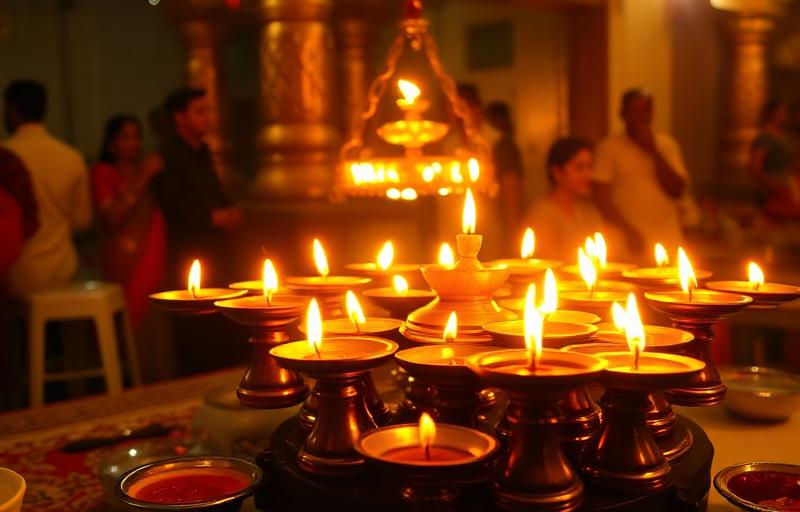
The earth as the lamp, the surrounding ocean as its oil, the burning sun as its flame - and by that light he set down a hundred verses, a garland of words, at the feet of the Lord.
Bhutham made another:
Love as the lamp, longing as the oil, the mind melting as the wick - and lit it with knowledge, and made his hundred.
And then Pey saw:
I saw the golden form, I saw the rising sun's colour, I saw the discus, I saw the conch - and he made his hundred.
The fourth in the corridor was Vishnu, who had come to be among them and who was standing there in the dark.
Why the story is good. Because of the escalation.
The first saint makes a lamp out of the cosmos: the physical earth, the physical ocean, the physical sun. That is the largest thing anybody could think to do.
The second saint makes a lamp out of the interior: love, longing, the melting mind. That is the reply to the first, and it says that the inner light is the one that shows.
And the third saint does not make a lamp at all. He sees. His verse is a list of what is in front of him: the golden body, the colour, the discus, the conch.
The sequence is: the world, the self, and then simply the sight. That is a very sophisticated piece of construction and the tradition has told it for well over a thousand years.
Thirukovalur today. It is a Divya Desam, in Villupuram district, Tamil Nadu.
The deity is Trivikrama, Vishnu in the form that measured the worlds, which is fitting for the place where a saint made a lamp out of the earth and the sun.
The idaikazhi, the narrow passage, is shown at the temple, and the three Alvars have shrines there.
The Mudhal Thiruvandhadhi

What he wrote. One work, of a hundred verses: the Mudhal Thiruvandhadhi, the First Sacred Antadi.
It is the first item in the Nalayira Divya Prabandham.
What an antadi is. This is a technical matter and it is worth explaining because the form does real work.
Antadi, from antam meaning end and adi meaning beginning:
- The last word or syllable of each verse becomes the first of the next
- And the last word of the final verse returns to the first word of the first verse
- So the whole hundred forms a closed ring
Why that matters:
- It makes the sequence fixed. No verse can be moved, dropped or added without breaking the chain
- It made the work memorisable and transmissible before writing was the normal medium of preservation
- It is a formal image of no beginning and no end, which is the theological point the poems are making anyway
- And it is extremely difficult to do well across a hundred verses while also saying something
The three Mudhal Alvars each wrote an antadi of a hundred verses, and the form is a large part of why the three works are grouped.
What the poems are about. They are dense, allusive and quick.
The recurring subjects:
- The avataras, and particularly Vamana and Trivikrama, the measuring of the worlds
- Krishna at Gokula, the butter, the cart, the calf
- Rama
- Varaha, Narasimha, the Kurma and the churning
- The temples, named and praised
- The name, and the sufficiency of remembering it
- The feet of the Lord, which is the constant image
The style. Poigai is compressed. A verse frequently packs two or three separate avatara references into four lines, expecting the hearer to catch each from a single word.
That is not obscurity. It is a poet writing for an audience who knew the stories completely and would take pleasure in the speed.
A representative move. The opening verse, the lamp, has been quoted above.
What it does technically is worth noticing: he does not say the Lord is like light, or that he sought light. He says he made a lamp, and the components he names are the three largest physical things available.
And the purpose of the lamp is not to see. It is to have light by which to compose, so that the verses can be laid at the feet.
So the entire cosmos is instrumental to the act of praise, which is a very large claim made in four lines.
The theology. Set out plainly, the Mudhal Thiruvandhadhi holds:
- Vishnu is supreme and is the cause of the world
- He is accessible, having come repeatedly as the avataras and having taken residence in temples
- The relationship is one of service and refuge, not of achievement
- The name and the feet are the practical means
- The world is his, so praising him with the world is proper
Those points, in these hundred verses, are already essentially the Sri Vaishnava position, several centuries before Ramanuja set it out philosophically.
The philosophy came later and it was built on this.
What the Alvars Made Possible
The Mudhal Alvars stand at the beginning of something very large, and it is worth tracing what followed.
The immediate sequence:
- The other nine Alvars, over the following centuries
- Nammalvar, whose Thiruvaymozhi became the central text
- Nathamuni, in the ninth or tenth century, who recovered the scattered Prabandham and set it to music
- Yamunacharya
- Ramanuja, in the eleventh and twelfth centuries, who gave the tradition its philosophy, Vishishtadvaita
- The Sri Vaishnava tradition as it exists
What Nathamuni did. It deserves its own note because without it none of this would survive.
By his time the Prabandham had been scattered and largely lost. He heard eleven verses of Nammalvar being recited, sought the rest, and by tradition recovered the whole four thousand through the repetition of Madhurakavi's Kanninun Siruthambu at Alwarthirunagari.
He then arranged them, set them to music, and instituted their recitation in temple worship.
So the entire corpus, including Poigai's hundred verses, survives because one man went looking.
The Ubhaya Vedanta position. This is the distinctive Sri Vaishnava claim and it comes from the Alvars.
Ubhaya means both. The tradition holds two Vedantas as authoritative:
- The Sanskrit scripture: Vedas, Upanishads, Gita, Brahma Sutras
- The Tamil Prabandham of the Alvars
Both are treated as revelation. Both are recited in temples. Commentaries are written on both.
That is a genuinely unusual position. Very few traditions anywhere have elevated vernacular devotional poetry to the status of scripture alongside their classical canon.
Araiyar Sevai. The performance tradition of the Prabandham, in which the Araiyar recite, sing and enact the verses with gesture before the deity, at Srirangam, Alwarthirunagari and Srivilliputhur.
It is very old, it is now practised by very few families, and it is the living form of what Nathamuni instituted.
The Divya Desams. The 108 temples the Alvars sang.
- Most in Tamil Nadu
- Some in Kerala, Andhra, Gujarat, Uttar Pradesh and Uttarakhand
- Including Badrinath, Muktinath in Nepal, Ayodhya, Mathura, Dwaraka and Srirangam
- Two are not on earth: Thiruparkadal, the ocean of milk, and Paramapadam, the supreme abode
That last detail is worth pausing on. The canonical list of temples the saints sang includes two that cannot be visited, and the tradition kept them in the list.
Where Poigai sits in it. First. His hundred verses open the Prabandham, and the lamp he made of the earth and the sun is the first thing anybody reciting the four thousand says.
How to encounter the work now:
- Editions of the Nalayira Divya Prabandham with Tamil text and translation are available, in print and online
- Recitation recordings exist and the Prabandham is chanted daily in Sri Vaishnava temples
- Thirukovalur can be visited
- Kanchipuram, where he appeared, has the Yathothkari temple at Thiruvekka, which is a Divya Desam
And if you want one thing to take away, it is the opening image: that a person who wanted to praise God thought first about what he could use for a lamp, and answered the earth, the sea and the sun.
Reading the Alvars at Home
For a reader who wants to do something with this rather than only know it, here is what is practical.
Start with what is short. The Prabandham is four thousand verses. Nobody begins there.
Good entry points:
- Thiruppallandu, Periyalvar's twelve verses, which open the Prabandham's recitation order and are sung at the start of almost everything
- Kanninun Siruthambu, Madhurakavi's eleven verses
- Thiruppavai, Andal's thirty verses, which very many households already recite in Margazhi
- The opening verse of each of the three Mudhal Thiruvandhadhis, which are the three lamps
On reading in translation. Necessary for most people and worth saying honestly.
Alvar Tamil is old, dense and highly allusive. A translation gives you the sense and loses the compression, the sound and the antadi chain.
That is a real loss and it is not a reason to avoid translations. Read the translation, and if you can, listen to the Tamil recitation alongside it, because the sound is a large part of what the poems are.
A simple daily practice:
- Light a lamp in the evening
- Recite or read one verse, in whatever language you have it in
- Sit with it for a few minutes
- That is enough
The Vaishnava daily forms, if you want the fuller frame:
- Vishnu Sahasranama, the thousand names, on any day and particularly Ekadashi
- Thiruppallandu and a portion of the Prabandham
- The Dwaya mantra and the Ashtakshara, Om Namo Narayanaya, for those who have received them from a teacher
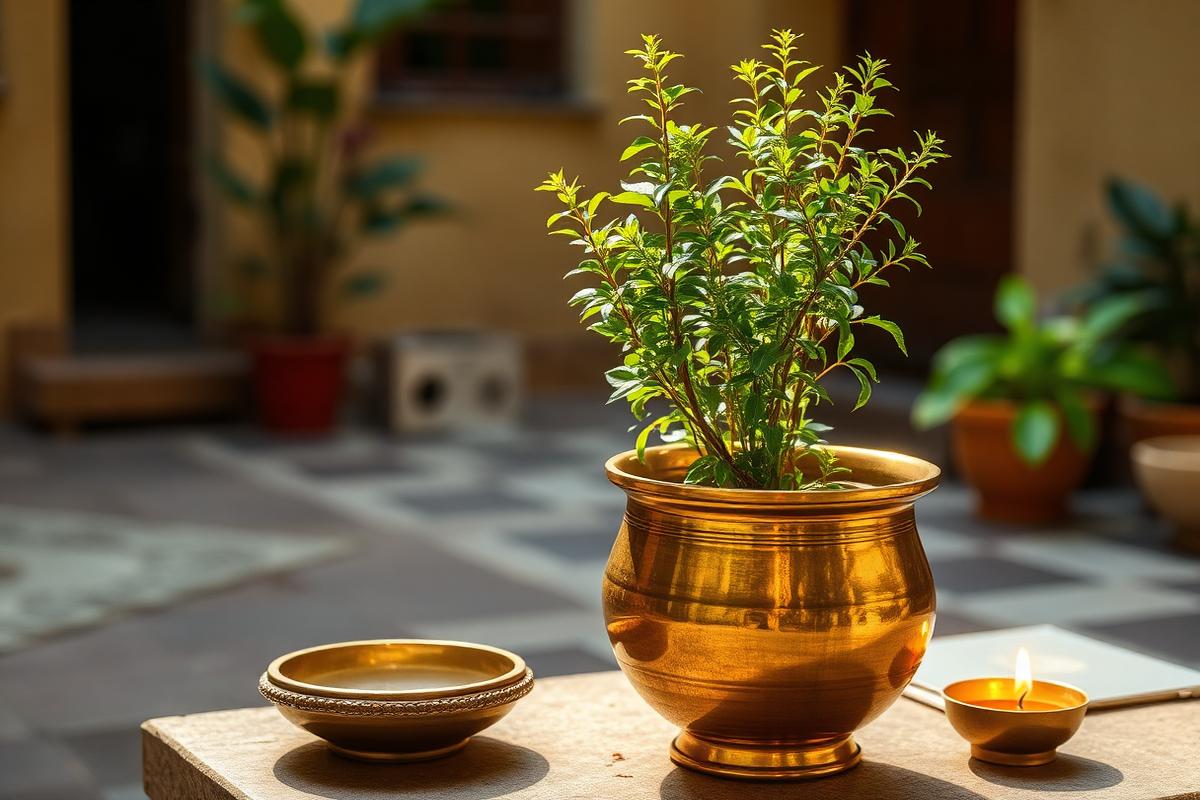
- Tulsi offered
- Ekadashi observance
On initiation. Some parts of Sri Vaishnava practice, particularly the mantras and the pancha samskara initiation, are traditionally received from an acharya and are not simply picked up from a book.
That is worth respecting. Reciting the Prabandham and the Sahasranama needs no initiation and is open to everybody. The specific mantras of the sampradaya are held differently, and if you want them, the way is to approach a teacher.
Where to hear it:
- Srirangam, the foremost Divya Desam, where the Prabandham is recited daily and the Araiyar Sevai survives
- Alwarthirunagari, Nammalvar's birthplace, in Tirunelveli district
- Srivilliputhur, Andal and Periyalvar's town
- Thirukovalur, for the corridor
- Any Sri Vaishnava temple during Adhyayana Utsavam, the twenty one day festival in Margazhi at which the whole four thousand is recited
Adhyayana Utsavam is the thing to see if you can arrange it. Over roughly twenty one days in December and January, the entire Prabandham is recited before the deity, in order, at Srirangam and elsewhere, with the ten days of Pagal Pathu and ten of Ra Pathu, the day ten and night ten.
The day it concludes, at Srirangam, is Vaikunta Ekadashi, when the northern gate is opened.
So the four thousand verses that begin with Poigai Alvar making a lamp out of the earth end, once a year, with a door being opened.
Common Questions From Devotees
Who was Poigai Alvar?+
The first of the twelve Alvars, the Tamil Vaishnava poet saints, and one of the three Mudhal or first Alvars along with Bhutham and Pey. Tradition holds he appeared not from a womb but in a lotus in a pond, a poigai, at Thiruvekka in Kanchipuram, which is where his name comes from. He composed the Mudhal Thiruvandhadhi, a hundred verses which open the Nalayira Divya Prabandham.
What is the story of the corridor at Thirukovalur?+
The three Mudhal Alvars arrived separately at Thirukovalur on the same rainy night. Poigai lay down in a narrow passage wide enough for one, Bhutham came and they sat, Pey came and all three stood. In the dark they felt themselves pressed as though a fourth had joined them. Poigai made a lamp of the earth with the ocean as oil and the sun as flame, Bhutham made one of love with longing as oil and the melting mind as wick, and Pey then saw the Lord standing there. Each composed a hundred verses.
What is an antadi?+
A verse form in which the last word or syllable of each verse becomes the first of the next, and the last word of the final verse returns to the first word of the first, so the whole set forms a closed ring. It fixes the sequence so no verse can be moved or dropped, it makes the work memorisable, and it is a formal image of having no beginning and no end. Each of the three Mudhal Alvars composed one of a hundred verses.
What is the Nalayira Divya Prabandham?+
The collected four thousand Tamil verses of the twelve Alvars, recovered and arranged by Nathamuni in the ninth or tenth century after they had been scattered and largely lost. Sri Vaishnavism treats it as revelation alongside the Sanskrit scripture, a position called Ubhaya Vedanta or both Vedantas, and it is recited daily in temples. The Alvars sang at 108 temples, the Divya Desams, two of which are not on earth.
Where can I visit places connected to Poigai Alvar?+
Thiruvekka in Kanchipuram, where he appeared, which has the Yathothkari temple and is a Divya Desam. Thirukovalur in Villupuram district, Tamil Nadu, where the corridor story happened, which is a Divya Desam with Trivikrama as the deity and where the narrow passage and shrines to the three Alvars are shown. Srirangam is the foremost Divya Desam and is where the Prabandham is recited daily.
How should a beginner start reading the Alvars?+
Start with what is short: Periyalvar's twelve verse Thiruppallandu, Madhurakavi's eleven verse Kanninun Siruthambu, Andal's thirty verse Thiruppavai which many households already recite in Margazhi, or the opening verse of each of the three Mudhal Thiruvandhadhis. Read a translation if you do not have Tamil, and if you can, listen to the recitation alongside it, since the sound is a large part of what the poems are.
About the author
Pandit Ravindra Sharma · Vedic Rituals & Bhakti, 22+ years
Pandit Ravindra is the Vandnaa editorial team's resident specialist on aarti, chalisa, and daily devotion. He has performed home and temple pujas across Varanasi and Delhi for over two decades and contributes the bhakti-focused articles on this site.
Meet the Vandnaa editorial team →