Who Is Shri Ram
Shri Ram is the seventh avatar of Lord Vishnu and the hero of the Ramayana, revered as Maryada Purushottam - the perfect man who upholds dharma in every situation. As the son of King Dasharatha and prince of Ayodhya, he embodies truth, duty, sacrifice and ideal conduct as a son, husband, brother and king. With Sita, Lakshman and Hanuman by his side, Ram represents the victory of righteousness over evil, and his very name is held to be a powerful mantra.
Significance of the Ram Aarti
The aarti is the loving climax of worship, when a lit lamp is circled before the deity to the sound of song, bell and clapping. The popular Ram Aarti, 'Aarti Kije Ramchandra Ji Ki', praises Ram with Sita, Lakshman and Hanuman in his divine darbar. Singing it together as a family fills the home with devotion and peace, and is believed to invite Ram's grace, protection and the strength to live by truth and dharma.
Ram Aarti Lyrics
Aarti kije Ramchandra ji ki, Hari Hari Hari naam japo sukh-daayi. Pehli aarti Pushpan ki maala, Kaali naag nathaiya gwaala. Doosri aarti devaki nandan, Bhaktan ke prabhu maan-mardan. Teesri aarti tribhuvan moohni, Tulsidas prabhu deen-dukh-bhanjani.
The aarti calls Ram the giver of joy and the destroyer of devotees' sorrows, honouring him with lamps and flowers in the company of his beloved family.
Meaning of the Aarti

The opening line invites all to perform the aarti of Ramchandra and to chant the joy-giving name of Hari. The verses then offer successive aartis - with garlands of flowers and lamps - to the Lord who is the enchanter of the three worlds and the remover of the sorrows of the humble. Through simple, heartfelt words, the aarti reminds devotees that surrendering to Ram and chanting his name brings peace, courage and the dissolving of grief.
Aarti Vidhi - How to Perform
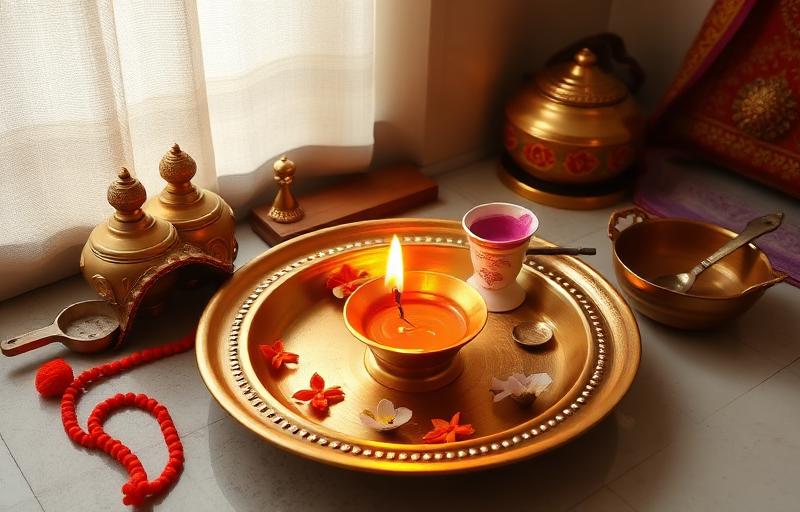
1. After completing the puja, light a ghee lamp with an odd number of wicks (one, three or five) on the aarti thali. 2. Add flowers, roli, akshat, incense and a small bell to the thali. 3. Stand before Shri Ram's image, ring the bell and begin singing the aarti. 4. Move the lamp clockwise in gentle circles before the Lord - first the feet, then the whole form. 5. After the aarti, take the warmth of the flame over your palms to your eyes and head. 6. Offer bhog such as fruits or sweets and distribute prasad to all present. End by chanting 'Shri Ram, Jai Ram, Jai Jai Ram' and bowing in surrender.
Common Questions From Devotees
Who is Shri Ram?+
Shri Ram is the seventh avatar of Vishnu and the hero of the Ramayana, revered as Maryada Purushottam, the ideal man who upholds truth and dharma as a son, husband, brother and king.
What is the popular Ram Aarti?+
The most popular Ram Aarti is 'Aarti Kije Ramchandra Ji Ki', which praises Ram as the giver of joy and the remover of devotees' sorrows, honouring him with lamps and flowers.
How is the Ram Aarti performed?+
After the puja, light a ghee lamp on the aarti thali, ring the bell, and move the lamp clockwise before Ram's image while singing. End by taking the flame's warmth to your eyes and offering prasad.
Why is the lamp moved clockwise during aarti?+
Moving the lamp clockwise follows the auspicious direction of the sun and represents offering light and devotion to the deity, dispelling darkness and inviting positive energy.
When is the best day to sing the Ram Aarti?+
It can be sung daily, but Ram Navami in the month of Chaitra is the most special day. Many sing it at noon, the hour of Ram's birth, along with the whole family.
What is the power of chanting Ram's name?+
The name of Ram is held to be a powerful mantra. Chanting 'Shri Ram, Jai Ram, Jai Jai Ram' is believed to bring peace, courage, protection and the dissolving of grief.
About the author
Acharya Vinaya Kapoor · M.A. Sanskrit, Mantra & Stotra Studies
Acharya Vinaya holds an M.A. in Sanskrit from Banaras Hindu University and writes the mantra and stotra commentary on Vandnaa. Her focus is on accurate pronunciation, traditional context, and helping modern readers connect with classical texts.
Meet the Vandnaa editorial team →Explore on Vandnaa
Related Articles
Ram Darbar - Significance, Puja Vidhi & Mantra
9 min read
Sankatmochan Hanuman Ashtak - Lyrics, Meaning & Benefits
8 min read
Hanuman Aarti Lyrics in Hindi & English - Aarti Kije Hanuman Lala Ki
9 min read
Hanuman Chalisa Meaning, Benefits & How to Chant (हनुमान चालीसा अर्थ)
10 min read
Vishnu Chalisa - Lyrics, Meaning, Benefits & Jap Vidhi
9 min read
Krishna Aarti Lyrics in Hindi & English - Aarti Kunj Bihari Ki
9 min read