
What is Rudrabhishek & Why It's the Most Powerful Shiva Worship
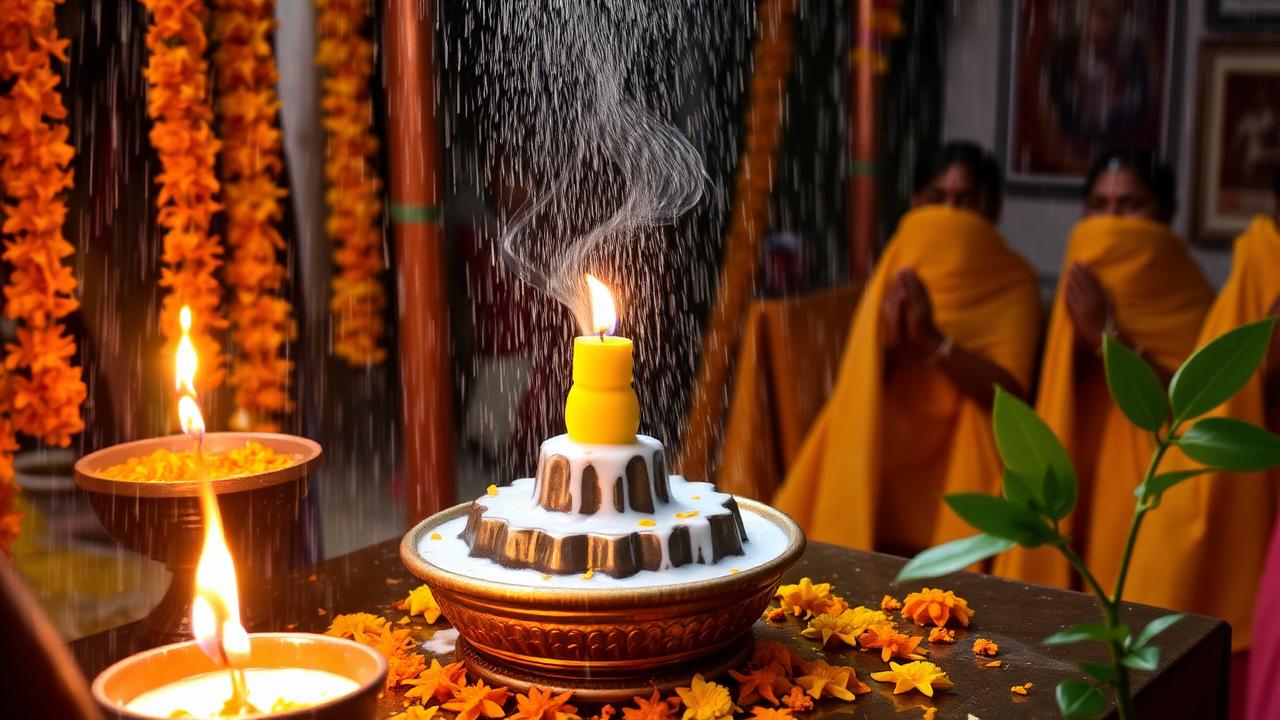
Rudrabhishek = Rudra (Shiva's fierce form) + Abhishek (sacred bathing). It is the continuous pouring of sacred substances over a Shivling while reciting specific Vedic mantras - primarily the Rudram (Shri Rudram Chamakam).
While any Shiva puja is good, Rudrabhishek is considered the supreme form of Shiva worship for these reasons:
1. It uses Vedic mantras, not just devotional verses. The Rudram is from the Yajurveda - direct cosmic vibration, not just prayer.
2. The continuous flow creates a unique energy. Unlike puja (which is point-by-point), abhishek is continuous - like a river of grace.
3. It can be done at home. Unlike major Vedic yajnas which need a priest, rudrabhishek is householder-friendly. With basic Sanskrit pronunciation and sincere bhakti, anyone can do it.
4. It is multi-purpose. Different abhishek substances grant different boons - milk for purity, ghee for wealth, honey for sweetness in life, sugarcane juice for marriage, panchamrit for overall blessing.
5. Maharaj Sawan is the peak time. During Shravan month (mid-July to mid-August in 2026), every Shiva temple does rudrabhishek daily. Doing it at home during Sawan multiplies the merit 100x according to tradition.
The Vedic foundation: The Shri Rudram has 11 sections (anuvakas) of praise to Rudra, followed by the Chamakam (11 anuvakas of asking for boons). Together they total 22 sections. Each section invokes specific aspects of Shiva - destroyer of disease, protector of forests, deity of healers, lord of warriors. Reciting all 22 with abhishek = complete Shiva worship.
For householders, a shorter version is acceptable - chanting 'Om Namah Shivaya' or Mahamrityunjaya Mantra during the abhishek instead of full Rudram. The key is the continuous abhishek + continuous mantra combination.
🔱 The Vandnaa App has Rudrabhishek audio (full Rudram + simplified for beginners), step-by-step vidhi, and Sawan rudrabhishek tracker.
Items You Need for Home Rudrabhishek
The essential setup:
- Shivling - copper, brass, or pure stone (Narmada Bana Lingam preferred). Size: 6-12 inches for home.
- Yoni Pitha (the base) - the platform around the Shivling that catches the abhishek liquid
- Brass plate (thaal) - to place under the yoni pitha
- A small spout/pot (kalash) - to channel liquids to flow over the Shivling
- Drainage outlet - channel for liquids to flow away from the puja area
The 8 abhishek substances (Ashta Dravya):
1. Pure water (Ganga jal preferred) - for purification 2. Cow's milk - represents Lakshmi/abundance 3. Curd (dahi) - represents Annapurna/nourishment 4. Ghee - represents victory/strength 5. Honey - represents sweetness in relationships 6. Sugar (or cane juice) - represents joy 7. Coconut water - represents purity 8. Panchamrit (mix of milk+curd+ghee+honey+sugar) - represents overall blessing
Decorative & ritual items:
- Bilva (Bel) leaves - minimum 11, ideally 108 fresh leaves
- White flowers - datura, kaner, jasmine (avoid red on Shiva)
- Bhasma (sacred ash) - for tilak on Shivling and yourself
- Rudraksha mala - to wear and for jap
- Chandan (sandalwood paste) - for tilak
- Bhang - symbolic, usually substituted with leafy greens
- Akshat - uncooked rice
Diyas & lamps:
- Mustard oil diya - single wick for daily, 11-wick for special
- Ghee diya - alongside the oil one
- Camphor for aarti
Bhog items:
- Bel laddoo or fruits (Shiva's preferred bhog)
- Halwa or panchmewa (5 dry fruits + jaggery)
Optional but powerful:
- Datura fruit - Shiva's specific offering (handle carefully - poisonous if eaten)
- Bhang prasad (in regions where legal/traditional)
- Snake offering - symbolic black thread or silver snake
- Trishul (small) - placed at the base
- Dhatura, akwan, kewada - specific to advanced practice
Total cost: ₹500-1500 for a complete home setup (one-time + monthly consumables).
One-time investment items (purchase once):
- Brass/copper Shivling: ₹500-2000
- Yoni pitha: ₹300-800
- Thaal: ₹200
- Kalash: ₹150
Monthly consumables (₹200-400):
- Milk, ghee, honey: from regular kitchen
- Bilva leaves: free (pluck from any Bilva tree)
- Camphor, akshat: minimal
🔱 The Vandnaa App has a complete Rudrabhishek shopping list with regional vendor links and quantity calculator based on number of family members participating.
Step-by-Step Rudrabhishek Vidhi
Best time: Brahma muhurat (4-6 AM) on Mondays, all Sawan Mondays, Mahashivratri, Pradosh evenings.
Total duration: 60-90 minutes for a complete home rudrabhishek.
Phase 1 - Preparation (15 min):
1. Bath, wear clean white/saffron dhoti or loose clothes (avoid black/red for Shiva) 2. Apply bhasma tilak (3 horizontal lines) on forehead 3. Wear rudraksha mala 4. Sit on a clean asana facing east or north 5. Set up Shivling on yoni pitha on a brass thaal 6. Arrange all abhishek substances in separate small bowls 7. Light an agarbatti and a ghee diya
Phase 2 - Sankalpa (Resolution, 5 min):
Take water in right palm, state clearly: 'Today, [date], being [day], I, [name], perform Rudrabhishek for [your specific intention]. Through the grace of Lord Shiva, may my purpose be fulfilled.'
Pour the water at the base of the Shivling.
Phase 3 - Initial Purification (5 min):
1. Pour pure water over the Shivling first - to purify the lingam 2. Wipe gently with a clean cloth 3. Chant 'Om Namah Shivaya' 11 times
Phase 4 - The Eight-Substance Abhishek (40 min):
In this exact order, pour each substance slowly over the Shivling while chanting Mahamrityunjaya mantra continuously:
'Om Tryambakam Yajamahe Sugandhim Pushti-vardhanam, Urvarukamiva Bandhanan Mrityor Mukshiya Maamritat.'
1. Cow's milk (continuous slow stream while chanting Mahamrityunjaya 11 times) 2. Curd (chant 11 times) 3. Ghee (chant 11 times) 4. Honey (chant 11 times) 5. Sugar/cane juice (chant 11 times) 6. Coconut water (chant 11 times) 7. Panchamrit (chant 11 times) 8. Pure water final rinse (chant 21 times - extra for closing)
Between each substance, briefly wipe the Shivling and chant 'Om Namah Shivaya' once.
Phase 5 - Decoration & Bilva Offering (10 min):
1. Apply bhasma to the Shivling 2. Apply chandan tilak 3. Offer 11/27/108 fresh Bilva leaves one by one - say 'Om Namah Shivaya' with each leaf 4. Sprinkle akshat (rice + haldi) 5. Offer white flowers (datura, kaner, or jasmine) 6. Place camphor + light it on a small thaali
Phase 6 - Aarti & Closing (10 min):
1. Sing Shiv Aarti - Om Jai Shiv Omkara 2. Perform camphor aarti with circular motion 3. Offer the bhog 4. Take 1-2 minutes silent meditation, eyes closed 5. Distribute the bhog as prasad 6. Take a small amount of the abhishek liquid as charanamrit
Phase 7 - Cleanup:
1. The abhishek liquid (from the thaal) is highly auspicious - sprinkle in plants or a clean drainage that goes to a tree 2. Never throw it down the regular drain 3. Clean the Shivling and yoni pitha 4. Save Bilva leaves separately - dry them; they remain auspicious
The shorter daily version (20-30 minutes): For daily home practice, simplify to:
- Water + milk + honey only (3 substances)
- 11 Mahamrityunjaya mantras during each
- 11 Bilva leaves
- Closing aarti
This daily mini-rudrabhishek is acceptable for non-special days.
What Each Abhishek Substance Grants - The Boon Map
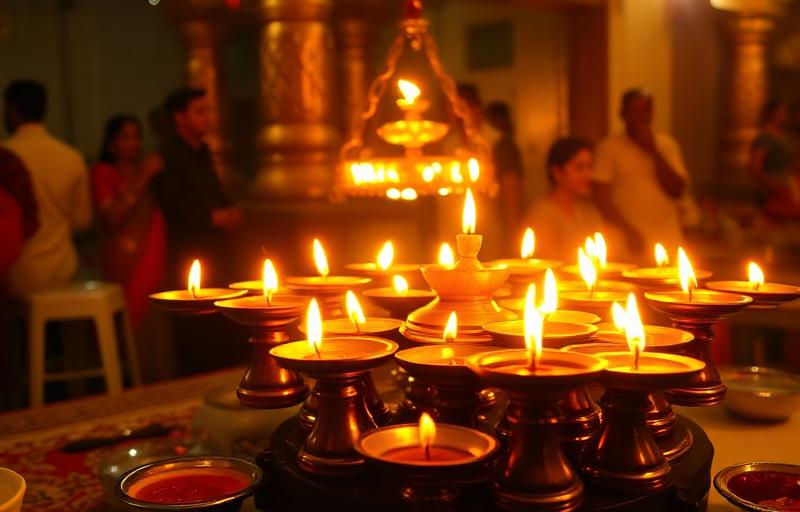
Each substance has specific significance in Shaivite tradition:
1. Pure Water (Jal abhishek) - Boon: Mental peace, removal of sins, cure of fevers and infections. The simplest abhishek, done daily.
2. Milk (Dugdh abhishek) - Boon: Wealth, prosperity, family welfare, removal of mental anxiety. The most popular Sawan abhishek. Use cow's milk only - never buffalo milk for Shiva.
3. Curd (Dadhi abhishek) - Boon: Strength, good health, longevity. Cures chronic stomach issues, weakness. Use fresh, sweet curd (not sour).
4. Ghee (Ghrita abhishek) - Boon: Victory in disputes, success in court cases, removal of enemies' hostility. Use only pure cow ghee.
5. Honey (Madhu abhishek) - Boon: Sweetness in marriage, removal of arguments, attracting kind people in life. Use unprocessed honey if possible.
6. Sugarcane juice (Ikshu rasa) - Boon: Marriage delays removed, romantic success, charming personality. Especially recommended for unmarried adults.
7. Coconut water (Naariyal jal) - Boon: Removal of negative spirits, evil eye, mental cleansing. Strong cleansing energy.
8. Panchamrit (5-nectar mix) - Boon: Universal blessing, encompasses all the above. Used for general welfare when no specific issue.
Beyond the 8 - special abhishek substances:
9. Sandalwood paste (Chandan) - Boon: Cooling of pitta dosha, mental calm, removal of anger.
10. Bhasma (sacred ash) - Boon: Removal of past karma, spiritual progress, detachment from material illusions. Most powerful but requires reverence.
11. Bilva leaves (after the liquid abhishek) - Boon: Each leaf removes the sin of one lifetime, per tradition.
12. Datura fruit - Boon: Removal of severe black magic, ancestral curses (pitra dosh). Handle with care - poisonous if consumed.
13. Tirth water (water from sacred rivers) - Ganga, Yamuna, Saraswati, Godavari, Narmada water adds tirth-merit when used.
The combined-purpose abhishek:
For wealth: Milk + ghee + honey + panchamrit (skip the others) For health recovery: Water + curd + Mahamrityunjaya mantra primary For court cases / enemies: Water + ghee + curd + Bilva leaves For marriage: Honey + sugarcane + chandan + jasmine flowers For Pitra dosh: Bhasma + datura + Pitru tarpan mantras alongside For protection from evil: Coconut water + bhasma + camphor primary
The strict Sawan rule: During Shravan month, abhishek is done DAILY in temples - and in homes serious devotees do at least milk-abhishek every Monday and Pradosh. The cumulative merit of 4 Sawan Mondays of full rudrabhishek is said to equal a year of weekly rudrabhishek.
Mantras to Chant During Rudrabhishek
Tier 1 - Beginner mantras (chant during pour):
Om Namah Shivaya - the simplest, most powerful Shiva mantra. Chant continuously while pouring. 1 chant ≈ 5 seconds. So 11 chants ≈ 1 minute per substance.
'Om Namah Shivaya' (ॐ नमः शिवाय)
Translation: 'Om, salutations to Shiva.'
Tier 2 - Intermediate (Mahamrityunjaya):
The greatest healing mantra of Hinduism. Specifically powerful during rudrabhishek.
'Om Tryambakam Yajamahe, Sugandhim Pushti-vardhanam, Urvarukamiva Bandhanan, Mrityor Mukshiya Maamritat.'
(ॐ त्र्यम्बकं यजामहे, सुगन्धिं पुष्टिवर्धनम्, उर्वारुकमिव बन्धनान्, मृत्योर्मुक्षीय मामृतात्।)
Translation: 'We worship the three-eyed Lord, fragrant and nourishing. From bondage may we be liberated, like a cucumber from its stalk - from death, may we be granted immortality.'
This is the rudrabhishek mantra. Each substance gets 11 Mahamrityunjaya repetitions.
Tier 3 - Advanced (Rudram-Chamakam):
The full Vedic Rudram has 11 anuvakas (sections) and the Chamakam adds 11 more - total 22 sections, 90 minutes when chanted properly.
For home, even chanting the first anuvaka of Rudram is a major spiritual offering:
'Om namaste rudra manyava utota ishave namaha. Namaste astu dhanvane bahubhyam uta te namaha. Ya ta ishuhu shivatama shivam babhuva te dhanuhu...'
Learn this from a Sanskrit teacher or audio recording. Improper pronunciation reduces benefit.
Tier 4 - Bilva offering mantra:
When offering each Bilva leaf:
'Trahi-dalam tri-gunaakaaram tri-netram cha tri-yayudham, Tri-janmapaapa-samhaaram eka-bilvam shivaarpanam.'
(त्रिदलं त्रिगुणाकारं त्रिनेत्रं च त्रियायुधम्, त्रिजन्मपापसंहारं एकबिल्वं शिवार्पणम्।)
Translation: 'The three-leafed, three-natured, three-eyed, three-weaponed one - the destroyer of three lifetimes' sins; this single bilva I offer to Shiva.'
Tier 5 - Closing mantra:
After completing all abhishek, close with the Shanti Mantra:
'Om Shantih Shantih Shantih.'
This 'seals' the merit and quiets the sacred space.
The integrated rhythm:
- Phase 1 (water purify) - Om Namah Shivaya x11
- Phase 2 (each of 8 substances) - Mahamrityunjaya x11
- Phase 3 (Bilva offerings) - Trahi-dalam x each leaf, OR Om Namah Shivaya if mass offering
- Phase 4 (closing) - Om Shantih Shantih Shantih
A common mistake to avoid: Reciting mantras silently in the head. Rudrabhishek mantras must be chanted aloud or at minimum with moving lips and clear voice. The vibration of the Sanskrit syllables IS part of the abhishek itself.
Common Mistakes & Critical Rules
1. Using buffalo milk instead of cow milk. Buffalo milk is forbidden for Shiva. Always cow milk.
2. Using packaged honey adulterated with sugar. Use pure raw honey. If unsure, use jaggery dissolved in water as substitute - better than fake honey.
3. Pouring substances too fast. Each pour should be slow, continuous, while chanting. Rushing = no benefit.
4. Wrong order of substances. The traditional order is: water → milk → curd → ghee → honey → sugar → coconut → panchamrit → final water rinse. Mixing the order is disrespectful.
5. Not wiping between substances. Briefly wipe the Shivling between substances so fresh substance contacts the lingam directly.
6. Throwing the abhishek liquid into regular drain. This is the gravest mistake. The liquid is consecrated. Sprinkle in a plant, a Bilva tree, or a clean drainage going to a garden.
7. Doing rudrabhishek angry or in turmoil. The fierce energy responds to bhava. If you're disturbed, postpone.
8. Using metallic Shivling without yoni pitha. The yoni pitha is mandatory - symbolizes the union of Shiva and Shakti. Just a Shivling alone is incomplete.
9. Wearing red or black during rudrabhishek. White, saffron, or yellow only. Black is Shani's color (clashes); red is Shakti's (incorrect for solo Shiva).
10. Skipping Bilva. Bilva is mandatory for Shiva. Even if you can only get 3 leaves, offer those. No substitution.
11. Using stale or rotten substances. All substances must be fresh - milk should be morning's, ghee should be home-made or pure, Bilva leaves picked that morning.
12. Not bathing before. Body must be clean. Even a quick shower if full bath isn't possible.
13. Eating just before rudrabhishek. Empty or near-empty stomach is best. Wait 3 hours after a heavy meal.
14. Reciting mantras in your head. Loud or whispered, but must be vocal. Silent mantra during abhishek is half-effective.
15. Not closing with aarti. The closing Shiv aarti 'Om Jai Shiv Omkara' is essential - it 'seals' the merit. Many people skip it.
Critical rules for women:
- Avoid rudrabhishek during menstruation (per traditional rule; modern devotees handle individually)
- Pregnant women can perform but should sit, not stand throughout
- After childbirth, wait 40 days (sutak period) before resuming
Critical rules for everyone:
- Never perform during a family death period (13 days)
- Never during eclipse (grahan) - wait until eclipse ends
- Never under intoxication
- Never with shoes on or wearing leather articles in the puja space
Make Rudrabhishek Your Monthly Sacred Practice
Rudrabhishek is not for daily - it is for special days that you mark on your calendar. Done correctly even once a month, it builds an enormous reservoir of merit and protective grace.
The classical home schedule:
Mandatory days (do not miss):
- All 4 Sawan Mondays - biggest spiritual ROI of the year
- Mahashivratri - once a year, full elaborate rudrabhishek
- Pradosh days (every 13th tithi, twice a month) - at minimum simplified rudrabhishek
Recommended days:
- Every Monday - short version (water + milk only) for daily devotees
- Sankashti Chaturthi if you have specific obstacles
- Family birthdays/anniversaries - special rudrabhishek for the person
- When facing major decisions - pre-decision rudrabhishek for clarity
Three sankalpa levels:
Level 1 - Sawan starter:
- Do rudrabhishek on all 4 Sawan Mondays + Mahashivratri = 5 times a year
- Sustainable for any householder
- Major merit accumulation
Level 2 - Monthly devotee:
- Once every Monday + Pradosh + special days = ~50 times a year
- Requires consistent commitment
- Transforms life over years
Level 3 - Devoted Shaivite:
- Daily simplified rudrabhishek (water-milk-honey, 20 min)
- Plus full version on Mondays, Pradosh, festivals
- ~365 sessions a year
- Reserved for those whose primary deity is Shiva
A final reflection:
Rudrabhishek is the only major Shiva worship form a householder can do without a priest. Every Vedic yajna requires brahmin priests. Every major temple ritual is priest-mediated. But Rudrabhishek - with its Mahamrityunjaya mantra and 8 simple substances - was deliberately given to common householders by the rishis.
This is Shiva's gift to the ordinary family. He doesn't ask you to come to Kashi. He doesn't ask for a full Vedic team. He says: 'Bring milk. Bring honey. Bring Bilva. Bring your sincere voice. I will come.'
The fundamental cosmic equation is simple: Sincere bhakti + correct vidhi + Sawan/Pradosh timing = Shiva's grace.
Do your first home rudrabhishek this Monday. The rest will unfold naturally.
Har Har Mahadev. Om Namah Shivaya.
🔱 The Vandnaa App's Rudrabhishek module includes: Mahamrityunjaya audio (108 count tracker), Sawan Monday alerts (with 2026 dates pre-loaded), shopping list, vidhi checklist, and Pradosh reminder.
What People Ask Most
Can rudrabhishek be done at home without a priest?+
Yes, absolutely. Unlike major Vedic yajnas, rudrabhishek was specifically designed for householder practice. With basic Sanskrit pronunciation of Mahamrityunjaya mantra and 8 substances, anyone can perform it. A priest is needed only for elaborate temple-style rudrabhishek with full Rudram-Chamakam.
What time is best for rudrabhishek?+
Brahma muhurat (4-6 AM) is most powerful. If unavailable, morning before 11 AM works. Pradosh kaal (just before sunset, 4:30-7 PM on Pradosh days) is the second-most auspicious. Evening after 9 PM is acceptable but not ideal.
How long does a complete rudrabhishek take?+
60-90 minutes for the standard 8-substance home version. The simplified daily version (water-milk-honey only) takes 20-30 minutes. Full Vedic Rudram-Chamakam version with priests takes 2-2.5 hours.
Can women perform rudrabhishek?+
Yes. There is no gender restriction. Women across India regularly perform rudrabhishek for family welfare, husband's longevity, and personal devotion. The only traditional restrictions are during menstruation (modern devotees handle individually) and during sutak periods.
What if I don't have all 8 substances?+
Even 3 substances (water, milk, honey) is acceptable for daily practice. The minimum is just water - even pure water with full Mahamrityunjaya chanting is a complete rudrabhishek. Don't skip the practice for missing substances.
Can I do rudrabhishek for someone else (e.g., a sick family member)?+
Yes - this is one of the most powerful uses of rudrabhishek. State the person's name in your sankalpa, dedicate the merit to their welfare. The Mahamrityunjaya mantra is specifically the healing mantra. For a critically ill person, perform 11 consecutive days of rudrabhishek with their name.
Is rudrabhishek done only on Mondays?+
No - Mondays are best, but rudrabhishek can be done any day. Pradosh days (twice monthly), Mahashivratri, all Sawan days, and any auspicious tithi are also excellent. Avoid only family death periods, eclipses, and inauspicious tithis.
About the author
Dr. Suresh Iyer · Vastu Shastra & Jyotish, 18+ years
Dr. Suresh has practiced traditional Vastu and basic Vedic Jyotish for over 18 years across South India. He contributes the Vastu, direction, and home-puja layout guides on Vandnaa.
Meet the Vandnaa editorial team →Explore on Vandnaa
Related Articles
Shiv Aarti Lyrics – Om Jai Shiv Omkara (शिव आरती)
13 min read

Shiv Chalisa Lyrics & Meaning in Hindi (शिव चालीसा)
13 min read
Om Namah Shivaya Mantra Benefits & Meaning (ॐ नमः शिवाय)
9 min read
Maha Mrityunjaya Mantra: Meaning & Benefits (महा मृत्युंजय मंत्र)
9 min read
Mahashivratri 2026: Date, 4-Prahar Puja Vidhi, Nishita Kaal Muhurat & Powerful Shiva Mantras
10 min read
Sawan Somwar 2026: Dates, Vrat Vidhi, Shiv Mantras & Why Mondays in Sawan Are So Powerful
10 min read